
Scientific Poster Design and Printing: A Guide to Academic Impact
Aug 25, 2026

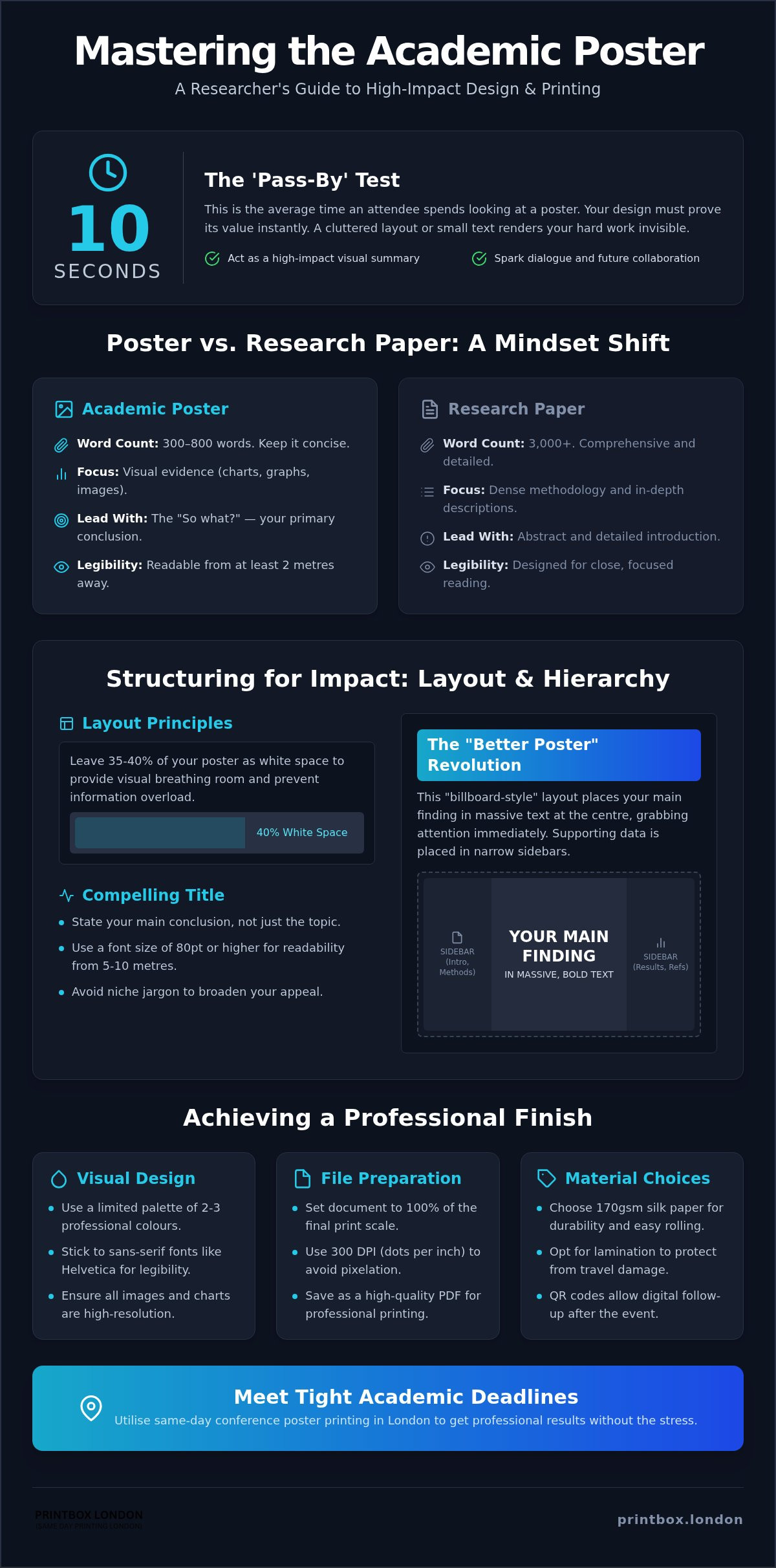
Did you know the average conference attendee spends just 10 seconds looking at a poster from a distance? That is a tiny window to prove your research matters. You've spent years on your data, but if your layout is cluttered or your text is too small, your hard work stays invisible. Finding reliable conference poster printing London shouldn't be the hardest part of your academic week. We understand the pressure of a looming deadline and the frustration of fighting with complex design software.
You want a result that looks professional and starts conversations, not a blurry print that arrives too late. This guide helps you master the art of academic poster design, from initial layout to professional large-format printing. We will look at the latest 2026 design trends, file preparation tips, and how to organise same-day collection in London without the stress. Let's turn your research into a visual powerhouse that commands attention on the conference floor.
Key Takeaways
- Focus on the "Billboard" layout by placing your main research finding in the centre to grab attention within seconds.
- Stick to a limited palette of two or three professional colours and use sans-serif fonts like Helvetica for maximum legibility from a distance.
- Avoid pixelation by setting your document to 100% scale and 300 DPI before sending it for professional production.
- Choose 170gsm silk paper for a balance of durability and easy rolling, or opt for lamination to protect your work from travel damage.
- Utilise same-day conference poster printing London to meet tight academic deadlines without sacrificing professional large-format quality.
What is a Scientific Poster and Why Does Design Matter?
A scientific poster is much more than a printed PDF of your abstract. Effectively, it is a visual summary of research designed to spark dialogue at professional events. It serves a dual purpose. It acts as a standalone report for delegates browsing the hall and as a high-impact backdrop whilst you present your findings. Because you are competing for attention in a room filled with hundreds of peers, your design must work fast. Attendees often decide whether to stop or walk past in about 10 seconds. If your layout is cluttered or the font is too small, they will move on. Modern academic design has shifted away from traditional, text-heavy blocks toward high-impact visual hierarchies that highlight your primary discovery immediately.
The Role of Posters in Academic Networking
A great design initiates "hallway conversations" that can lead to future collaborations or funding. Your poster is your best visual aid. It helps you explain complex datasets without forcing your audience to squint at tiny labels. Use your layout to guide the viewer's eye through your narrative logically. Always include QR codes and clear contact details. This allows interested parties to follow up digitally once the conference ends. If you are rushing to meet a deadline, reliable conference poster printing london ensures you arrive with a professional product that reflects your expertise.
Scientific Poster vs. Research Paper
One common mistake is treating a poster like a printed dissertation. Legibility is the priority. Aim for a total word count between 300 and 800 words. This keeps your message concise and readable from two metres away. Focus on visual evidence like high-resolution charts and images rather than dense methodology descriptions. Always lead with the "so what?". Your audience wants to know the primary conclusion or the real-world impact of your work within seconds.
Using professional conference poster printing london services helps ensure these visual elements are sharp and colours are accurate. When you move from a digital screen to a large-format print, every pixel counts. A professional finish tells your peers that you value your research enough to present it with precision. Keep your methods brief and your results bold to ensure your hard work gets the recognition it deserves.
Organising Your Content: Structure and Layout
Structuring research for a large-format display requires a different mindset than writing a journal paper. You must guide the reader's eye through a logical progression. Most academics stick to standard sections: Title, Introduction, Methods, Results, Conclusions, and References. However, the way you arrange these dictates whether a delegate stays to chat or walks away. Use a Z-pattern layout or clear vertical columns to create an intuitive reading path from top-left to bottom-right. Don't be afraid of empty space. Professional designers recommend leaving 35-40% of your poster as white space. This provides visual breathing room and prevents information overload. When you are ready to produce your final design, choosing a specialist for your conference poster printing london helps maintain the clarity of these open spaces.
Crafting a Compelling Title
Your title is your hook. Avoid vague, descriptive headings. Instead, write a title that states your main conclusion. This tells the reader immediately if the research is relevant to them. To be effective in a crowded exhibition hall, your title must be readable from at least 5 to 10 metres away. This usually requires a font size of 80pt or higher. Keep the language accessible. Avoiding niche technical jargon in the main heading broadens your appeal to interdisciplinary researchers who might otherwise walk past.
The Posters 2.0 Revolution
The Better Poster movement, pioneered by Mike Morrison, has transformed conference halls. This billboard-style approach places your main finding in massive text right in the centre. It is highly efficient for busy delegates who only have minutes to spare. Whilst this style works wonders for clear, single-point discoveries, it can be challenging for complex, multi-variable studies. The key is balance. Use the central area for your headline and place supporting data, methods, and references in narrow sidebars. This layout relies on high-contrast printing to be effective. Professional conference poster printing london services can help you choose the right paper finish to ensure your central claim really pops. High-resolution output is essential when your text is this large, as any blurring will be immediately obvious to your peers.
Focusing on a clean hierarchy ensures your message isn't lost. Whether you choose a traditional column layout or a modern billboard style, consistency is vital. Ensure your alignment is perfect and your margins are equal across the entire board. A tidy layout suggests a tidy mind and meticulous research. If you are working right up to the deadline, conference poster printing london provides the speed you need without compromising these vital design details.
Visual Design: Colours, Fonts, and Imagery
Visual design isn't just about aesthetics; it's about cognitive load. A well-designed poster helps the brain process your research faster. Start with a limited palette of two or three professional colours. Using too many shades creates a "rainbow effect" that looks amateur and distracts from your data. Stick to a primary colour for your headings and a secondary tone for highlights or accents. Typography also plays a vital role in legibility. Choose sans-serif fonts such as Arial or Helvetica for your body text. These fonts are easier to read from a distance than serif alternatives. When you arrange your text, maintain maximum contrast. Dark text on a light background is the gold standard for accessibility. If you are preparing files for conference poster printing london, ensure your imagery is top-tier. Use vector graphics where possible. If you must use raster images, they need to be at least 300 DPI at the final print size to avoid embarrassing pixelation.
Effective Use of Colour and Contrast
Use colour as a functional tool to categorise your sections or highlight key data points within your charts. This helps delegates navigate your research without needing a guided tour. Avoid "vibrating" colour combinations like red text on a blue background. These are physically painful to look at and will drive people away. Always check your design with a colour-blindness simulator before finishing. This ensures your work is inclusive and readable for all peers. If you're on a tight schedule, conference poster printing london services can often spot these contrast issues before your file hits the press.
Data Visualisation and Graphics
Cluttered charts are the enemy of comprehension. Simplify your graphs by removing unnecessary gridlines and legends. Label your data points directly so the reader doesn't have to bounce between a key and the chart. This speeds up their understanding of your findings. Don't overlook your institutional logos. A blurry university crest suggests a lack of attention to detail. Use high-resolution files to maintain your professional branding. Sharp graphics tell your audience that your research is as precise as your presentation. Professional production ensures these details remain crisp on the final large-format board.
Technical Specifications for Professional Printing
Precision is everything when transitioning from a digital screen to a large-format board. Even the most stunning design will fail if the technical specifications are incorrect. To avoid a blurry or distorted result, you must set up your document at 100% scale from the very beginning. Many researchers make the mistake of designing at A4 and expecting the printer to "blow it up." This approach almost always leads to pixelation. You also need to work in the CMYK colour space. Whilst digital screens use RGB (Red, Green, Blue) to display light, professional printing presses use CMYK (Cyan, Magenta, Yellow, Black) ink. If you don't convert your file, your vibrant on-screen colours may look dull or muddy on paper. For the best results, export your work as a PDF/X-4 file. This format is the industry standard for preserving fonts, high-resolution images, and complex transparencies.
Standard Poster Sizes (A0, A1, A2)
Choosing the right dimensions depends on your conference requirements and the amount of data you need to display. A0 dimensions (841 x 1189mm) are the gold standard for major international conferences in the UK. They offer maximum impact and enough room for complex data visualisations. If you are presenting at a smaller venue or a student showcase where space is limited, A1 dimensions (594 x 841mm) are a practical alternative. You can consult our detailed guide on the A0 paper format for specific dimension and use guidance. Getting the size right early prevents last-minute layout panics when you book your conference poster printing london.
Bleed, Margins, and Resolution
Professional finishing requires a few specific adjustments to your file. Always set a 3-5mm bleed on all sides. This extra area of background colour allows our North London centre to trim your poster perfectly without leaving unsightly white edges. You should also respect the "Safe Zone." Keep all essential text and logos at least 20mm away from the edge of the page. This prevents your content from being obscured by frames or mounting brackets at the venue. Finally, check your resolution. Every embedded image must be at least 300 DPI at the final print size. Low-resolution web images will look crisp on your laptop but appear blocky and unprofessional when printed at A0. If you are unsure about your file quality, you can order your large format prints online and our team will ensure your research looks its best.
High-quality production is the final step in securing your academic impact. When you invest time in these technical details, you ensure that your conference poster printing london results in a sharp, professional display that commands respect from your peers. Don't leave these settings to chance; check them before you hit export.
Production and Finishing: Getting Your Poster Ready
The physical quality of your poster is the final hurdle to academic impact. Once the design is locked, the material choices you make dictate how your research is perceived in a busy hall. Choosing conference poster printing london allows you to select premium finishes that protect your work and enhance its professional look. Paper weight is your first decision. Most researchers opt for 170gsm silk. It's flexible enough for easy rolling into a travel tube whilst maintaining a high-quality, professional sheen. If you need a more substantial feel that resists creasing during handling, 250gsm paper is a sturdier alternative. Adding lamination is a pragmatic move for any presenter. It shields your data from rain during the commute, coffee spills at the event, and general wear and tear from peers pointing at your charts.
Finishing Options for a Professional Look
Matt lamination is almost always the better choice for academic environments. It reduces glare from harsh overhead conference lights, ensuring your text is readable from every angle. Gloss lamination makes colours pop but often creates distracting reflections. If you plan to reuse your poster throughout the year, encapsulation offers total protection by sealing the edges entirely. For high-end exhibitions without existing display boards, mounting your research on 5mm Foamex or foam core boards creates a rigid, standalone display. This ensures your work remains flat and authoritative throughout the entire event.
Same-Day Printing and Local Collection in London
Deadlines often clash with the final stages of data analysis. Our same day printing London service is a vital safety net for researchers working under pressure. You can submit your files online whilst finishing your travel prep and collect the finished product from our North London shop just hours later. This speed doesn't compromise quality. We use high-resolution digital equipment to ensure every graph is razor-sharp. When you collect your conference poster printing london, we recommend using a protective tube for transport, especially for international travel. This keeps your work pristine from the shop to the presentation floor. Need it today? Order your poster printing now for same-day collection.
Maximise Your Academic Impact Today
Your research deserves a platform that matches its quality. Prioritising a clean visual hierarchy and adhering to precise technical specifications ensures your discovery isn't lost in a crowded hall. Design for the 10-second rule. Use bold findings and high-resolution graphics to stop delegates in their tracks. Moving from a digital file to a physical board requires expert production to maintain a professional edge.
Don't let logistics slow you down when a deadline hits. We specialise in high-resolution large format printing with professional lamination and mounting options that make your work stand out. Our fast same-day production in North London means you can focus on your presentation whilst we handle the heavy lifting. If you need reliable conference poster printing london, we're ready to help you meet your goals without the stress.
Order Your Same-Day Scientific Poster at Printbox London and arrive at your next event with total confidence.
Frequently Asked Questions
What is the most common size for a scientific poster in the UK?
A0 (841 x 1189mm) is the standard size for most major UK academic conferences. It provides the necessary surface area for high-resolution charts and detailed results. Some smaller venues or student events may specify A1 (594 x 841mm) instead. Always check your specific event guidelines before starting your layout. If you need urgent conference poster printing london, we specialise in these exact dimensions for rapid turnaround.
Can I use PowerPoint to design a professional scientific poster?
You can use PowerPoint, but you must set the slide dimensions to your final print size before adding content. Standard slides are far too small; this leads to blurry results when enlarged. Go to the Design tab and select Slide Size to enter your A0 or A1 dimensions in millimetres. Whilst professional software like InDesign offers more control, PowerPoint is a functional choice for researchers who aren't trained designers.
How many words should be on a scientific poster?
Aim for a total word count between 300 and 800 words for maximum impact. A poster is a visual aid, not a printed manuscript. If you include too much text, delegates will walk past rather than engage with your findings. Use bullet points and high-contrast headings to make your research skimmable. Keep your methodology brief and focus your word budget on the results and their real-world implications.
What font size is readable from 2 metres away?
Body text should be at least 24pt to 36pt to ensure it is readable from a distance of two metres. Your title needs to be much larger, typically between 80pt and 100pt, so it is visible from across a busy exhibition hall. Subheadings should sit around 40pt to 50pt. Using sans-serif fonts like Helvetica or Arial helps maintain clarity at these larger sizes during professional large-format production.
Should I choose matt or gloss lamination for a conference poster?
Matt lamination is the superior choice for academic posters because it eliminates reflections from harsh overhead lighting. Gloss finishes often create a glare that makes text difficult to read from certain angles in a conference centre. Matt lamination also provides a sophisticated, professional appearance and protects your research from handling damage. It is a durable solution for posters that need to survive travel and multiple presentation sessions throughout the year.
How do I transport a large A0 poster to an international conference?
Use a rigid plastic or heavy-duty cardboard tube to transport your A0 poster safely. These tubes protect your work from being crushed in overhead lockers or damaged by rain during transit. If you are travelling internationally, ensure the tube has a secure lid and a shoulder strap for convenience. Some researchers prefer fabric posters for folding, but a laminated paper poster in a tube remains the gold standard for professional display quality.
Is same-day poster printing available in London?
Yes, same-day conference poster printing london is available at our North London centre. We understand that research is often finished at the last minute, so we offer rapid production for A0, A1, and A2 formats. You can submit your PDF file online and collect your finished, professionally trimmed poster just hours later. This service is designed to alleviate the stress of urgent academic deadlines whilst ensuring high-resolution results for your presentation.
What file format do printers prefer for academic posters?
Printers prefer high-resolution PDF files, specifically the PDF/X-4 standard. This format ensures that your fonts, images, and transparencies are locked and won't shift during the printing process. Always export your file at 300 DPI with all fonts embedded to prevent errors. Avoid sending original PowerPoint or Word files, as these can look different on different computers. A flattened PDF is the most reliable way to guarantee your poster looks exactly as intended.