
A0 Paper Format: Dimensions, Uses, and Expert Printing Guide
Aug 21, 2026

You have spent weeks perfecting a complex architectural plan or a high-stakes exhibition poster, only to realise the site meeting is tomorrow morning and you are still second-guessing your file resolution. It is a common worry. Nobody wants to see their hard work turn into a pixelated mess when it is scaled up to a full square metre of paper. Getting the a0 paper format right requires more than just hitting print; it demands a clear understanding of technical specifications to ensure every line and image stays sharp.
We understand the pressure of tight deadlines and the need for absolute precision in large-format printing. This guide is designed to remove the guesswork and provide the technical clarity you need to succeed. You will find exact dimensions in millimetres, centimetres, and inches, alongside a professional checklist for file preparation that guarantees high-quality results. We also highlight how to secure reliable, same-day results right here in London. From DPI settings to paper weights, we have got the details covered so you can deliver your best work on time.
Key Takeaways
- Master the technical specifications of the a0 paper format, which measures 841 x 1189 mm and provides exactly one square metre of space.
- Identify the ideal paper weights for your project, from 90gsm bond for architectural plans to premium 250gsm silk for exhibition posters.
- Learn the professional "sweet spot" for resolution, maintaining 150-300 DPI and CMYK colour modes to prevent pixelation at large scales.
- Discover how lamination and finishing options protect your high-impact prints from moisture, UV fading, and site-handling damage.
- Utilise same-day London production and local collection to beat tight deadlines and ensure your large-format prints arrive in perfect condition.
What is the A0 Paper Format? Dimensions and Specifications
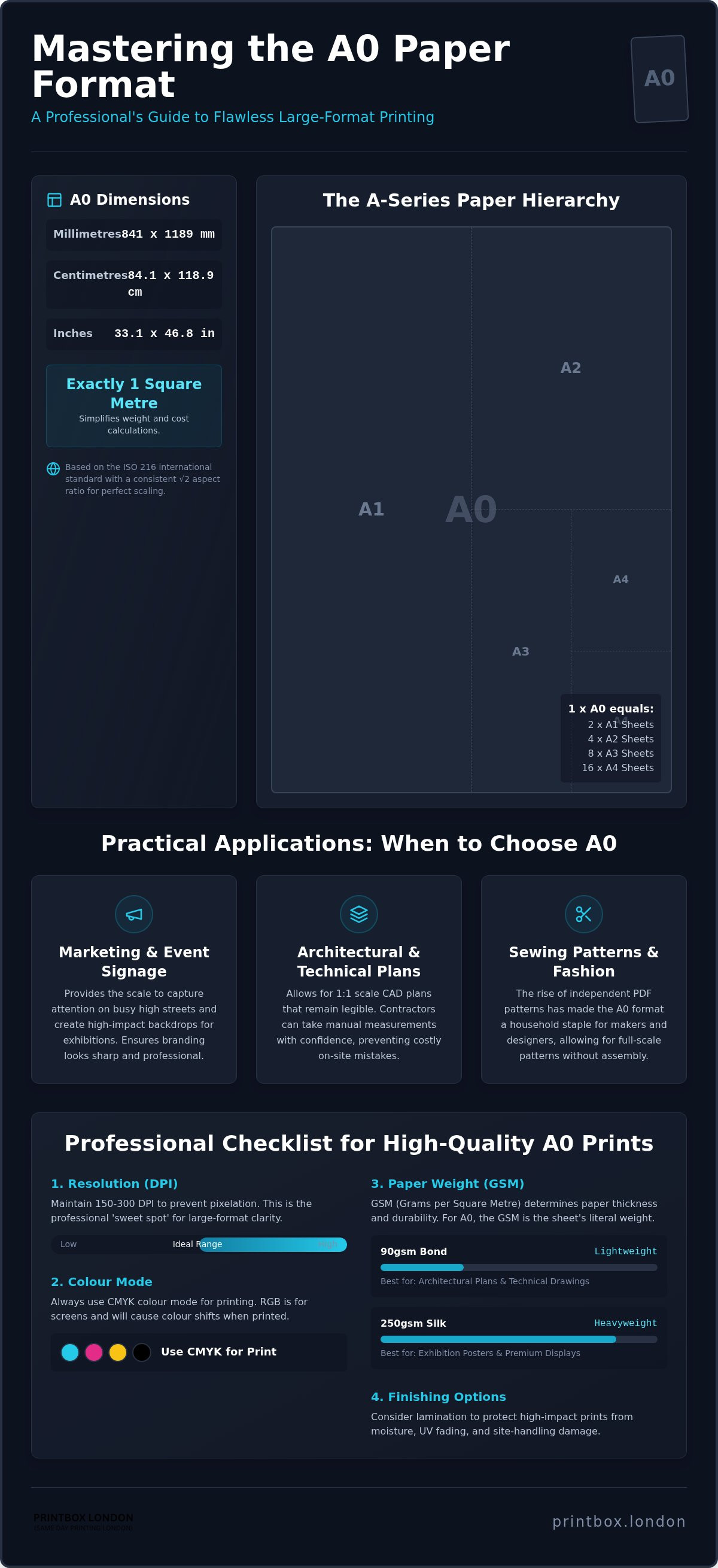
The a0 paper format is the foundation of the international A-series, acting as the largest standard sheet most professionals will ever handle. It is huge. Measuring exactly one square metre in total area, this format provides the maximum impact for physical displays. It isn't just a random size; it's a technical marvel designed for efficiency. This specific area makes it incredibly easy for printers and designers to calculate paper weight and ink coverage across large print runs.
Consistency is built into the design through the ISO 216 standard. Every sheet in the A-series follows a √2 aspect ratio, meaning the length divided by the width always equals 1.414. This mathematical logic ensures that when you fold an A0 sheet in half, you get an A1 sheet with the exact same proportions. It prevents your designs from being stretched or cropped when you scale them up or down. You can design a flyer in A4 and blow it up to A0 without losing your layout's integrity.
A0 Dimensions in Millimetres, Centimetres, and Inches
Accuracy is vital when you are setting up your artboard or checking if a poster fits a specific frame. These are the hard numbers you need:
- Millimetres: 841mm x 1189mm
- Centimetres: 84.1cm x 118.9cm
- Inches: 33.1in x 46.8in
The a0 paper format also simplifies weight calculations. Since the area is exactly one square metre, the GSM (grams per square metre) tells you the exact weight of a single sheet. If you choose a 100gsm bond paper for your architectural plans, one A0 sheet weighs exactly 100g. If you opt for a premium 250gsm silk poster, that single sheet weighs 250g. This makes calculating shipping costs or the strength needed for hanging displays straightforward and fast.
The A-Series Hierarchy: Comparing A0 to Other Sizes
Visualising the scale of A0 helps you understand its dominance. One A0 sheet is equivalent to 16 A4 sheets laid out together in a grid. It is also exactly double the size of an A1 sheet. If you have an urgent order for two A1 posters but only have A0 paper in stock, a single cut down the middle solves the problem instantly.
While A0 is the standard "limit" for most commercial printing projects, larger sizes like 2A0 and 4A0 do exist for massive billboards. However, for 99% of exhibition, retail, and construction needs, A0 is the pinnacle of the series. It offers the largest surface area that remains manageable for transport in standard tubes and easy to handle on site or in a gallery.
Practical Applications: When to Choose the A0 Format
The a0 paper format is the ultimate choice when visibility cannot be compromised. Its massive surface area makes it the go-to standard for professionals across London who need to communicate complex data or bold branding at a glance. Whether it's a bustling retail environment or a high-pressure construction site, the A0 size ensures your message isn't lost in the crowd. It provides the physical presence needed for high-impact communication that smaller formats simply cannot match.
Marketing and Event Signage
In the competitive London retail sector, window displays need to stop foot traffic instantly. A0 posters provide the physical scale required to capture attention from across a busy high street. For exhibition organisers at venues like ExCeL or Olympia, this format is essential for creating high-impact stand backdrops and clear wayfinding maps. Using the correct A-series paper dimensions ensures these graphics fit standard display frames perfectly, preventing unsightly gaps or overhanging edges. If you're prepping for a major launch, choosing a local partner for A0 poster printing ensures your branding looks sharp and professional.
Architectural and Technical Plan Printing
Precision is everything in construction. Architects and engineers rely on the a0 paper format for CAD plans because it allows for a 1:1 scale that remains legible. Small annotations, fine line weights, and complex layers in a structural drawing can become unreadable on smaller sheets. On-site, a full-scale A0 blueprint allows contractors to take manual measurements with confidence. It's the industry standard for ensuring every stakeholder is looking at the same big picture without squinting at tiny details. Reliability is key here; a missed annotation on a cramped A3 sheet can lead to costly mistakes on a build. For those transitioning from technical plans to the final interior finish, Wall & Ink provides essential advice on preparing surfaces like newly plastered walls for professional results.
The rise of independent PDF sewing patterns has transformed the A0 format into a household staple for makers and designers. Taping together 30 sheets of A4 paper is a tedious, error-prone task that can ruin a garment's fit. Professional sewing pattern printing on a single A0 sheet saves hours of prep time. It allows designers to include a "test square" for accuracy checks, ensuring the pattern is printed at the exact intended scale before any fabric is cut. This method is faster, more accurate, and much easier for pinning directly to your material. It's a pragmatic solution for anyone moving from digital design to physical production.
Preparing Your Files for Large Format A0 Printing
Preparing a file for the a0 paper format requires a different mindset than standard office printing. At this massive scale, any technical oversight is magnified. A slightly blurry logo on an A4 sheet is a minor annoyance; on an A0 poster, it's a professional disaster. You need to balance visual clarity with manageable file sizes to ensure your output is both sharp and easy to process. Errors at this scale are expensive and time-consuming, so getting the foundation right is essential.
Following technical drawing standards ensures your lines remain precise and your annotations stay legible. This is particularly critical for architectural plans where a fraction of a millimetre matters. When your file is set up correctly, the transition from screen to paper is seamless, avoiding the dreaded "pixelated" look that ruins large-scale displays.
Understanding DPI and Viewing Distance
There's a common myth that every file must be 300 DPI. For an A0 sheet, a 300 DPI raster file can become massive and crash your design software. If your poster is designed for an exhibition stand and will be viewed from two metres away, 150 DPI is often the sweet spot. It provides excellent clarity whilst keeping your PDF under 50MB for faster uploading and processing.
Always keep your text and logos in vector format. Unlike raster images, vectors don't rely on pixels and can be scaled to any size without losing sharpness. Rasterise only your high-resolution photos. This hybrid approach keeps your file responsive and your print crisp, ensuring that even at one square metre, your branding looks tight and professional.
Setting Up Your Canvas and Bleed
Don't make the mistake of designing at A4 and asking the printer to "blow it up". Start with a canvas set to exactly 841mm x 1189mm. This gives you total control over the final composition and ensures your line weights appear exactly as intended. Use the following checklist for a perfect setup:
- 3mm Bleed: Extend your background colours and images 3mm beyond the trim line. This prevents thin white borders if the guillotine shifts slightly during cutting.
- 10mm Safe Zone: Keep all critical text and logos at least 10mm from the edge. This protects your content from being obscured by poster frames or mounting clips.
- CMYK Colour Mode: Your screen displays colours in RGB, but our printers use CMYK inks. Convert your file to CMYK before exporting to avoid dull or shifted colours.
Export your final design as a high-quality PDF. It's the gold standard for large format printing because it embeds your fonts and preserves your vectors. If you're working on an urgent project, our team at Printbox London can check your file setup to ensure perfect results on the first run, saving you from the stress of a botched print job.
Choosing the Right Materials and Finishing for A0
Selecting the correct substrate for the a0 paper format is a critical final step. A massive one-square-metre print is physically demanding. If the paper is too thin, it will curl in a frame. If it's too glossy, your audience won't be able to read it under harsh exhibition lights. You need to match the material to the specific environment to ensure your project looks professional and lasts as long as you need it to. Large format prints are an investment in your brand's visibility, so the finish must be flawless.
Paper Stock Options for Every Project
For businesses that require even more specialised branding solutions beyond paper, such as UV printing or custom engraving, you can learn more about advanced digital production options.
Paper weight is measured in GSM (grams per square metre). Because the a0 paper format is exactly one square metre, the GSM tells you exactly how much each sheet weighs. This is helpful when you are planning for transport or hanging displays in a temporary venue. Choose your stock based on these industry standards:
- 90gsm Uncoated Bond: The standard for architectural and CAD plans. It is lightweight, cost-effective, and easy to fold for site meetings or technical archives.
- 170gsm-190gsm Satin: The professional choice for event posters. It offers a subtle sheen that makes colours vibrant without creating distracting reflections.
- 250gsm Premium Silk: A heavy, high-quality stock for luxury retail or boardroom presentations. It feels substantial, resists creasing, and looks impressive in a gallery setting.
Lamination and Mounting for Durability
Large format prints are vulnerable to fingerprints, moisture, and UV fading, especially in high-traffic London venues. Lamination adds a protective plastic layer that significantly extends the life of your print. Matt lamination is the preferred choice for exhibitions because it eliminates glare from overhead spotlights, making your text easier to read. Gloss lamination is better suited for retail environments where you want high-contrast colours to "pop" and grab attention from passers-by.
For a truly rigid display, consider mounting your print onto a board. Foamex board printing turns a flimsy sheet of paper into a sturdy, standalone sign. This is essential for London construction site boards, outdoor event wayfinding, or any situation where you don't have a wall for support. For shorter-term projects like site meetings, Correx board is a lighter, more cost-effective alternative. Both options provide a flat, professional finish that won't bow or warp over time. If you need a fast, durable solution for your next project, we can provide expert A0 lamination and mounting services with same-day results to meet your tightest deadlines.
Same-Day A0 Printing in London: Fast Solutions for Urgent Needs
London is a city that operates on tight schedules and even tighter deadlines. For many professionals, a deadline isn't a suggestion; it's a high-stakes commitment. If you're preparing for a major exhibition at ExCeL or a morning site meeting in the City, "next day delivery" is a gamble that often results in unnecessary stress. The a0 paper format presents unique logistical challenges. Because these prints are over a metre long, they are highly vulnerable to being crushed or bent during transit in standard courier networks. Opting for a local, same-day service removes this risk entirely.
Urgent Large Format Printing in North London
Our production centre at 52 West Green Road serves as a high-speed hub for professionals across the capital. We specialise in rapid turnaround, offering same-day results for posters, plans, and patterns. This speed is vital for London's creative community. Students finishing portfolios and architects prepping for client presentations need a reliable local fixer who can produce high-quality results in hours, not days. Local collection allows you to pick up your prints in person, ensuring they remain in pristine condition from our printer to your destination. It is the most pragmatic way to handle large-scale documents in a fast-paced urban environment.
Why Choose a Professional Print Shop Over Online-Only?
Online-only platforms often rely on automated workflows that miss critical errors. When you work with a professional London print shop, you gain an extra layer of security. We provide expert file checking as standard, catching resolution issues or incorrect colour profiles before they become expensive mistakes. At the scale of the a0 paper format, seeing a physical sample or proof can be the difference between a successful event and a professional embarrassment.
We offer direct advice on material selection, helping you choose between a 90gsm bond for a quick site plan or a 250gsm silk for a premium gallery display. This personalised service ensures you get the best value for your budget. Our high-energy team is dedicated to solving your printing problems with speed and efficiency. We don't just print files; we partner with you to ensure your project is delivered on time and to the highest standard. Our "can-do" attitude ensures that even the most demanding requirements are met without hesitation.
Need it today? Order your A0 poster printing from Printbox London and experience the reliability of a local specialist.
Deliver High-Impact Results with Professional A0 Printing
Mastering the technical side of the a0 paper format ensures your vision translates perfectly from the screen to a physical display. You now have the exact dimensions, file preparation checklist, and material knowledge required to avoid common pitfalls like pixelation or colour shifts. Whether you are prepping detailed architectural plans or high-stakes exhibition posters, these specifications are your blueprint for success.
Don't let a looming deadline or complex file requirements slow you down. Our North London production centre is ready to handle your most urgent projects with high-resolution digital printing and expert finishing options. We offer same-day production and local collection to ensure your work stays in perfect condition. From durable lamination to rigid mounting, we provide the reliable solutions you need to stand out. Order Same-Day A0 Printing in London today and let us take the stress out of your large-format needs. Your next project is in safe hands.
Frequently Asked Questions
How big is an A0 poster in cm?
An A0 poster measures exactly 84.1 cm by 118.9 cm. This size provides a total surface area of one square metre, making it the largest standard sheet in the A-series. It is a massive format that requires careful handling to avoid creasing. When you are planning your display space, ensure you have enough room for this substantial physical presence, especially if you are adding a frame or mounting it to a board.
Can I print an A4 file as an A0 poster?
You can scale an A4 file up to the a0 paper format because both sizes share the same √2 aspect ratio. However, the quality depends entirely on your original file. If your design uses vector graphics and fonts, it will remain perfectly sharp. If you are using raster images, like JPEGs, they must be high resolution. Blowing up a low-quality A4 image will result in significant pixelation at the A0 scale.
What is the best resolution for A0 printing?
The ideal resolution for A0 printing is between 150 and 300 DPI. For posters viewed from a distance of two metres or more, 150 DPI is usually sufficient to maintain a crisp appearance while keeping file sizes manageable. If your project contains fine technical details or is meant for close-up inspection, aim for the higher 300 DPI limit. Always prioritise vector formats for text and logos to ensure absolute clarity regardless of the resolution.
How much does it cost to print an A0 sheet in London?
Printing costs in London vary based on your choice of material, finishing options, and turnaround speed. A standard 90gsm bond paper for technical plans is the most cost-effective option, while premium 250gsm silk photo paper with lamination will be priced higher. Urgent same-day services also factor into the final investment. To get an accurate figure for your specific project, it is best to check current options based on your paper and durability requirements.
Is A0 the same as a movie poster size?
No, A0 is not the standard size for commercial movie posters. The film industry typically uses a format known as a "One Sheet," which measures approximately 68.6 cm by 101.6 cm. While the a0 paper format is larger and offers more surface area, it is primarily used for academic research, retail displays, and architectural drawings. If you are designing a film poster, always verify the specific frame dimensions before choosing the ISO A0 standard.
How should I transport an A0 print?
The best way to transport an A0 print is inside a heavy-duty cardboard postal tube. This protects the edges from fraying and prevents the sheet from being crushed or creased. Avoid folding the paper, as this creates permanent marks that ruin the professional finish. If you are in London, collecting your prints directly from our shop is the safest method. It eliminates the risk of your large-format tubes being damaged in a courier's sorting facility.
Can you print A0 architectural plans on the same day?
We can print A0 architectural and CAD plans on the same day at our North London production centre. This service is designed for professionals working under tight site deadlines. Simply provide your drawings in PDF format to ensure all line weights and layers are preserved correctly. Our high-speed equipment handles complex technical annotations with ease, allowing you to collect your full-scale blueprints and head straight to your meeting without any delay.
Do I need to add bleed to my A0 design?
You should always include a 3mm bleed on all sides of your A0 design. This extra margin ensures that your background colours or images extend right to the edge of the paper after it is trimmed. Without a bleed, you risk having thin, unsightly white borders around your finished poster. Keeping your critical text and logos within a 10mm safe zone from the edge also protects your content from being obscured by frames or mounting clips.