
Waterproof Sticker Printing UK: Materials, Use and Artwork Explained
Oct 13, 2026
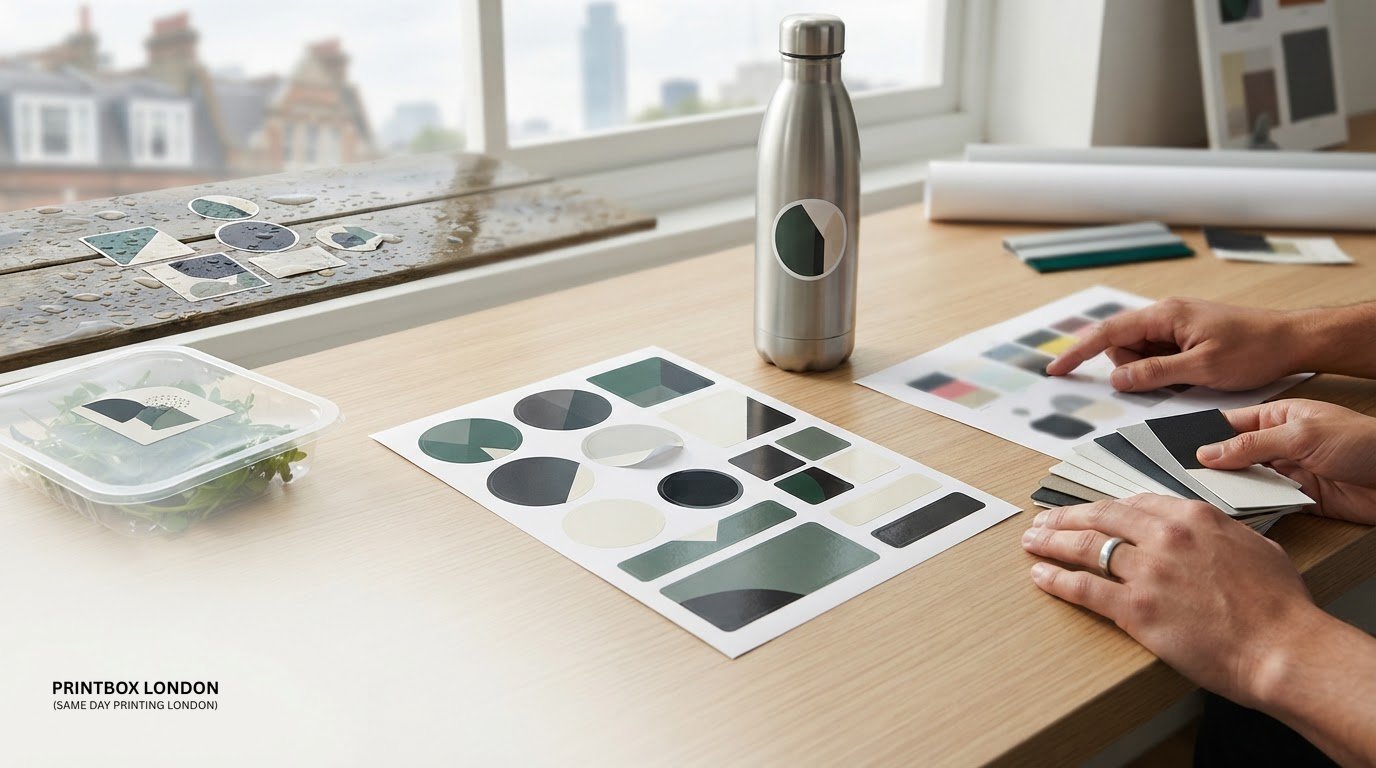
A glossy finish alone doesn’t make a sticker waterproof. If you’re looking into waterproof sticker printing UK, start by describing the conditions the sticker will face, then consider the material, adhesive, print and any protective finish as a complete specification.
A label on dry packaging has different demands from one exposed to rain, condensation or regular cleaning. Water resistance and waterproof performance are not interchangeable promises, and the word “waterproof” on its own does not establish how a sticker will perform in a particular setting. This guide explains what to consider before ordering, including surface, exposure, artwork and the details needed for a useful quote.
Printbox London (Same Day Printing London) produces custom sheet-based stickers and labels in varied shapes and sizes. When you enquire, include the intended use, finished size, quantity, material or finish preference, artwork and deadline. That gives the job a clear starting point without assuming that one sticker specification suits every wet environment.
Key Takeaways
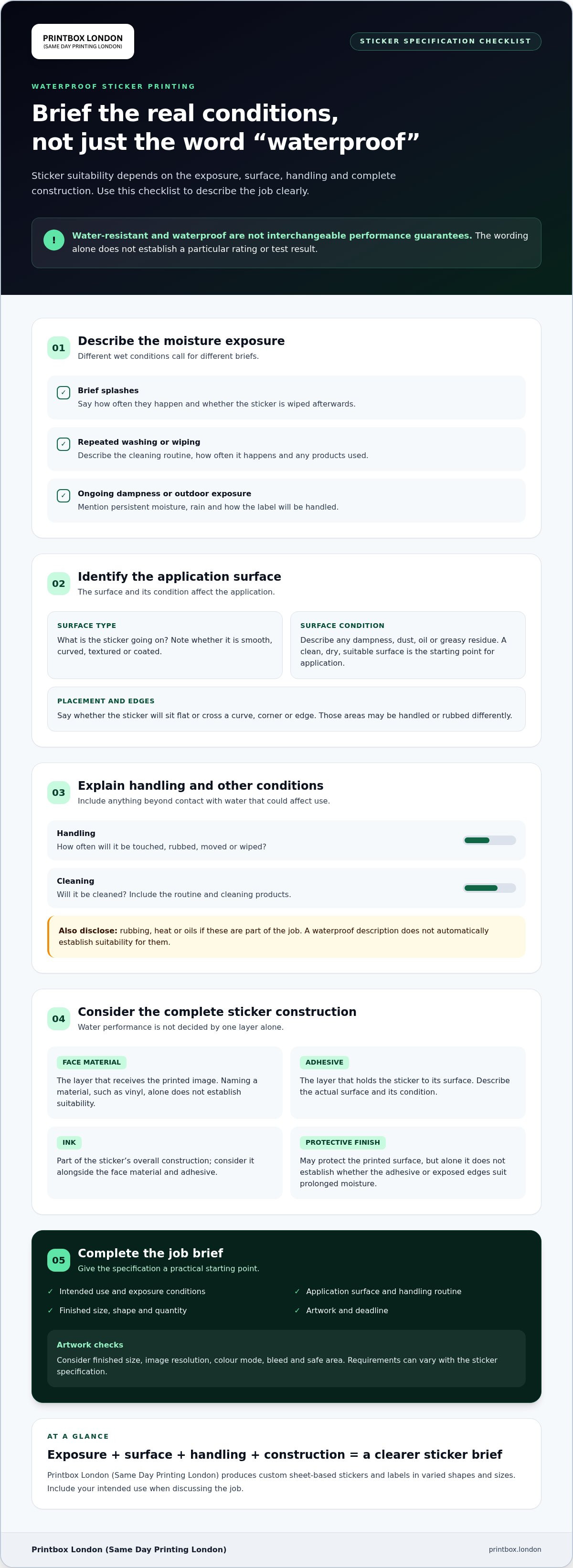
- Describe the real conditions the sticker will face, from occasional splashes to ongoing outdoor exposure.
- For waterproof sticker printing UK, consider the face material, adhesive, print and protective finish together rather than relying on appearance alone.
- Include the application surface, handling and cleaning routine in your brief. These details help define the job more clearly than a general request for a “waterproof” sticker.
- Prepare artwork with the finished size, image resolution, colour mode, bleed and safe area in mind. Requirements can vary with the sticker specification.
- Send Printbox London (Same Day Printing London) the size, quantity, intended use, artwork and deadline for a quote. Same-day printing is available for selected quantities and specifications.
What does waterproof sticker printing mean for your intended use?
Waterproof suitability depends on how a sticker is made and the conditions it will face. A label on a dry product package has different demands from one that gets splashed, wiped repeatedly or left outdoors. Before choosing a specification, note where the sticker will go, what it may come into contact with and how often it will be handled.
Let the exposure, not the word “waterproof”, guide your sticker brief. A waterproof description does not automatically mean the sticker is suitable for rubbing, heat, oils or cleaning products. If any of these are part of the job, include them in the requirements instead of assuming they are covered.
Water-resistant or waterproof: what should buyers understand?
These terms aren’t interchangeable performance guarantees. “Water-resistant” may suggest suitability for limited moisture, while “waterproof” can imply more demanding use, but the wording alone does not establish a particular rating or test result. Explain what will happen in practice. A label facing an occasional splash has a different exposure from one that is regularly wiped down or kept damp.
The broader ideas behind waterproof fabrics and coatings can help explain how materials are designed to limit water penetration. Sticker performance also depends on the complete construction, the application surface and how the label is used.
Where might a water-suitable sticker be used?
Consider the difference between a product package that might get briefly splashed, a container that is repeatedly washed and an equipment label exposed to rain. These are separate use cases, not interchangeable examples of “wet conditions”. State whether moisture is occasional or ongoing, and whether the sticker will be cleaned, handled often or used outside.
For example, a food business might use a sticker on packaging handled during service, while an outdoor equipment label may face continuing exposure to rain and sunlight. Don’t assume that a specification suited to one use will suit the other.
Note the application surface as well as the moisture. A smooth, clean container and a textured or curved surface can present different application conditions. Include whether the sticker is applied to a dry surface and describe any relevant surface coating or texture.
- Brief splashes: Explain how often they happen and whether the sticker is wiped afterwards.
- Repeated washing: Describe the cleaning routine and any products involved.
- Outdoor exposure: Mention ongoing weather exposure and how the label will be handled.
Printbox London (Same Day Printing London) produces custom sheet-based stickers and labels in varied shapes and sizes. Describe the intended use when discussing custom sticker and label printing, so the job can be considered against the conditions you’ve outlined.
Which factors affect how a printed sticker copes with water?
Water performance is a combination of factors, not a single material choice. The printable face, adhesive, ink and any protective finish each have a role. Application and use matter too. For example, a coating may protect the printed surface, but that alone does not establish whether the adhesive or exposed edges are suitable for prolonged moisture.
Build the brief around the sticker’s full journey, from application through routine handling and cleaning. Consider what happens before it is applied, where it will be placed and how it will be treated in use. For waterproof sticker printing UK, describe those conditions first, then set out the required size, shape and quantity.
| Factor | What to describe |
|---|---|
| Exposure | Brief splashes, persistent dampness, rain or another regular source of moisture. |
| Surface | What the sticker will be applied to, including whether it is smooth, curved, textured or coated. |
| Handling | How often the label will be touched, rubbed, moved or wiped. |
| Cleaning routine | Whether the item is cleaned, how often and what products are used. |
How the sticker surface and adhesive affect suitability
The face material is the layer that receives the printed image; the adhesive is the layer that holds the sticker to its surface. Both matter, alongside the ink and any protective finish. Vinyl is one general example of a sticker material, but naming a material alone does not establish its water performance or suitability for a particular job. Adhesives also vary by purpose and surface, as outlined in information about types and applications of adhesives.
In a food business, a label might go on packaging, a container or equipment. Those surfaces aren’t automatically equivalent. Dampness, dust, oil and texture can affect contact between adhesive and surface, so describe the actual material and condition rather than just saying “container”.
Why application and handling matter
For application, start with a clean, dry surface that is suitable for the sticker. Dirt, moisture or greasy residue can affect how well it bonds. Curves and corners matter too: a sticker fitted over an edge may be handled or rubbed differently from one placed flat. Frequent contact can put added strain on the printed face and edges.
Include these details when you discuss custom sticker and label printing. They give the job a practical starting point without assuming a material or finish will perform in conditions it has not been confirmed for.
If you’re preparing an enquiry, share your sticker requirements, including the surface, moisture exposure and cleaning routine.
How do waterproof sticker options compare for different jobs?
There isn’t one sticker specification that suits every job. Start with the label’s purpose, then consider how it will be exposed, where it will be applied and how it will be handled. A packaging label kept indoors has a different brief from equipment identification used outside. The table compares these situations, not guaranteed levels of water performance.
| Use case | Potential advantage | Key limitation to consider |
|---|---|---|
| Short-term indoor use | A straightforward choice where the sticker is mainly used for identification or promotion in a dry setting. | It may not suit regular splashes, wiping or a change to damp conditions. |
| Damp handling | Worth considering for packaging or containers that may be touched with wet hands or briefly splashed. | Repeated wiping, moisture at the edges or cleaning routines add demands beyond an occasional splash. |
| Outdoor exposure | Relevant for equipment identification or other labels that remain outside. | Ongoing weather exposure and frequent handling need to be described; an indoor-use specification should not be assumed suitable. |
Match the sticker choice to the job
For a food business, a promotional sticker on a dry takeaway package may face different conditions from a product label on a container handled during service. An equipment identification sticker kept outdoors has another set of demands. In each case, set out the exposure, application surface, finished size and handling. These details help frame the job without assuming that a generic material or finish guarantees a particular result.
For custom sticker and label printing in London, explain what the sticker needs to do as well as how it should look. Water exposure is only one part of the specification. State whether the label is promotional, informative or intended to identify an item, and whether it will be touched, moved or cleaned in regular use.
When do shape, size and quantity matter?
Shape and format affect layout and fit, but they don’t determine water resistance. A round sticker might suit a small brand mark, while a square or rectangular label can give more room for text. Check the available application area, including curves, edges and space needed to keep important wording clear.
Set the artwork to the intended finished dimensions and leave enough room for essential details. A label that looks clear on screen may feel cramped once it is sized for a small container. Quantity also matters when requesting a quote, particularly if you need different designs or sizes. Keep the shape decision separate from the performance brief: specify both, and explain the conditions the sticker will face.
That distinction is central to waterproof sticker printing UK: choose the format for the surface and design, then consider the complete specification against the exposure and handling.
How should you prepare artwork and request waterproof sticker printing?
A clear brief makes it easier to discuss the job and prepare a useful quote. Work through the details in order: explain the sticker’s use, set the finished size, confirm the quantity, note any material or finish preference, then prepare the artwork. For waterproof sticker printing UK, describe the moisture exposure too. A technically print-ready file does not explain how the sticker will be used.
What should a sticker artwork file include?
A correctly prepared PDF is generally suitable for print. Build the design at its intended finished size and use images with enough resolution to look clear at that size. Low-resolution screenshots can appear soft or pixelated once printed.
CMYK is commonly used for print, while RGB is used by screens, so colours can look different when printed. Include bleed if the design runs to the edge, and keep essential text and logos inside a safe area, away from the trim or cut line. Exact file requirements can vary with the sticker’s shape and specification.
Before sending the file, check the wording, spelling, logo, colour and final dimensions. Make sure no important detail sits too close to an edge that may be trimmed or cut. If the design has a shaped outline, confirm that the artwork and intended cut shape correspond. Printbox London (Same Day Printing London) produces custom sheet-based stickers and labels in varied shapes and sizes for businesses preparing bespoke artwork.
What details help produce a useful quote?
Send a concise brief with the practical information up front. Include:
- Product type and intended use, such as a packaging label or promotional sticker.
- Finished dimensions and shape, plus the quantity required.
- Material or finish preference, if you have one.
- The surface the sticker will be applied to and the moisture or handling it will face.
- Print-ready artwork and your required deadline.
If you’re unsure about a material or finish, describe the job rather than guessing a technical term. Explain whether the sticker will face occasional splashes, regular wiping or outdoor exposure, and mention any cleaning routine. That gives the specification discussion a useful starting point.
Same-day printing is available for selected quantities and specifications. Turnaround depends on the order requirements and production workload; artwork readiness and material stock can also affect timing. Send the finished size, quantity, artwork and deadline together so the request can be assessed efficiently.
Where can you order custom stickers in London?
When ordering a label for a food business, set out its intended dimensions and use, then provide the information needed for a quote. Be specific about moisture exposure too. A request for waterproof sticker printing UK should describe the conditions the sticker will face, rather than relying on the word “waterproof” alone.
Printbox London (Same Day Printing London) serves customers throughout Greater London from its shop in Tottenham, North London. Customers across Central, East, South and West London, including Haringey, Hackney, Islington, Camden, Enfield, Barnet, Westminster, Newham, Redbridge and Waltham Forest, can enquire about custom sticker and label printing.
Same-day printing is available for selected quantities and specifications. Turnaround depends on the order requirements and production workload, so include your deadline with the rest of the brief rather than assuming a completion time before the details are known.
What happens when you enquire?
Make your enquiry useful from the start. State the product type, finished size, quantity and preferred finish or material, if you have one. Include the final artwork and explain where the sticker will be applied and how it will be used. For example, say whether it is for packaging, a container or equipment, and describe any damp conditions, wiping or outdoor exposure. This gives the job a clear basis for discussion.
If you’re still organising the file, share the intended dimensions and the artwork status. A print-ready file helps move the request forward; if the design is not final, say so and identify what remains to be completed. Include your required deadline, especially for an urgent job. Same-day production is available for selected quantities and specifications, with timing affected by the order requirements and current production workload. Clear details help avoid unnecessary back-and-forth.
Collection and next steps for London customers
Collection is from the Tottenham shop once the order is confirmed ready: 52 West Green Road, South Tottenham, London N15 5NR. This is the collection point for customers across the capital.
Before sending your enquiry, check that the dimensions are the finished sticker size, the quantity is correct and the artwork matches the intended shape. Note any preference for material or finish, but focus on describing the actual job if you’re unsure which option to request. This is especially useful for labels intended for damp handling or outdoor exposure, because the complete specification needs to be considered against the use.
For a practical starting point, prepare your order details and send the product type, finished size, quantity, intended exposure, deadline and artwork to request a quote from Printbox London (Same Day Printing London).
Make your next sticker order easier to specify
Turn the details you’ve gathered into a short brief you can reuse. Record the intended application, exposure, finished dimensions, shape, quantity and artwork version. For future orders, update anything that has changed, such as the label size or the way the product is handled. This gives your team a consistent starting point and makes it easier to spot changes before artwork is sent for waterproof sticker printing UK.
A clear specification won’t replace product-specific advice, but it helps keep the discussion focused on the real job rather than assumptions based on a label such as “waterproof”. Include your preferred deadline, then allow the order requirements to shape the timing.
Ready to discuss a sticker job? Send Printbox London (Same Day Printing London) your artwork, size, quantity, intended use and deadline to request a quote.
Frequently Asked Questions
Is a waterproof sticker completely unaffected by water?
No. The word “waterproof” isn’t a promise that a sticker will remain unchanged under every condition. Performance depends on the complete sticker specification and how it is applied and used. If the information on the label needs to remain legible, describe the exposure and handling when you request a quote rather than relying on the label alone.
Can waterproof stickers go in a dishwasher?
Don’t assume so. A dishwasher combines conditions that a general waterproof description may not cover, including heat, detergent and repeated washing. A sticker that appears intact after one wash is not necessarily suitable for repeated cycles. If dishwasher use is essential, include it in the intended-use details when discussing the specification.
Are waterproof stickers suitable for outdoor use?
Not automatically. The word alone does not establish whether a sticker is suitable for a particular outdoor setting. Describe the expected exposure, how often the label will be handled and what information needs to remain readable. Do not assume an indoor-use specification is suitable for continuing weather exposure.
Will waterproof stickers stick to any surface?
No. Surface texture, coatings, seams and curves can affect application. Describe the material and condition of the surface rather than referring to it simply as plastic or metal. Where practical, applying a sample to a representative item can help assess fit and placement, but it does not establish long-term performance in wet conditions.
What file format should I use for sticker printing?
A properly prepared PDF is generally a practical file to send. Before sending it, proof the wording, especially product names, ingredients or contact details, and make sure you have supplied the approved version rather than a draft. Check that fonts and placed images display correctly in the exported file.
Can custom stickers be printed the same day in London?
Same-day printing is available for selected quantities and specifications, but completion depends on the order requirements and production workload. Give Printbox London (Same Day Printing London) a specific deadline and say when you need the stickers ready for use or collection. Send final artwork where possible so the request can be assessed against the specification.
What details should I include when requesting a sticker printing quote?
Include the sticker type, finished size, quantity, shape, material or finish preference, intended use, deadline and final artwork. If you’re sending several designs, use clear filenames and identify the version to print for each one. You can include these details in an enquiry about custom stickers and labels so the job can be considered as a complete specification.
Article by
Printbox London Team
The Printbox London (Same Day Printing London) team provides practical printing guidance based on real customer requirements and day-to-day print production. We serve customers across Greater London from our Tottenham print shop, with same-day printing available for many products depending on quantity, specification, artwork and production capacity.