
Transporting and Handling Mounted Prints: A Practical Guide
Oct 10, 2026
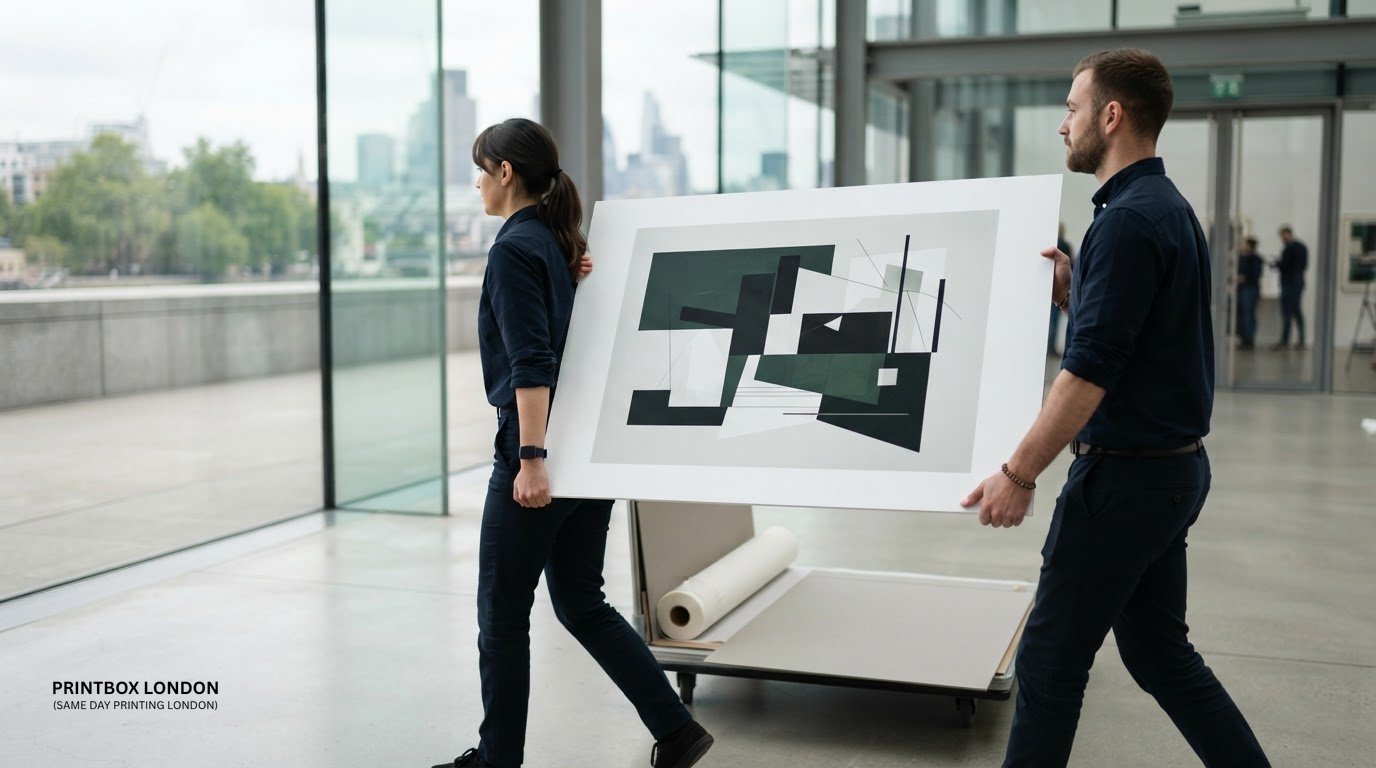
A mounted print can be ready for display and still be vulnerable on the journey there. Scratches, pressure on the printed face, a flexing board or a splash of rain can leave visible damage before you reach the venue. The safest approach to transporting and handling mounted prints is simple: support the board, protect its surface and keep it flat.
It’s understandable to be unsure where to hold a large, rigid print, especially when you’re moving through busy London streets, doorways or exhibition spaces. Lift it by the edges, use both hands and avoid carrying it by one corner. Choose surface protection and outer support to suit the print’s size and mounting, without letting cushioning rub directly against the image.
This guide covers preparation, lifting, packing, vehicle and public transport considerations, and arrival at the venue. It also explains why foam board needs particular care: it’s intended for indoor use and isn’t waterproof. Follow these steps to reduce the risk of bending, scraping or moisture damage, and arrive ready to handle or display your print.
Key Takeaways
- Learn a simple lifting routine that helps you support the board without pressing or scuffing the printed face.
- Prepare a clear route and choose surface protection that won’t rub against or stick to the image.
- Plan around the print’s dimensions before travelling, then keep it supported and clear of obstacles on the way to the venue.
- See how careful transporting and handling mounted prints can reduce the risk of bending, scratches and moisture damage.
- Explore foam-board mounting for indoor displays, available in A4-A0 sizes, with 5 mm white board commonly used.
Why transporting and handling mounted prints needs a different approach
Keep mounted prints flat, fully supported and protected from rubbing. A mounted print is artwork fixed to a supportive board, so it holds its shape rather than behaving like a loose sheet. That rigidity makes it unsuitable for rolling, but it doesn’t make the print indestructible. A board can flex, its corners can take knocks, and the printed face can be scuffed or exposed to damp.
Featured snippet: Safe transporting and handling mounted prints means keeping the board flat, supporting it across its surface and edges, and preventing pressure, impacts, rubbing and moisture during the journey.
These precautions matter whether you’re carrying one display piece to an exhibition or moving several prints through a venue. The board changes how the artwork responds to movement, so handle it as a rigid panel, not as paper that can be tucked away or reshaped.
Mounted prints versus unmounted posters
An unmounted poster is flexible paper that can be rolled for some journeys. A mounted print has a firm backing, which gives it structure but means it must stay flat. Don’t roll or fold it: either can crease the artwork or damage the board. The print’s dimensions and board construction also affect how widely it needs to be supported while lifting and carrying.
The artwork itself may be produced using different printmaking techniques and terminology, but the mounted board is what determines how you move it. Treat it as a rigid panel and support it appropriately for its size.
What can damage a mounted print in transit?
Four risks deserve attention: pressure, impact, friction and damp. Objects pressed against the printed face can leave marks; a collision can dent or crush a corner; rubbing against another surface can scuff the image. Moisture can also affect the board. Foam board, for example, is for indoor use and isn’t waterproof, so keep it out of wet conditions.
Large boards need particular care at the edges. If you lift one corner while the rest hangs unsupported, the board may flex under its own weight. Support it evenly instead of letting an edge or corner bear the load alone. Take a moment to look for nearby obstacles before moving it, and avoid placing anything on top. Prevention is simpler than dealing with a marked face or damaged board after arrival.
How to lift and handle mounted prints without bending or scuffing them
A careful lift starts before the board leaves the table. Check that your hands are clean and dry, the route is clear, and there’s somewhere safe to put the print down. This small pause helps prevent hurried grips, collisions with doorframes and awkward twists that can mark the face or strain the board.
Safest grip: support the board, not the artwork’s centre. Hold sturdy edges and spread the load rather than pressing on the printed area.
Use this routine for transporting and handling mounted prints:
- Prepare the route. Move bags, chairs and other obstacles. Open doors fully and check that the print can pass through without catching.
- Choose your grip. With clean, dry hands, take hold of sturdy edges where your fingers won’t touch the printed face. Avoid pinching a corner.
- Lift evenly. Support the lower edge and keep the board upright or flat. Don’t twist it or allow unsupported sections to hang.
- Set it down with care. Lower the print onto a clean, flat surface. Don’t leave it balanced on one edge or resting against an unstable object.
Use the same controlled movements when picking the print up again. If you need to change direction, pause and reposition your feet rather than turning your body while holding the board at an angle.
Lifting a small or medium mounted print
A smaller board may be manageable by one person, but it still needs a secure hold. Place one hand beneath the lower edge and use the other to steady a side edge. Keep the board close enough to control without pressing it against your clothing or another surface. Lift smoothly, keeping the panel level or upright, and avoid gripping, pinching or leaning fingers on the image.
Handling a large mounted print with another person
For a large or awkward board, agree who will lift, which direction you’ll move and where you’ll set it down before either person takes hold. Each person should support an edge or section so the board doesn’t sag between them. Move at a steady pace, call out before turning and avoid sudden stops. Set the print on a clean, flat surface together, rather than balancing it on an edge.
Foam-board prints, including rigid foam-board displays, benefit from this even support. If you’re planning a mounted display, you can discuss your print requirements with Printbox London (Same Day Printing London) before preparing it for transport.
How to protect mounted prints for transport to an event
Protect the printed face first, then plan how to shield the board from knocks. Before leaving, check the artwork and edges, clear the route and decide how you’ll hold the print at each stage. A few minutes of preparation can prevent a mark caused by a rushed lift, a rubbing surface or an item shifting against the board.
A clean, smooth layer such as glassine or acid-free tissue can help separate the image from other surfaces. Keep it flat over the print rather than dragging it across the artwork. Avoid putting bubble wrap or other textured cushioning directly against the printed face, as rubbing or pressure may leave marks. Any outer protection should stay secure without adhesive touching the image.
Protect the printed face and corners
Keep the image facing away from rough surfaces, loose dirt and other objects. Add clean protection over the face and take care around exposed corners, which can be vulnerable to knocks. Don’t apply tape or adhesive to the artwork. If using rigid protection to reduce accidental contact, make sure it covers the print without pressing on it or shifting during the journey.
Before moving off, check that nothing can slide between the print and its protective layer. Pens, keys, clips and display fittings can scratch the surface or strike an edge if they move about. Keep these items separate. A cover helps create a barrier, but it won’t prevent damage if the print is squeezed against heavy or sharp objects.
Keep mounted artwork dry and separate
Plan for the weather as well as the route. Keep foam-board displays away from rain and damp, including during the transfer between a vehicle and an exhibition venue. Use protection that stays in place and keep the board out of wet areas throughout the journey.
Don’t place two prints face-to-face without a clean separating layer. Their surfaces can rub together as they move. Avoid stacking heavy items on top, too: pressure may mark the image or damage the board beneath it. For further context on how a rigid display board differs from other sign materials, see foam-board display printing and the guide “What Is Foamex Board Used For? Indoor Displays, Signs and More”. Foamex and foam board are different materials, so don’t assume the same handling advice or properties apply to both.
Use this quick pre-travel check:
- Inspect the printed face, corners and edges for existing marks.
- Clear doorways and the space where you’ll lift and set down the print.
- Place a clean protective layer over the image without sticking it to the artwork.
- Keep the print separate from loose items, other prints and anything heavy.
- Plan how to keep it dry from collection through arrival at the venue.
Good preparation makes transporting and handling mounted prints more predictable. Match the protection to the board and journey, and check it again before setting off.
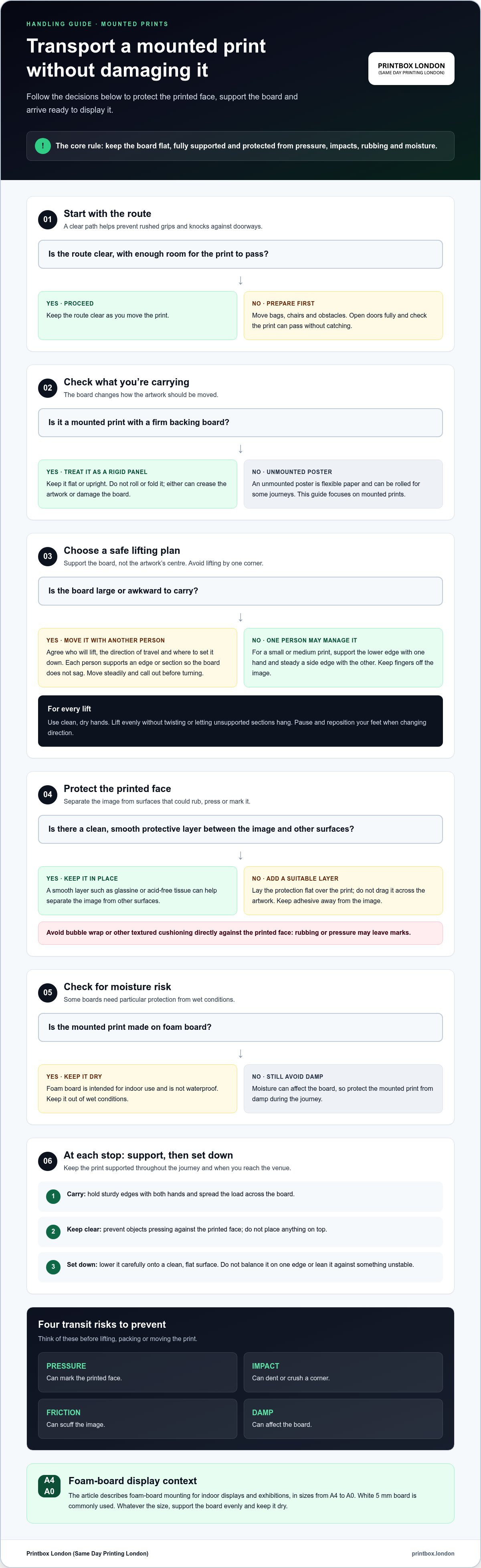
Plan the journey: carrying mounted prints through London and into a venue
Measure the print before choosing how to travel. Compare its full length and width with the available space in your vehicle or the route you intend to take, including doorways, turns and the space needed to hold it safely. Don’t assume an A-series board will fit a particular car, lift or entrance. The actual dimensions and the route matter.
Build in time to check access details for the venue. Look for information about entrances and lifts, or contact the venue about access if you need to. A route that looks clear on a map can still include narrow corridors, steps or tight turns. Work out where you can pause without blocking other people, and keep the board under control rather than resting it in a busy walkway.
Choose a practical route and carrying position
For public transport, assess the board against the space you can manage on the whole journey, not just the carriage or vehicle. You need to carry it through stations, doorways and any stairs, while keeping it supported and clear of nearby passengers and objects. If a large rigid print would be awkward in a crowd, plan a quieter route or another way to travel rather than relying on space appearing when you arrive.
For vehicle travel, check that the print can lie flat or be held securely in the space available. Keep it separate from luggage and equipment. Items that shift during braking or turning can press against the board or knock its corners. Don’t wedge it tightly into a space or leave an unsupported edge hanging. A rigid print needs room to remain stable without being squeezed.
Some large-format plans are designed to be folded, but that doesn’t make a mounted print foldable. Treat the rigid board as a flat panel throughout the journey. Choose the carrying position that lets you see the route and keep the board steady, and ask someone to guide you through a tight turn if needed.
Check the print after arrival
Once inside the venue, find a clean, level place before removing the protective layer. Avoid uncovering the artwork in a busy entrance where people or equipment could brush against it. Check the printed face, edges and corners for marks or damage, then keep the print flat and dry until it’s ready to be displayed. This arrival check also helps you spot any issue before installation begins.
For an exhibition display, plan the handling around the specific board material. Foam board and Foamex are different materials, so don’t assume guidance for one applies to the other.
Choose mounted foam-board prints for indoor displays and exhibitions
A rigid foam-board print can suit a presentation or exhibition display when you want the artwork to stay flat and be handled as a panel. It differs from a loose poster that may be rolled for transport. Think about the display location as well as the design: the finished dimensions need to fit the space, and your transport and handling plan needs to account for the board’s rigidity.
When does a mounted foam-board print suit an indoor display?
Foam-board prints can work well for indoor presentations and event displays where a firm backing is useful. Printbox London (Same Day Printing London) offers foam-board printing in A4-A0 sizes, with 5 mm white board commonly used. Foam board is not waterproof, so it isn’t suitable for wet conditions. Plan to keep it indoors and dry from collection through display.
Before choosing the finished size, consider where the board will be placed and how it will be carried through the venue. Check the available display area and access route, including any tight turns. A board that fits the display may still be awkward to move if the route is narrow. These details matter for transporting and handling mounted prints without compromising the artwork.
The foam-board display printing page gives an overview of the mounted option. For fixing advice, the guide “How to Hang a Foamex Sign” covers a different board material. Don’t assume its hanging guidance applies to foam board, or that the materials have the same properties.
What to include when requesting a mounted print
Share the details that define the job and its intended use. Provide the finished size, quantity and print-ready artwork, and state clearly that you want the print mounted. Describe the indoor display setting, such as a presentation or exhibition, so the requirement is clear from the outset. If you’re working to a particular space, give its dimensions too, then check the artwork layout against the finished print size before sending it.
A print-ready PDF is generally suitable when correctly prepared. Check that the page is set to the intended finished size and that the image quality and layout are appropriate for the final dimensions. Requirements can vary with the artwork and specification, so include any relevant instructions alongside the file rather than relying on a small preview to show every detail.
- Finished width and height
- Number of mounted prints required
- Print-ready artwork file
- A clear note that mounting is required
- Intended indoor use and any display-space measurements
Giving these details helps align the print with the display and the practicalities of getting it there. Discuss a mounted print for your display with Printbox London (Same Day Printing London).
Plan your display with confidence
Give the print a clear role in the exhibition plan before the event day. Decide where it should sit, who will take responsibility for it on arrival and when it needs to be ready for display. Sharing those details early helps connect the finished print with the practical demands of the venue, rather than treating transport as an afterthought.
Good transporting and handling mounted prints starts with choices that suit the display itself. If you’re preparing a presentation or exhibition, consider the space, the viewing position and how the board will be managed once it reaches the venue. A little planning now can make the next steps calmer and help your artwork arrive ready for its intended setting.
With the right preparation in place, you can focus on presenting your work and welcoming visitors with confidence.
Frequently Asked Questions
Can you roll a mounted print for transport?
No. Rolling a mounted print can crease the image or damage the board because the backing is rigid. Keep it flat and check that the space available, whether in a car or along your route, can take its full dimensions. If the print is too large to carry without bending or twisting, arrange help or a more suitable way to move it rather than forcing it into a smaller space.
How do you carry a large mounted print on your own?
Only carry it alone if you can keep the whole board supported and remain in control of your route. Hold it by sturdy edges, not by the printed face, and pause before steps, doors or tight turns to reposition safely. If the print blocks your view, feels awkward to grip or cannot be supported evenly, ask another person to help. Avoid attempting a solo lift that could make you lose control.
What is the safest way to protect mounted prints from scratches?
Place a clean, smooth protective layer over the printed face before adding any outer protection. Glassine or acid-free tissue can help prevent direct contact, but keep it clean and don’t drag it across the image. Separate the print from keys, fittings and other loose items. During transporting and handling mounted prints, avoid textured cushioning touching the artwork directly, as friction or pressure can leave marks.
Can foam-board mounted prints get wet?
No. Foam board is not waterproof, so keep a foam-board print away from rain, splashes and damp surfaces. If you’re taking it to an event, plan how to keep it dry between the vehicle and the indoor venue, including while waiting to enter. If the board becomes damp, don’t rub the printed surface. Handle it carefully and allow it to dry in a suitable indoor place.
Can I put two mounted prints face-to-face in a car?
Avoid placing the printed faces directly together. Movement during a journey can make the surfaces rub, causing scuffs or marks. If you need to carry two prints together, put a clean, smooth separating layer between them and make sure it stays in place. Keep the pair stable and don’t put luggage or other equipment where it can press against the boards or shift into their edges.
How should I store a mounted print overnight before an exhibition?
Store it flat in a clean, dry indoor place where it won’t be stepped on, knocked or used as a surface for other items. Keep it separate from loose equipment and avoid stacking anything on top. If it’s already protected, check that the covering is clean and hasn’t slipped onto the image. Leave the print undisturbed until you’re ready to prepare it for the exhibition journey.
Are foam-board mounted prints suitable for outdoor events?
Foam-board mounted prints are intended for indoor use, not wet or exposed outdoor conditions, because the board is not waterproof. For an event with an outdoor element, consider whether the display can remain in a dry indoor area throughout use. Don’t assume a sheltered position will keep it safe from damp. The suitability of other mounted materials depends on their specific properties and intended use.
Article by
Printbox London Team
The Printbox London (Same Day Printing London) team provides practical printing guidance based on real customer requirements and day-to-day print production. We serve customers across Greater London from our Tottenham print shop, with same-day printing available for many products depending on quantity, specification, artwork and production capacity.