NCR invoice book printing in the UK: prices and specifications
Nov 14, 2026

NCR invoice books create duplicate, triplicate or other copies without traditional carbon paper. NCR means “No Carbon Required”: pressure transfers writing from one sheet to the next through coatings on the paper. For NCR invoice book printing in the UK, the main choices are the number of parts, finished size, layout and numbering.
Choosing a book is about more than getting copies. The layout needs room for the details you record, while the paper sequence and colours help distinguish each copy. Numbering can keep invoices in order, and personalisation can make the form fit the way your business handles transactions.
This guide explains how NCR paper works and what to consider when choosing a layout, numbering and personalisation. It also outlines what affects a quote, helping you prepare a clear brief rather than rely on a generic price list. Use it as a practical starting point for selecting invoice books that suit your paperwork and day-to-day process.
Key Takeaways
- Understand how NCR paper makes copies without traditional carbon paper, and why the number of parts matters.
- Choose a form layout around the details your business needs to record, then consider whether sequential numbering would help organise paperwork.
- See how company details and a logo can make invoice books more recognisable and practical for everyday use.
- Compare formats for invoices, receipts, order forms and delivery notes, including 2-part, 3-part and 4-part options.
- Prepare a clearer quote request by deciding on the size, quantity and personalisation you need.
Sequential numbering and bespoke layouts
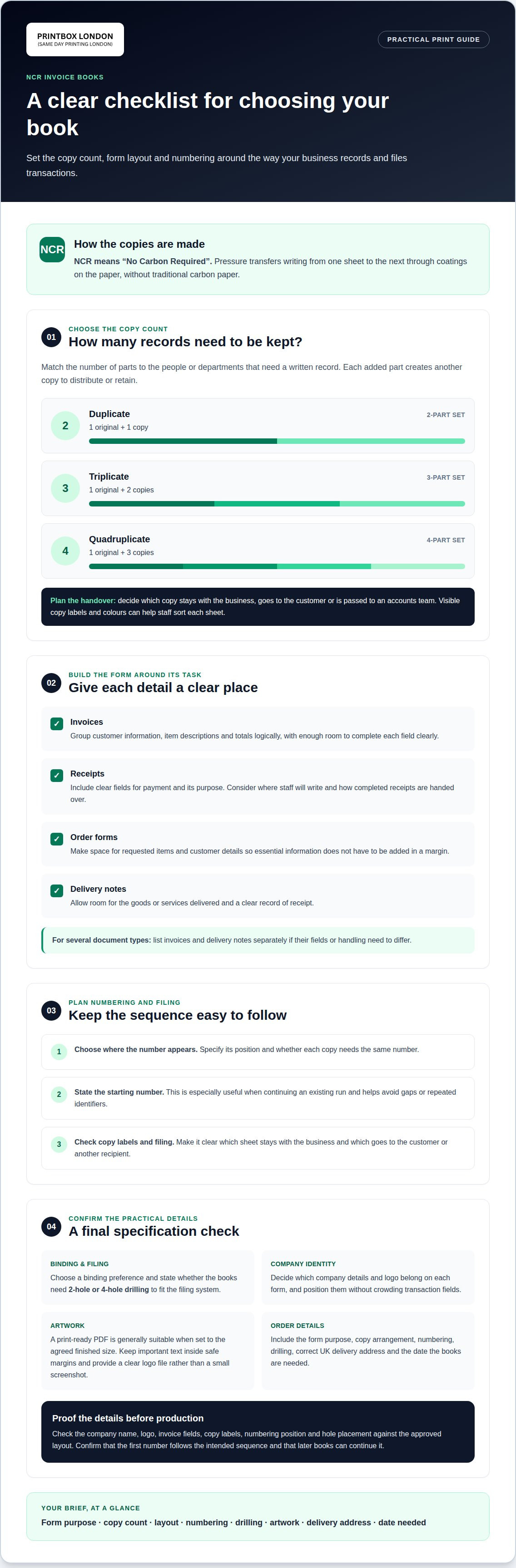
A useful invoice layout gives the required company details and transaction fields, such as customer information, items and totals, enough space to be completed clearly. Group the fields in a logical order so the information is easy to follow. The layout can be tailored to your form, but the design itself does not establish whether an invoice meets every legal or accounting requirement.
A bespoke layout can include a supplied company logo and sequential numbering. Specify where the logo and number should appear, and whether each copy needs the same number. Consecutive identifiers help businesses file invoices or delivery notes in order. State the starting number in your brief, especially if continuing an existing run, to help avoid gaps or repeated identifiers.
Drilling is another specification to plan around. NCR books can be produced with 2-hole or 4-hole drilling, which affects how forms fit a filing system. State the hole arrangement and intended use in the job details. For UK delivery, provide the correct delivery address and the date the books are needed. That lets the production schedule and numbering plan be considered together, particularly when the forms must continue an existing sequence.
Design the form around its task, not just the company branding. For an invoice, group customer details, item descriptions and totals logically. For delivery notes, leave room for the goods or services delivered and a clear record of receipt. Keep copy labels visible so staff can distinguish which sheet stays with the business and which goes to the customer. This makes carbonless copies easier to use and file.
For artwork, a print-ready PDF is generally suitable when it uses the agreed finished size and keeps important text inside safe margins. Supply a clear logo file rather than a small screenshot, and check that names, contact details and form labels are legible. If numbering is part of the design, show its position clearly and provide the requested starting number in the order details. Printers can review the layout for practical issues before production.
Proofing is the final design step. Review the company name, logo, invoice fields, copy labels, numbering position and hole placement against the approved layout. Check that the first number follows the intended sequence and that later books can continue it. A simple specification list can keep the job clear: form purpose, layout, copy arrangement, numbering, drilling and UK delivery address. This gives the printer the information needed to prepare a consistent set of NCR forms.
Uses for invoice books, receipts, order forms and delivery notes
NCR books suit handwritten transactions that need matching records. The document type and number of copies determine which format fits. Invoices record sales, receipts acknowledge payments, order forms capture requests, and delivery notes document handovers. Matching the fields to each task helps staff complete paperwork consistently and gives the business useful records to file.
Consider how staff carry, write on and store each set. Think about where forms are completed and how copies will be separated and filed.
Duplicate, triplicate and quadruplicate books
A 2-part duplicate set produces an original and one copy. A 3-part triplicate set produces an original and two copies, whilst a 4-part quadruplicate set produces an original and three copies. Choose the format by deciding how many parties need a written record, such as the business, customer and accounts team. Each added part creates another copy to distribute or retain.
Plan the handover before selecting a format. A tradesperson might keep one delivery-note copy and leave another with the recipient. A business sharing transaction records with several departments may need more parts. Copy colours and labels can help staff identify each sheet and direct it to the right person. Match the copy count to your actual filing process.
Invoice books and receipt pads
Personalised invoice books and receipt pads can include business details and fields suited to each transaction. An invoice might need spaces for customer information, descriptions and totals; a receipt may focus on payment and its purpose. Clear labels help staff find the right field quickly. Leave enough room for the details normally recorded on each form.
For a portable receipt pad, consider where staff will write and how they handle completed forms. Check whether a pad suits the way staff complete and hand over receipts. Consistent fields across NCR sets also make recurring paperwork easier to review.
NCR books are used for more than invoices. An order form can record requested items and customer details, while a delivery note records what has been handed over. Service businesses can use receipts to acknowledge payments or completed work. Match each form’s fields to its task so staff do not have to add essential information in a margin.
Prepare a short specification listing each form’s purpose, copy count, layout and binding preference. List invoices and delivery notes separately if they need different fields or handling. This gives the printer a clear brief and helps organise the finished paperwork around your business process.
For a job involving several document types, discuss your NCR book requirements with the team and outline the forms you need.
Personalisation with company details and logos
Personalised NCR invoice books put your business identity directly on each form. A logo, trading name and contact details help recipients identify who issued the paperwork. Decide which details belong on every copy, then position them where they are easy to find without crowding the transaction fields.
Logo placement affects how quickly users recognise a form. Positioning it near the business name, for example, gives the top of an invoice a clear identity. Supply a clean logo file rather than relying on a small screenshot, which may lose detail when printed. A print-ready PDF can show the intended layout and finished size.
Keep contact details accurate and consistent across the book. Include the relevant business name, address, telephone number or email address, then check spelling and punctuation against the supplied artwork. A change to one detail can affect every printed form, so review the complete proof before approval. Keep essential customer and transaction fields distinct from the branding area.
Branding also involves colour, type and spacing. Use the logo’s established colours where they reproduce clearly, and choose text styles that remain legible on a handwritten form. Avoid placing decorative elements behind fields for dates, descriptions or totals. On a multi-part NCR layout, a consistent hierarchy across copies helps staff recognise the document and complete each set consistently.
Personalised layouts can reflect how orders move through a business. A supplier might place order references near customer details, while a service company may prioritise work descriptions and charges. Use field labels staff already understand. If a form has several copies, decide whether each needs the same branding and labels or a clear copy designation.
A quadruplicate form needs particular attention to space and clarity. Repeating a logo across copies can strengthen identification, but the design must leave practical room for handwritten entries. Keep labels aligned between sheets so information is easy to compare. Give the printer a clear brief describing the document’s purpose, fields, branding and copy arrangement.
Before printing, review the proof as a complete business record. Check the logo, company details, field order, spelling and legibility at the finished size. Make sure no important text sits too close to an edge or overlaps a writing area. These checks help make personalised invoice books recognisable, usable and consistent with the paperwork your team handles.
Uses including invoices, receipts and delivery notes
NCR sets support paperwork that needs a copy at the point of a transaction. An invoice records a sale, a receipt acknowledges payment, and a delivery note records goods handed over. The same carbonless process can capture an order before fulfilment. Matching each form to its task keeps fields relevant and helps staff complete records consistently.
For an invoice, a business might include customer details, item descriptions and totals. A receipt can focus on the payment and what it covers. A delivery note needs space to describe the items supplied and record handover. Perforated edges can help separate completed sheets cleanly, while a writing shield can protect the next set from pressure marks.
Production timing depends on the order’s quantity, specification, artwork readiness, finishing and current workload. Same-day printing is available for selected quantities and specifications, subject to these requirements and capacity. For an urgent job, provide the finished format, number of copies, artwork status and required date together. Clear details help production planning.
When preparing an NCR invoice book order, include the finished format, quantity and any finishing requirements in the brief. Allow time to check the layout before production, particularly if the forms include customer details, item descriptions or totals. A delivery note for a scheduled job, for example, should be ready before staff need to record the handover.
Set out the form requirements clearly when requesting a quote. Include the quantity, finished size, artwork status and any finishing details, such as perforated edges or a writing shield. If the forms need to be ready by a particular date, state this when discussing the order. These details help confirm the specification and available production schedule before you proceed.
Digital printing reproduces forms from supplied artwork, while the layout determines how each copy works in practice. A personalised invoice can include the company identity and fields already used by the accounts team. For receipts, clear payment labels help staff record the same information each time. Delivery notes benefit from distinct item and handover areas, so the recipient can follow what was supplied.
Before approving production, review a complete form layout at its finished size. Check that handwritten fields have enough room, labels match the business process, and perforated sections fall where sheets need separating. Confirm the required date in the order details. These steps help ensure the paperwork and production schedule suit the job.
Invoice book prices and specifications
Before ordering, settle the finished size, number of copies, quantity, colour, layout and numbering. These choices shape the specification and help produce forms suited to your workflow. A standard NCR invoice book contains 50 sets, equivalent to 100 sheets. Check whether that quantity of writing sets suits how often your business issues invoices.
Available sizes include A6, A5, A4, A3, DL and custom formats. Choose a size that gives each field enough writing room without making the book awkward to handle. An A6 form may suit brief entries, whilst a larger layout gives descriptions and totals more space. Confirm the finished dimensions match the intended document.
NCR paper colours include white, blue, green, pink and yellow. Colour can help staff distinguish copies, particularly when a transaction involves several recipients. Decide which sheet stays with the business and which goes to the customer or accounts team. The number of parts determines how many copies each written entry creates, without a separate carbon-paper sheet.
Pad quantities and book quantities can differ. NCR pads are available with 25 or 50 sets per pad, while standard books contain 50 sets. Check the unit in the specification before comparing orders. A set means the grouped sheets that create one completed form, not one individual sheet.
Settle sequential numbering before production. Give the starting number and indicate where it should appear. If continuing an existing run, state the next number clearly. Review the sequence against the approved layout so each identifier is easy to read and record.
For NCR invoice book printing in the UK, the price depends on the specification and is provided after a quote request. Quantity, finished size, number of parts, personalisation and finishing affect the cost. A bespoke A4, 3-part book has different production requirements from a standard A6 duplicate pad. Compare quotes using the same job details.
Before placing an order, check the form’s purpose, size, number of parts, sets per book, paper colours, logo, fields and numbering. Review the artwork at its intended size, including spelling, contact details and writing space. Include the delivery address and required date in the order details. A complete brief keeps the specification clear before production starts.
Printbox London (Same Day Printing London): Booklet Printing
Printbox London (Same Day Printing London) provides invoice book printing for businesses that need printed transaction forms. Set out the form’s purpose, copy arrangement, finished size, artwork and numbering requirements to create a clear specification. This helps align the printed book with how your team records invoices, receipts or orders.
For other multi-page documents, booklet printing and stapled booklets suit content arranged in pages rather than carbonless copy sets. These formats serve different purposes: choose invoice books for duplicated handwritten records and booklets for paged information.
If you’re ready to discuss your invoice book requirements, contact Printbox London (Same Day Printing London).
Put your invoice paperwork into a clear workflow
Plan how printed forms will fit into your business process beyond each transaction. Decide who updates the layout when contact details or procedures change, and how staff will identify the current version. Assigning responsibility for artwork helps prevent outdated forms from remaining in circulation.
For NCR invoice book printing in the UK, turn that plan into a concise production brief. Set out the form’s purpose, the artwork to use and any changes from your existing paperwork. This gives the printer a practical starting point for preparing the next run.
Printbox London (Same Day Printing London) provides invoice book printing and same-day printing, including posters and flyers. Same-day printing is available for selected quantities and specifications. If your business also needs printed materials for a deadline, include those requirements in your enquiry.
Bring your paperwork brief together and take the next step when you’re ready.
A clear brief helps plan NCR invoice book printing in the UK and move towards forms ready for business use.
Frequently Asked Questions
What is NCR paper?
NCR means “No Carbon Required”. It is paper designed to transfer handwriting onto following sheets without a separate carbon-paper sheet. Pressure on the top sheet triggers a reaction between coatings, creating copies beneath it. For example, writing an invoice by hand can produce a matching record for the customer. Copies are made as the form is written, so there is no separate copying step.
What is NCR invoice book printing and how does it work?
NCR invoice book printing produces grouped, multi-part forms for handwritten transactions. The sheets are arranged so writing on the top form transfers to the sheets below. This gives the business and recipient matching records from one entry. A printer prepares the agreed artwork and layout, including the fields needed for the transaction. The completed sets are then assembled as books or pads for use.
Which UK printers offer custom NCR invoice books?
Printbox London (Same Day Printing London) offers Invoice Book Printing, including personalised layouts for business paperwork. A useful brief describes the form’s purpose, required fields, number of copies, finished size and any branding or numbering. For example, a mobile service business may want customer and job details prominent, while an office may prioritise item descriptions and totals.
How much do NCR invoice books cost in the UK?
The price for invoice books depends on the specification and is provided after a quote request. Key cost factors include quantity, finished size, number of parts, personalisation and finishing. For a useful quote, describe whether you need invoices, receipts or another form, then provide the required quantity and layout details. This helps ensure the estimate reflects the product you intend to order.
What sizes, paper colours and copy sets are available for NCR invoice books?
Common size choices include A6, A5, A4, A3, DL and custom dimensions. Paper colours can include white, blue, green, pink and yellow. Copy formats include 2-part duplicate, 3-part triplicate and 4-part quadruplicate sets. Select the finished size based on the writing space needed, then choose the copy count according to how many people or departments need a record.
What delivery options and costs do UK NCR invoice book printers offer?
Delivery arrangements and costs depend on the printer and the order. Contact Printbox London (Same Day Printing London) to request verified information about delivery availability and costs for your invoice books. Include your postcode and required date when enquiring.
Article by
Printbox London Team
The Printbox London (Same Day Printing London) team provides practical printing guidance based on real customer requirements and day-to-day print production. We serve customers across Greater London from our Tottenham print shop, with same-day printing available for many products depending on quantity, specification, artwork and production capacity.