
Folding & Handling Large-Format Plans: Site Meeting Guide
Sep 25, 2026
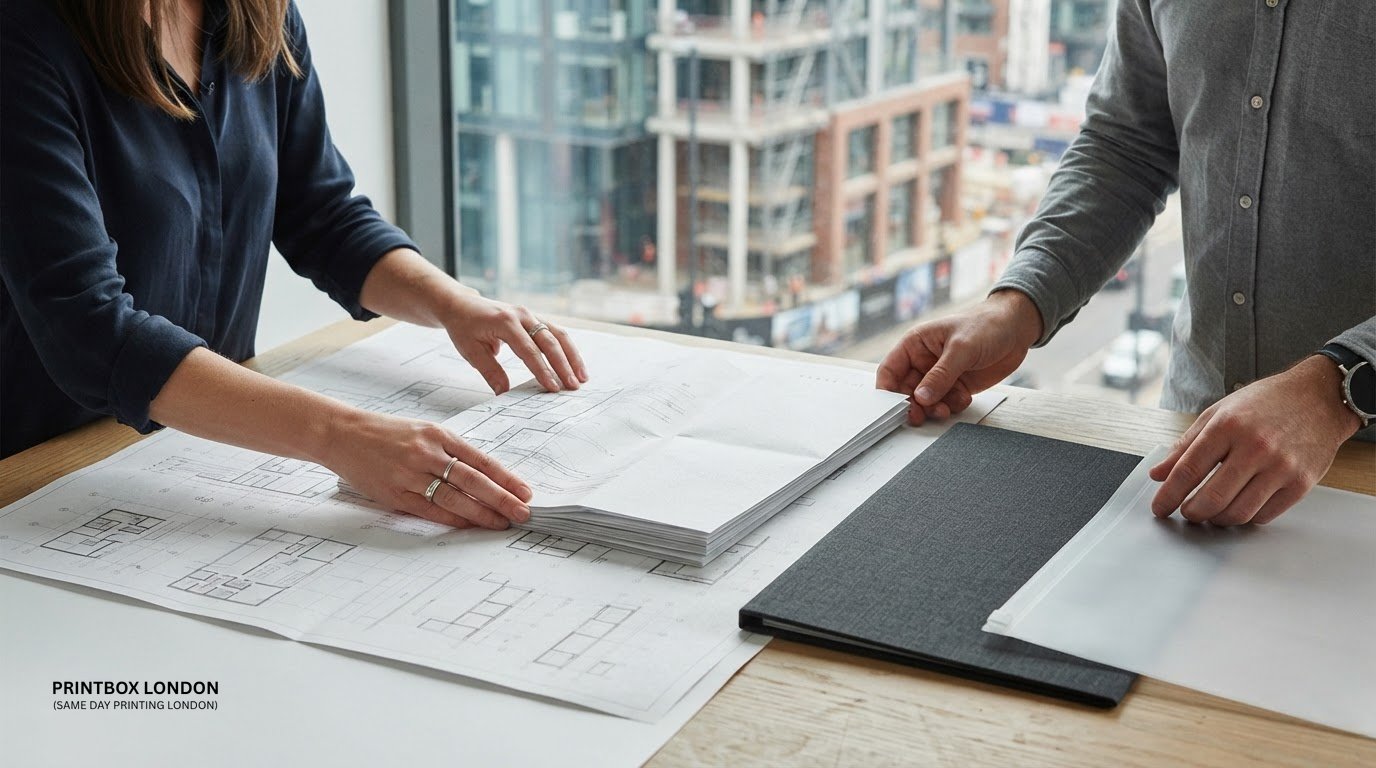
What’s the point of a clear A0 plan if it reaches the site creased, smudged or awkward to unfold? Large drawings can be easy to damage in transit, and carrying a loose sheet on the London Underground is no one’s idea of a smooth start to a meeting. Good folding/handling large-format plans starts with choosing a fold and carrier that suit the drawing and the journey.
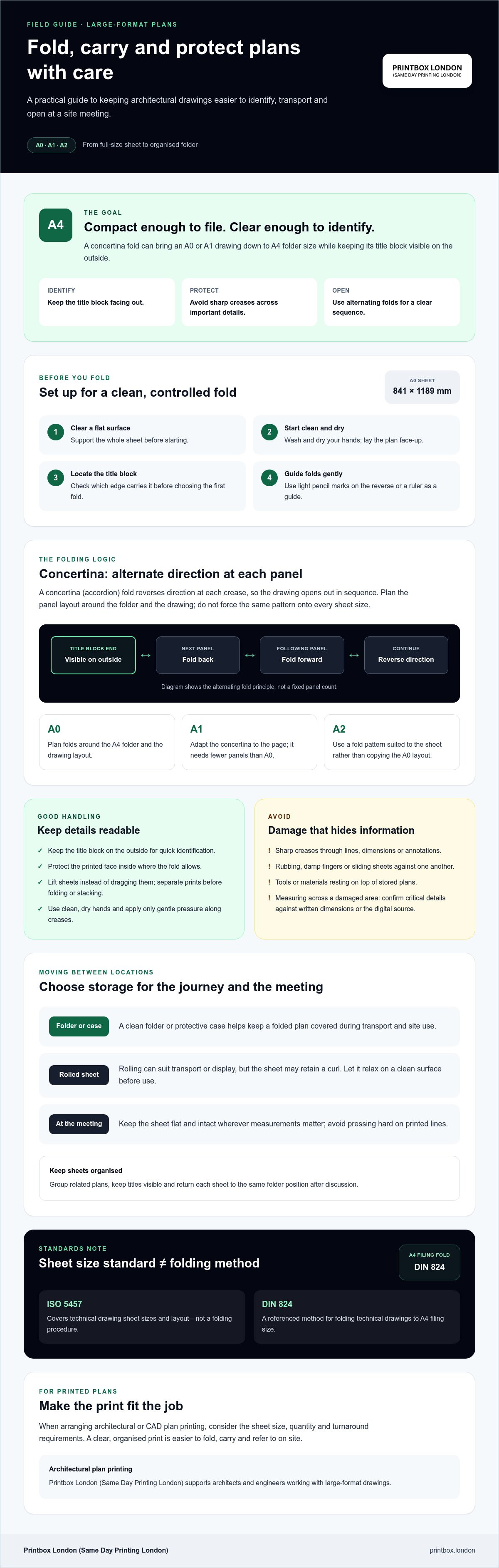
A considered concertina fold can bring an A0 or A1 drawing down to A4 folder size while keeping the title block visible, so you can identify the sheet without opening it fully. Fold carelessly, though, and notes or drawing details can end up hidden, rubbed or caught in a crease.
This guide explains how to fold plans for an A4 folder, protect them during transport and open them efficiently at a site meeting. You’ll also find practical ways to reduce tears and smudges, helping keep drawings readable through handling and site use.
Key Takeaways
- Learn how a concertina fold can bring A0 and A1 drawings down to A4 folder size while keeping the title block easy to identify.
- See how careful folding and handling can help keep drawing details clear and reduce the risk of creases, tears and smudges.
- Explore practical ways to protect plans during transport and site meetings, including when a folded sheet or rigid display board may suit the job.
- Get useful pointers for folding/handling large-format plans so they’re easier to carry, store and open when needed.
- Find out what to consider when ordering architectural or CAD plan printing, including size, quantity and turnaround requirements.
Why Correct Plan Handling is Essential for Site Success
A damaged drawing can interrupt a site discussion at exactly the wrong moment. If a key dimension is hidden by a crease, a corner has torn away or a mark has been rubbed off, the team may need to find another copy or check the original file before making a decision. That can interrupt an inspection and delay clarification.
Folding doesn’t change a plan’s printed scale by itself. The risk is that a sharp crease, tear or smudge can obscure a line, dimension or note. If someone tries to measure across a damaged area, the reading may be unreliable. Keep the printed drawing flat and intact wherever measurements matter, and use the written dimensions or digital source to confirm critical details.
Technical drawings rely on consistent symbols, line conventions and annotations to communicate design information. A useful overview of the general principles of technical drawings shows why small marks matter. On site, organised sheets make those details easier to find. Group related plans, keep titles visible and return each sheet to the same folder position after discussion.
A site-ready print is not simply a large office document. It needs to travel, open clearly and remain readable while people refer to it in a working environment. While professional hubs and serviced offices such as WorkCity provide clean, spacious tables to review blueprints comfortably, on-site conditions demand extra care. Choosing a suitable fold, keeping the sheet covered between uses and handling it with clean, dry hands can help protect the information. The right approach depends on whether the plan needs to be filed, carried between locations or displayed for a group.
The Risks of Improper Storage
Construction sites can expose paper to dust, damp surfaces and frequent handling. Store plans in a clean folder or protective case, away from wet areas, and avoid placing tools or materials on top. On busy developments where teams coordinate around machinery and site access support from providers such as rocketrentals.co.uk, keeping technical drawings shielded from dust and grit is essential. Rolling can suit transport or display, but a rolled sheet may retain a curl and resist lying flat during a meeting. Let it relax on a clean surface before use, and avoid pressing hard on printed lines.
High-resolution CAD and engineering prints can contain fine lines and compact notes. Rubbing, damp fingers or sliding one sheet against another can leave marks that make details harder to read. Lift sheets rather than dragging them, and separate prints before folding or stacking them.
Professionalism and Client Impressions
Neatly folded drawings are easier to identify, carry and open in sequence. A consistent fold also helps everyone locate the same title or area without repeatedly turning the sheet around. For plans that need printing, architectural plan printing from Printbox London (Same Day Printing London) supports architects and engineers working with large-format drawings.
Step-by-Step: Folding A0 and A1 Plans for A4 Filing
First, a standards clarification: ISO 5457 covers technical drawing sheet sizes and layout, not a folding procedure. DIN 824 is a referenced method for folding technical drawings to A4 filing size. The practical aim is to make the plan compact, keep its title block visible on the front and allow it to unfold in a clear sequence. The customary folding method for drawings offers a useful visual reference, though its examples may use different sheet formats.
Prepare a clean, flat surface large enough to support the whole sheet. Wash and dry your hands, then lay the plan face-up and check which edge carries the title block. Use light pencil marks on the reverse or a ruler to guide folds. A bone folder can help create a neat crease, but don’t press hard across printed details. A concertina, or accordion, fold alternates direction at each panel so the drawing opens out in sequence.
Folding A0 Plans for A4 Filing
An A0 sheet measures 841 × 1189 mm, so plan the folds around the A4 folder you intend to use. Start by making an A4-width panel at the title-block end, taking care that the title remains visible when the folded pack is closed.
Fold the remaining width into alternating panels, checking the title block will sit on the outside of the finished pack. Then make the horizontal fan fold, folding the sheet into sections from one end and reversing direction at each crease so it opens like an accordion. Arrange the panels to suit the folder’s height and the drawing layout. Avoid forcing a crease through important drawing information.
For the final fold, bring the panels together with the printed face protected inside where the fold allows. Keep the title block facing out for identification. Run a ruler or bone folder gently along each crease, and avoid sharp pressure over fine lines or annotations.
Managing A1 and A2 Drawing Sizes
A1 and A2 sheets need fewer panels than A0, so adapt the concertina to the page rather than copying the same fold pattern. For A1-size prints, check that the finished pack fits your folder and leave the title block visible. Open one panel at a time during a meeting to keep the rest of the drawing tidy. If comparing poster sizes, see this guide to A2 poster printing.
A2 site notices may be displayed rather than filed. Fold only if storage requires it, and choose creases that avoid headings, diagrams and key instructions. These steps make folding/handling large-format plans easier without specialised machinery. For a plan that needs printing, Printbox London (Same Day Printing London) provides architectural and CAD plan printing. Same-day printing is available for selected quantities and specifications.
Protecting Large-Format Prints in Challenging Environments
Match the finish to the plan’s intended use. A drawing carried to one meeting has different needs from a reference sheet that will be handled repeatedly in a workshop. Consider whether the print needs to fold, accept mark-ups or stay on display. A protective finish can change how a sheet is handled, so check its suitability for the intended use before ordering.
Lamination and Weather Exposure
Lamination can help protect a print’s surface from dirt and splashes, but it shouldn’t be treated as making a plan waterproof or suitable for every outdoor condition. A laminated sheet may also fold or accept annotations differently from an unlaminated print. Check which finish is suitable and available for your specific print. For A0 posters or plans, consider whether the laminated sheet will still fold and take annotations as needed.
A repeated-use A0 sewing pattern may also benefit from a protective finish, depending on how it will be marked and stored. Lamination can affect folding and writing on the pattern, so decide based on your workshop process rather than assuming it’s essential.
Rigid Displays for Site Offices
A mounted print stays flat for group viewing and can be useful for a site-office briefing. An A1 foam board, for example, can display a notice or reference drawing where a team can consult it. Foam board is intended for indoor use and is not waterproof. Check that the information is easy to read from the intended viewing position.
During transport, carry mounted prints upright and support the board so its edges and corners don’t catch on doorways or other items. Keep heavy objects off the face. For loose prints, avoid dragging sheets against each other, and remove dry dust gently with a clean, soft cloth or brush. Don’t scrub printed details or use liquid cleaner on paper.
Protection is part of planning how a drawing will be used after printing. Printbox London (Same Day Printing London) offers large-format plan printing, lamination and mounted poster printing. Confirm which finish is suitable for the print’s size and intended use.
Transporting Architectural Drawings Across London
Choose a carrier that suits the route and the drawing. A folded plan in an A4 folder is compact and easier to keep close on a busy commute. A portfolio keeps sheets flat but takes up more room. A plan tube protects a rolled drawing from some knocks, though the sheet may curl when you open it. Consider how crowded the journey is, whether you’ll need to refer to the plan en route and how much protection the last part of the trip requires.
Tube and Bus Travel Strategies
On a crowded train or bus, keep plans under your control and out of the way of doors and other passengers. If using the Tube, hold a plan tube securely rather than resting it somewhere it could roll or be pressed by bags. Don’t force an oversized portfolio into a packed space. During busier periods, allow room to manoeuvre and avoid placing drawings on the floor or beneath other luggage.
For a rainy walk between transport and site, put the folder or portfolio inside a waterproof outer bag. A tube can shield a rolled sheet, but keep its ends protected from rain and don’t leave it somewhere damp. To reduce curling, avoid winding the plan too tightly. On arrival, unroll it on a clean, flat surface and give it time to relax before the meeting.
If you’re carrying several sheets, label the outside of each folder and arrange plans in the order you’ll use them. That way you can retrieve the right drawing without repeatedly opening and handling the whole set. Careful folding/handling large-format plans matters most when space is tight and the drawing will be needed immediately.
Collection and Urgent Print Planning
For urgent drawings, confirm the print specification and collection arrangements directly with Printbox London (Same Day Printing London). Same-day printing is available for selected quantities and specifications, so share the size, number of copies and required timing before setting off. Don’t assume a courier option is available or that a delivery time can be guaranteed. Check what can be arranged for your order.
Send a properly prepared PDF where possible, and check the page size and scale before submitting it. A file set to “fit” or “shrink” during printing can change the intended scale, so make clear if the drawing must print at a particular size. For more advice on preparing technical drawing files, use a guide from a source you trust. Printbox London (Same Day Printing London) provides architectural plan printing for architects and engineers.
Professional Plan Printing at Printbox London (Same Day Printing London)
A site drawing needs to arrive at the intended size, with notes and linework clear enough to read. Printbox London (Same Day Printing London) provides large-format architectural, CAD and engineering plan printing in A0, A1 and A2 formats. Based in Tottenham, the shop serves customers across Greater London, with same-day printing available for selected quantities and specifications.
Prepare Your Technical Drawing File
Before sending artwork, check the page size, orientation and intended print scale. PDF is the preferred format, but the file still needs checking. A setting such as “fit to page” can alter scale, and low-resolution content may not reproduce clearly at a large size. If the drawing must print at a particular scale, state this when enquiring and confirm the output settings.
For more detail on scale checks, refer to the guide Printing Technical Drawings to Scale. For plan printing options, see architectural plan printing from Printbox London (Same Day Printing London).
To request a quote, provide the sheet size, quantity, colour preference and required timing. Attach the artwork and flag any scale requirements or details that must remain legible. These details help the team assess the specification and confirm the available turnaround. Same-day availability depends on the order, including quantity and specification, so confirm timing before arranging your site meeting.
Plan Ahead for Collection
Printbox London (Same Day Printing London) is based at 52 West Green Road, South Tottenham. Before travelling, consider how you’ll carry the finished plans: a folded drawing can fit into a folder, while a sheet that needs to stay flat may need a suitable portfolio. Choose an option that protects the print and suits your journey.
For questions about a technical drawing or an urgent order, call Printbox London (Same Day Printing London) on 0207 018 5678. Share the artwork, size, quantity and deadline so the team can confirm the suitable specification and available turnaround.
Keep Your Plans Ready for the Next Site Meeting
Good folding/handling large-format plans starts with a clean, consistent fold that keeps the title block visible. Protect drawings in a suitable folder or portfolio, and choose a tube only when carrying a rolled plan suits the journey. On site, handle sheets carefully and keep them clear of dust and damp.
For new drawings, check the PDF’s page size and scale before printing, then share the required size, quantity and deadline. Printbox London (Same Day Printing London) provides architectural and CAD plan printing in large formats. Same-day printing is available for selected quantities and specifications.
Based at 52 West Green Road, South Tottenham, Printbox London (Same Day Printing London) serves professionals who need large-format plans for their work. Send the artwork and order details so the team can confirm the suitable specification and available turnaround.
Frequently Asked Questions
What is the standard ISO fold for an A0 plan?
There isn’t an ISO folding method: ISO 5457 covers drawing sheet sizes and layout, whilst DIN 824 describes a commonly used approach for folding technical drawings to A4 filing size. Lay the A0 sheet flat and use alternating concertina folds, arranging the panels so the title block is visible on the front. Fold gently and adapt the creases to avoid obscuring important notes or drawing details.
Can I fold an A1 plan to fit inside a standard A4 ring binder?
Yes. An A1 plan can be folded to A4 size for filing, with the title block positioned on the front for identification. Use alternating concertina folds and check the finished width and height against your folder before creasing the sheet. Avoid folding through dense notes or key details where possible. A consistent fold makes plans easier to file and retrieve during London site meetings.
Is it better to roll or fold architectural drawings for transport?
It depends on the journey and how quickly you need to consult the drawing. Folding/handling large-format plans into an A4 folder keeps them compact and can be practical on a crowded London commute. A portfolio helps keep a sheet flat but takes up more space; a tube protects a rolled plan but the paper may curl. Choose the option that protects the drawing and suits its next use.
How do I protect my plans from rain and mud on a construction site?
Keep plans inside a closed folder, portfolio or protective outer bag between uses, and don’t place them on wet or dusty surfaces. For the walk from transport to site, use a waterproof outer bag and keep the opening protected from rain. Handle sheets with clean, dry hands. If a plan gets dusty, lift away loose dirt with a clean, soft, dry cloth or brush rather than rubbing printed lines.
Does Printbox London (Same Day Printing London) offer same-day plan printing?
Yes. Same-day plan printing is available for selected quantities and specifications, with turnaround depending on the job and production requirements. Contact Printbox London (Same Day Printing London) to confirm availability before travelling to the Tottenham shop. The business serves customers across Greater London, including Central, North, East, South and West London, and Haringey, Hackney, Islington, Camden, Enfield, Barnet, Westminster, Newham, Redbridge and Waltham Forest.
What file format should I use for large-format technical drawings?
PDF is the preferred format for large-format technical drawings. Check the page size, orientation and scale before sending it, and state any required print scale clearly. Printbox London (Same Day Printing London) also accepts JPG/JPEG, PNG, TIFF and ZIP files. For raster images, the target is 300 dpi at final size. Suitability can depend on the file and print specification.
Can you print sewing patterns on A0 paper in colour?
Yes. Printbox London (Same Day Printing London) offers A0 sewing pattern printing in colour. Before submitting your file, check that the page size and scale are correct, particularly if the pattern includes test squares or measurement marks. Send the final artwork and confirm the required size and colour specification when enquiring. Same-day availability depends on the order’s quantity and specification, so check the turnaround before making plans.
What are the dimensions of an A0 plan in millimetres?
An A0 sheet measures 841 × 1189 mm. This is the standard ISO A-series size, whether the sheet is used for an architectural plan, CAD drawing or poster. Check the orientation in your artwork before printing: the same dimensions can be arranged in portrait or landscape format. If the drawing must print to scale, make sure the PDF page size and print settings match the intended output.
Article by
Printbox London Team
The Printbox London (Same Day Printing London) team provides practical printing guidance based on real customer requirements and day-to-day print production. We serve customers across Greater London from our Tottenham print shop, with same-day printing available for many products depending on quantity, specification, artwork and production capacity.