Flyer and Leaflet Printing with Custom Design Uploads
Oct 24, 2026
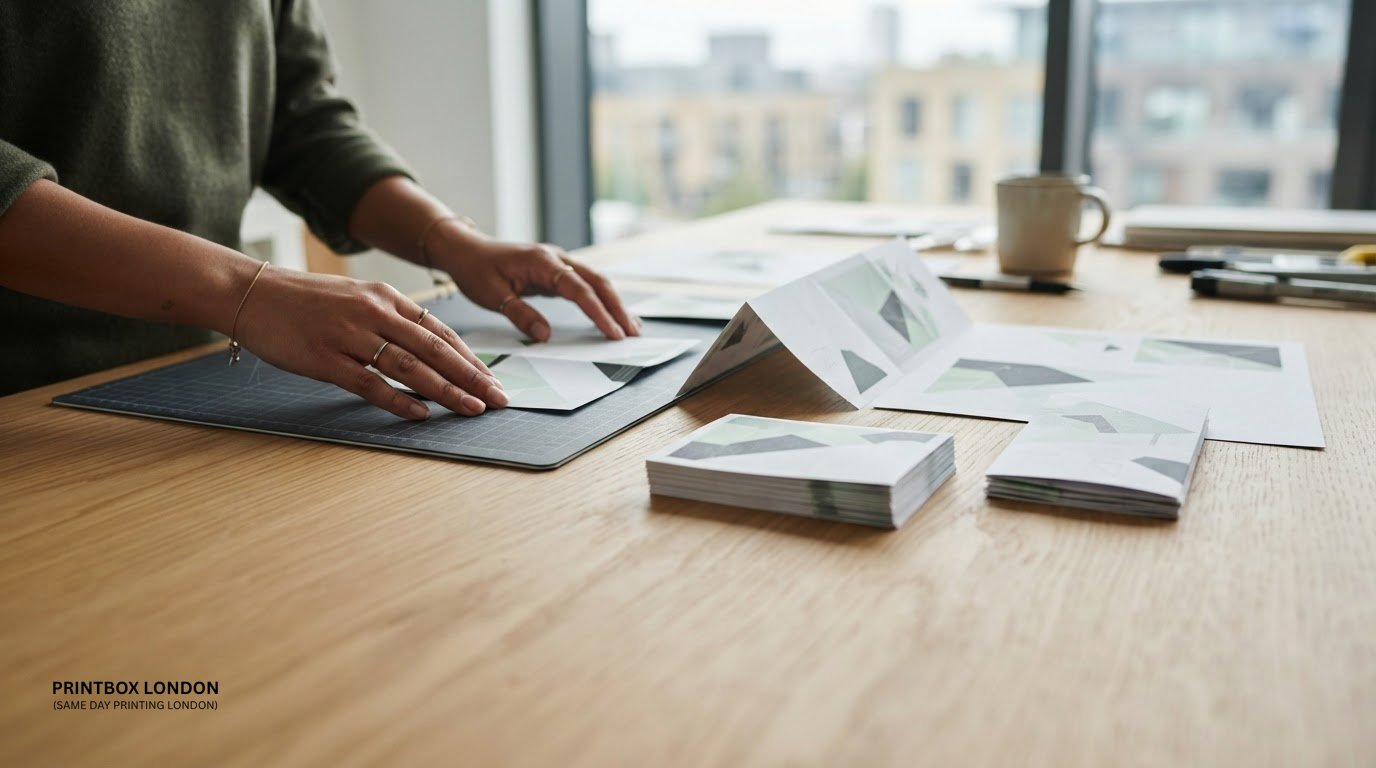
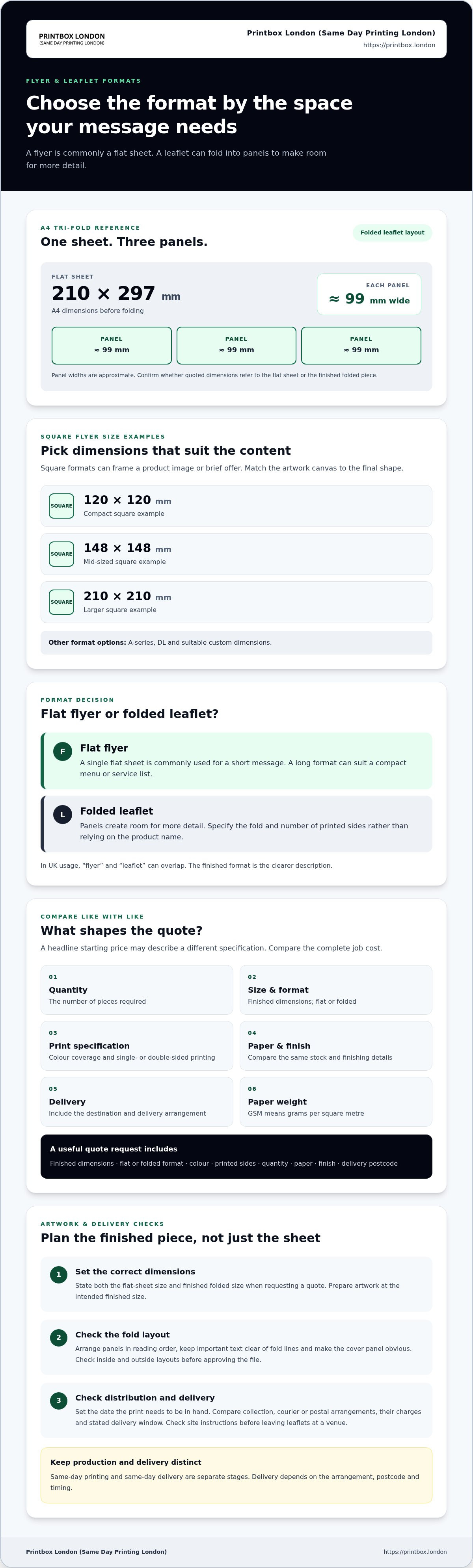
A flyer and a leaflet can begin as the same size sheet, but the finished format changes how much information they can carry. For flyer and leaflet printing, the key difference is usually the layout: a flyer is commonly a single flat sheet, while a leaflet may fold into panels for more detail. An A4 sheet measures 210 x 297 mm; when folded into three panels, each panel is around 99 mm wide.
Choosing between them isn’t just about what to call the print. The right format depends on how much information you need to share, how people will use it and how you’ll distribute or display it. Size, quantity and print specification also affect the quote, so compare like with like.
This guide explains the difference between flyers and leaflets, compares common and custom sizes, and outlines what affects pricing without relying on made-up price lists. You’ll also find practical guidance on delivery options and preparing a custom design file, including checks that help avoid problems when it goes to print.
Key Takeaways
- Choose a flat flyer for a short message or a folded leaflet when you need room for more detail.
- Check whether the listed dimensions describe the sheet before folding or the finished folded format.
- Compare quotes using the same size, quantity and print specification, as these details affect the price.
- Prepare your artwork at the intended finished size and check image quality, bleed and safe margins before uploading.
- Same-day printing is available for many jobs, with turnaround depending on the order’s quantity and specification.
Do the size options refer to folded or unfolded leaflets or flyers?
Check whether a size describes the flat sheet or the finished folded piece. An A4 sheet measures 210 x 297 mm before folding. An A4 tri-fold leaflet has three panels around 99 mm each, so its closed dimensions are smaller than the unfolded sheet. State both sizes when requesting a quote.
That distinction matters during layout. A design for a flat sheet won’t automatically arrange itself correctly as a folded leaflet. Set the panels in reading order, keep important text clear of fold lines and make the cover panel obvious. For an A4 tri-fold, check the outside and inside layouts before approving the file.
Flyers can use A-series, DL, square and suitable custom dimensions. Square examples include 120 mm x 120 mm, 148 mm x 148 mm and 210 mm x 210 mm. A square format can frame a product image or brief offer, while a long format can suit a compact menu or service list. Match the canvas to the final shape.
Flyers and leaflets are often names for similar printed pieces. A flyer usually means a flat sheet with a short message; a leaflet often includes more detail or folds into panels. In UK usage, the terms overlap, so specify the finished format, fold and number of printed sides rather than relying on the product name.
There’s no single cheapest UK printer for every specification. Compare quotes for the same quantity, size, colour coverage, sides, paper and finishing. A starting price may describe a different product, so request a total for your exact requirements instead of choosing by headline cost alone.
Choose paper and finish to suit the job. A lightweight sheet can be easier to distribute, while a heavier stock can feel more substantial. GSM means grams per square metre and describes paper weight. Compare available weights and finishes against your design, how the piece will be handled and your budget.
Digital printing transfers artwork directly from a file and can suit shorter runs or changing designs. Litho printing uses plates and can suit larger, consistent runs. The suitable method depends on quantity, artwork and finishing. Leaflets are printed using professional print equipment; the exact production setup varies with the job.
For distribution in the UK, plan where and how you’ll hand out the material. Public spaces, private venues and business premises may have different site arrangements. Check the relevant site instructions before leaving leaflets there, and make sure your distribution method suits the venue and campaign.
Recycled paper is an option to include when comparing specifications. Check that each quote describes the same recycled stock, format and finish, as these can affect the finished look and feel. This makes it easier to weigh the material against the purpose of your print run.
Flyers can be printed in A-series, DL, square or custom dimensions; square examples include 120 mm, 148 mm and 210 mm. Paper can be lightweight for easy distribution or heavier for a more substantial feel, with the available weights and finishes compared against the design and intended use.
Flyer pricing and delivery options
Compare the full job cost, not just the price per printed sheet. Quantity, format, printed sides, paper, finish and delivery all affect the quote.
Decide how the flyers will reach their audience before choosing collection or delivery. Collection, courier and postal options can each affect the overall cost and schedule.
Flyer pricing and delivery charges
The quote depends on quantity, size, material and finishing. Ask for printing and delivery costs to be shown separately, so you can compare the complete amount in pounds rather than a headline starting price.
For a useful comparison, give each printer the same details: finished dimensions, flat or folded format, colour, single- or double-sided printing, quantity and delivery postcode. As commercial print specialists such as Linemark point out, setting out clear specifications from the start ensures a reliable estimate, as adding a fold or changing the quantity can alter production requirements and the total.
Include the destination and delivery arrangement in your budget. Delivery can depend on parcel size, weight and postcode. If the flyers accompany a takeaway menu or voucher campaign, include the quantities and delivery needs for both in your quote request.
Same-day and next-day delivery
Same-day printing and same-day delivery are separate stages. Printing may be completed on the day, while delivery depends on the arrangement, postcode and timing. For an urgent London campaign, give Printbox London (Same Day Printing London) your deadline and address before approving production.
Next-day delivery describes a delivery service, not same-day printing. Check the stated dispatch and arrival dates, order cut-off and destination coverage. A print-ready file and clear specification can help avoid delays caused by artwork changes or unanswered production questions.
Collection can remove the courier leg, but it requires arranging collection and transporting the finished order yourself. Courier delivery brings the print to the supplied address; provide a complete postcode, recipient name and access details to reduce handover problems. For UK delivery, compare the stated service, charge and delivery window together. A “next-day” option should clearly identify when the clock starts, such as after artwork approval or dispatch.
Before placing an order, follow these steps:
- Set the in-hand date, not just the date printing should finish.
- Share quantity, size, finish and delivery postcode together.
- Choose collection or delivery and check the quoted charge.
- Allow time for artwork approval and production before distribution.
For a time-sensitive campaign, send the print specification, artwork status and required arrival date in one printing enquiry. That gives the quote request the details needed to assess production and delivery together.
Uploading custom designs and accepted file formats
Custom artwork can be prepared for a flat flyer, folded leaflet or suitable square or long format. Set the document to the finished dimensions first, then check that its orientation and layout match the intended print. Artwork designed for a different shape may need repositioning, rather than simple resizing, to keep text and images balanced.
Accepted artwork formats include PDF, JPEG, PNG and TIFF. You can also supply ZIP files or files shared through Google Drive, Dropbox or WeTransfer. Choose a format that preserves image quality, and make sure shared files open without extra passwords or missing linked artwork.
Before uploading, run through these checks:
- Confirm the document’s finished size and orientation.
- Check that every side or panel appears in the correct order.
- Keep logos, names and contact details clear of trim and fold lines.
- Use 300 dpi for raster images at their final print size.
- Set colour to CMYK and include suitable bleed where the artwork reaches the edge.
A raster image is made from pixels, so enlarging a small image can make it look soft or blocky. Check photographs and logos at their intended print size, not just on screen. A vector logo stays sharp when resized, which can help when adapting a design to another format.
Custom square designs are available in 120 mm x 120 mm, 148 mm x 148 mm and 210 mm x 210 mm dimensions. Long formats such as DL suit narrow layouts, while A6 and A7 can work for brief messages. Match the canvas to the chosen finished format before arranging headlines, images and contact details.
For a folded leaflet, treat each panel as a separate reading area. Set up the flat artwork with the cover, inside panels and back in their intended positions. Keep headlines and small text clear of fold lines. For a multi-panel design, export and inspect the complete file to make sure the reading order works when folded.
Bleed is artwork extending beyond the final trim edge; 3 mm is a common allowance, but it isn’t universal for every product. Use the supplied print requirements for the job rather than applying one setting automatically. Crop marks can help identify the intended trim, but include them only when the file setup calls for them.
For flyer and leaflet printing, check the exported file before sending it. Confirm that fonts display correctly, content hasn’t shifted and images remain clear. A correctly prepared print-ready PDF is generally suitable; an appropriate Canva export can also be used.
Design tips for effective flyers and leaflets
Give each design one clear job: attract attention, explain an offer or prompt an action. For a running event, put the date and location before supporting details.
Design templates and artwork uploads
An online template can speed up a first draft, but adapt its layout to your message. Replace sample wording, images and contact details, then check every panel or side. For example, an A5 promotion should still read clearly when held at arm’s length. Use a template built for the intended format, not one that needs awkward stretching.
Review the design at its final size before submitting it. Check that headings stand out, small print is readable and important content isn’t too close to an edge. A print-ready PDF or suitable Canva file can carry custom artwork. Inspect the exported file rather than relying only on the editor preview.
Design support and customisation
Decide whether you need help creating a layout or only preparing existing artwork for print. A clear brief should state the audience, offer, format and desired action. For example, a restaurant handout might promote a lunch deal and show opening hours, while an event flyer needs the date and venue.
Customisation can include changes to wording, image placement, colours and panel order. Keep brand colours consistent across the headline and logo, and check contrast against the background. When adapting an earlier design, replace outdated dates and contact details before approval.
For advertising, make the main benefit visible first. Use one headline, one supporting message and one call to action, such as “Book a place” or “Visit this weekend”. Readers should understand the offer without searching through a paragraph. Keep secondary information, such as terms or directions, separate from the main message.
Event and promotional designs need details people can act on. A market handout could group the event name, date, address and entry information. A discount flyer should state the offer and any relevant conditions clearly. For a folded leaflet, use the cover to introduce the subject and arrange the remaining details in a logical reading order.
- Choose one focal image that supports the offer, not several competing pictures.
- Use headings to divide details, such as dates, location and booking instructions.
- Keep logos and contact details consistent across matching campaign materials.
- Ask someone unfamiliar with the event to scan the proof and identify the key action.
Before approving the final proof, compare the artwork with your brief line by line. Confirm names, dates, spelling, prices and contact details, then check that the design works as a printed handout, not just on screen.
Leaflet and flyer prices
A useful quote helps you judge the whole job, not just the cost of printing each sheet. For flyer and leaflet printing, compare the final amount with the finished quantity and check what the quote includes. A lower total may describe a different job, so review the details before comparing figures.
Start with how the print will be used. A shop handout may need fewer copies than a campaign distributed across several locations. Estimate how many you can realistically use, then request a quote for that quantity. This helps prevent unused stock becoming a hidden cost after the campaign.
Ask for a clear breakdown of production and fulfilment. Depending on the job, the quote may separate printing, finishing and delivery. Check whether it covers the complete order and whether collection or delivery is included. If an item is optional, compare the total with and without it.
- Record the quantity and finished product being priced.
- Note the requested colour coverage and number of printed sides.
- Write down any folding or other finishing requirement.
- Compare the paper specification and delivery arrangement.
- Record any exclusions or changes from your original brief.
Paper choice affects the overall specification. If recycled paper matters to your campaign, request the same stock in each quote. Compare the same colour requirements too. Artwork with large solid areas or detailed photography may differ from a mostly text-based design, so describe the actual file rather than calling it simply “full colour”.
Include finishing only when it serves a clear purpose. A fold can organise information into sections, while a flat sheet may suit a single offer. Choose finishing that supports how recipients will use the piece. The quote should describe the finished item, helping you spot a mismatch before approving production.
The quote depends on the project. Quantity, size, material and finishing all affect the amount. If you change the specification after receiving a quote, ask for a revised total and compare it with the original. This shows which change affected the cost and keeps the decision focused on your campaign’s needs.
Before ordering, compare the quote with your brief and intended use. Confirm the finished quantity, delivery arrangement and any included finishing. This final check helps you choose a suitable specification without relying on an incomplete starting figure.
Printbox London (Same Day Printing London): Same Day Printing
Printbox London (Same Day Printing London) provides Same Day Flyer Printing for urgent campaigns, event handouts and promotional materials. Same-day printing is available for selected quantities and specifications. Turnaround depends on factors such as flyer size, paper, finishing, artwork readiness and production capacity.
Send the finished dimensions, quantity, artwork and required date together. These details help establish a suitable production plan. Same Day Poster Printing and Same Day Business Card Printing are also available when you’re coordinating several printed materials for an event or campaign.
For urgent or larger orders, contact Printbox London (Same Day Printing London) to discuss your requirements. You can also visit printbox.london.
Make your next campaign easier to act on
Give your printed campaign one clear purpose before finalising the artwork. Decide what you want people to do after reading, then make that action easy to spot and follow. For example, a booking-focused promotion should direct readers to the booking step instead of splitting attention across unrelated messages.
That decision can guide the design, wording and print specification. It also gives you a practical way to judge whether the finished piece works for its audience. For flyer and leaflet printing, a clear brief helps move an idea towards a print-ready job without losing sight of the campaign’s aim.
When you’re ready to discuss your requirements, contact Printbox London (Same Day Printing London) with your artwork and project details.
Take the next step with a focused message and artwork ready for print.
Frequently Asked Questions
What is the difference between flyers and leaflets?
A flyer is usually a single sheet for a short, direct message, while a leaflet often carries more detail and may be folded. The terms are also used interchangeably, so the product name alone doesn’t define the finished format. For example, a café could use a flat handout for a one-day offer and a folded leaflet for a menu with several sections.
Do I need to fold the leaflets or flyers myself?
Not if you order the finished piece folded. State the required fold and prepare artwork with the panels in the correct sequence. A flat flyer needs no folding. If you’re distributing a large quantity yourself, receiving folded leaflets can save handling time. For display or direct mail, consider whether flat or folded sheets better suit the intended use, as direct mail specialists like We Mail America note that format can significantly influence response rates.
How much is delivery?
Delivery cost depends on the destination and the order’s size and weight, so one charge won’t apply to every job. Include the full postcode and delivery preference when requesting a quote, and compare the delivery charge with the print cost. A small local parcel and a larger consignment sent elsewhere in the UK may need different arrangements.
What machines are leaflets printed on?
Leaflets are produced using professional digital printing equipment. The suitable production setup depends on quantity, format, artwork and finish. A short run of event information and a larger promotional order can have different production requirements. You don’t need to choose the equipment: provide the finished size, quantity, colour requirements and whether the leaflet needs folding.
What is the difference between flyers and leaflets in the UK?
In the UK, there’s no fixed distinction between the two names. A business might call a single-sheet event announcement a flyer and a folded information sheet a leaflet, but usage varies. Focus on the specification: say whether you need a flat or folded piece, how much information it carries and how readers will use it.
How do I prepare artwork and print-ready files for flyers?
Export a print-ready PDF where possible, then check the final-size artwork before sending it. Include fonts and images correctly, keep essential text away from trim edges and ensure image resolution suits the finished size. Printbox London (Same Day Printing London) also accepts JPG/JPEG, PNG, TIFF and ZIP files. Raster images should target 300 dpi at final size, with CMYK colour and suitable bleed where relevant.
What are the standard flyer and leaflet printing turnaround times?
Same-day printing is offered for most orders placed by noon, with timing dependent on the job’s requirements and production capacity. Quantity, artwork readiness, stock and finishing can affect turnaround, so a folded order or a larger run may need a different schedule from a straightforward flat flyer. Provide your required date with the specification when arranging the order.
How does delivery work for flyer printing across the UK?
Collection is available from the Tottenham shop, and same-day local courier delivery across London may be available depending on postcode, job size, completion time and courier availability. UK-wide delivery is offered for selected products. For a flyer order, provide the full delivery postcode and required date so the appropriate delivery arrangement can be included in the order details.
Article by
Printbox London Team
The Printbox London (Same Day Printing London) team provides practical printing guidance based on real customer requirements and day-to-day print production. We serve customers across Greater London from our Tottenham print shop, with same-day printing available for many products depending on quantity, specification, artwork and production capacity.