
Fast book printing in London: prices and express turnaround
Nov 04, 2026
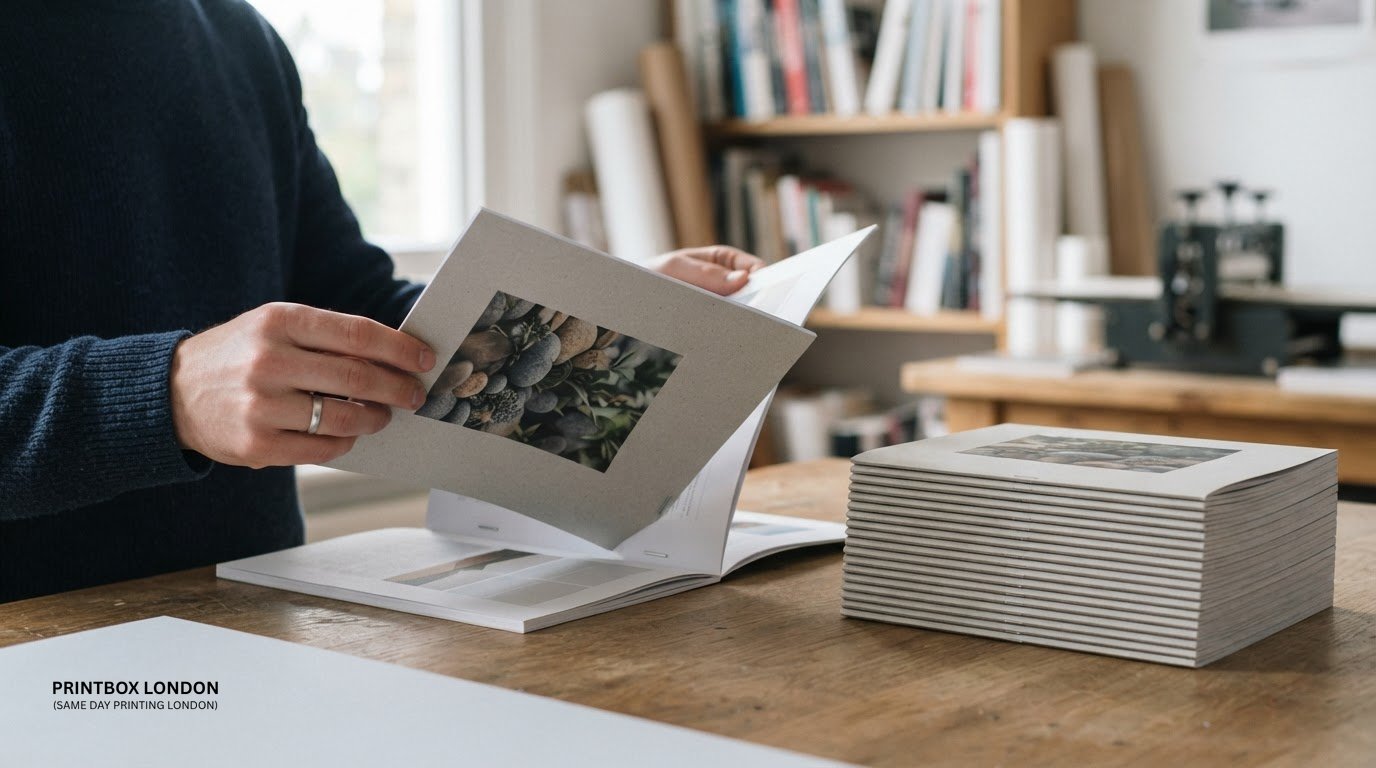
For fast book printing in London, stapled and wire-bound books are quicker options than hardback binding, and same-day production can be available for suitable orders. Turnaround depends on the quantity, specification and finishing required.
A tight deadline doesn’t mean every format is suitable for your book. The binding method, page count and artwork readiness all affect how quickly production can begin.
This guide explains which formats are suited to an express turnaround, what affects the price, and what to prepare when requesting a quote. You’ll also find practical file-preparation tips to help avoid delays and get a clear answer on the fastest suitable option for your project.
Key Takeaways
- Binding choice affects turnaround: stapled or wire-bound formats can be quicker to produce than hardback books.
- Prepare your finished page count, book size, quantity and print-ready artwork to help get a useful quote.
- Price depends on the job’s specifications, including quantity, format and finishing.
- Minimum order quantities vary by binding type, so check that your planned print run suits the format.
- Plan around opening days: Printbox London (Same Day Printing London) is closed on Sundays, and urgent turnaround depends on the order details.
Express printing turnaround options
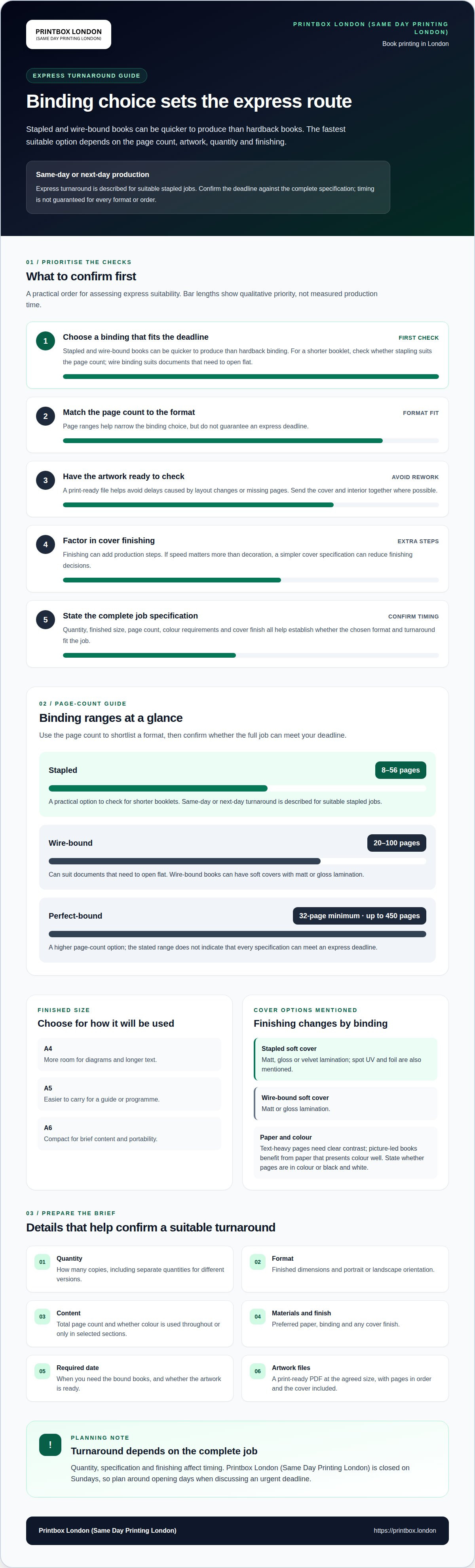
Express book production depends on the format, page count, artwork and finishing. London booklet printers offer urgent stapled jobs with same-day or next-day turnaround. That makes stapling a practical option for short publications such as event programmes, sample chapters or compact guides. A print-ready file also helps avoid delays caused by layout changes or missing pages.
Page count can help narrow the binding choice. Stapled books are available from 8 to 56 pages, while wire-bound books range from 20 to 100 pages. Perfect-bound books can reach 450 pages, with a minimum of 32 pages. These are format ranges, not a promise that every specification can meet an express deadline. For a shorter booklet, check whether its page count suits stapling before choosing cover finishes.
Book size shapes how readers use the finished piece. A4 gives diagrams and longer text more room, while A5 is easier to carry for a guide or programme. A6 suits compact handouts where brief content and portability matter. Tell the printer the finished size, page count and quantity together. Those details help establish whether the chosen binding and turnaround fit the job.
Paper choice affects a publication’s feel and readability. Text-heavy pages need clear contrast, while picture-led books benefit from paper that presents colour well. A separate cover can make a book feel more substantial. State whether the pages are in colour or black and white, and flag any images that need particular attention. These details help assess the specification accurately.
Cover finishes can add production steps, so include them when discussing deadlines. Stapled books can have soft covers with matt, gloss or velvet lamination. Spot UV and foil are further embellishment options for stapled covers. Wire-bound books can also have soft covers, with matt or gloss lamination. If speed matters more than decoration, a simpler cover specification can reduce the number of finishing decisions involved.
- Choose a binding suited to the page count, such as stapling for a shorter booklet or wire binding for a document that needs to open flat.
- Send the finished size, page count, quantity, colour requirements and cover finish together.
- Allow time for artwork checks; confirm page order, margins, images and cover layout before production begins.
Booklets and brochures work well for programmes, guides and compact publications. A clear finished size, page count and binding choice help match the format to the content. For an urgent job, describe the finished book and required date, and provide the cover and interior artwork together where possible.
Online price calculator and quotations
A book-printing quote depends on the full specification, not just the number of copies. Quantity, finished size, page count, colour, paper, binding and cover finish all affect production. When comparing options, keep the details consistent so you can see what changes between them.
An online calculator, if available, can estimate a job from the options selected. Treat the result as an estimate until the artwork and full specification have been reviewed. Unusual dimensions, mixed-colour pages or specialist finishing may require a quote based on the complete brief.
- Quantity: say how many copies you need, and whether you want separate quantities for different versions.
- Format: specify the finished dimensions and whether the pages are portrait or landscape.
- Content: provide the total page count, and note whether pages use colour throughout or only in selected sections.
- Materials and finish: describe the paper you have in mind, the binding, and any cover finish.
- Timing: give the date you need the bound books, and state whether the artwork is ready.
There is no single specification for quality paper. The right choice depends on the book’s purpose: a text-led reference guide has different needs from a picture-heavy portfolio. Include your preferred stock in the brief, or describe how the book will be used if you’re flexible.
Artwork affects both the estimate and the production plan. A print-ready PDF should match the agreed finished size and have pages in the correct order. Include the cover artwork with the interior pages, and flag colour sections or design elements that need particular attention. If the file needs layout changes, resolve them before settling the final specification.
For a useful comparison, request quotes with identical details, then change one option at a time. For example, compare the same quantity and page count with different binding or cover finishes. This makes each difference easier to assess. Don’t compare a basic specification with a more elaborate one as if they were equivalent.
Price depends on the project and is provided after a quote request; quantity, size, paper, colour, binding and finishing all affect it. To send the book details for a tailored quotation, use the contact form for print enquiries.
Which London printers offer fast book printing?
When choosing fast book printing in London, look for a printer whose services include finished booklets or brochures. General document printing does not necessarily include a bound publication: loose pages and a finished book are different products. Check that the service covers the binding and cover you need, and find out how to submit the artwork.
Understand what happens after you submit your files. A practical process should explain how artwork is reviewed, how questions or corrections are handled and when production can begin. If your book has a separate cover, illustrations or colour sections, describe these clearly. The words “express printing” alone do not explain how the job will be handled.
Be precise about what “fast” means for your project. The date you need to collect finished copies is different from the date you can approve artwork or place the order. Turnaround depends on the finished product and its requirements, not just the time needed to print pages. Keep your deadline and any approval steps clear.
Request a quote that describes the finished publication and the choices affecting its result. This gives you a basis for checking that the quoted job matches your intended book. If you need several versions, such as editions for different audiences, keep each version’s artwork and requirements separate.
- Match the service: make sure book or booklet production is explicitly included.
- Review the workflow: understand how artwork is submitted and how changes are resolved.
- Define the deadline: distinguish order approval from the date you need the finished copies.
- Keep versions clear: identify separate editions and provide the correct files for each one.
For a London project tied to a launch, course or event date, choose a printer that can discuss the complete finished item. The cover, interior and final presentation are all part of the job. The service should make it clear how book production differs from ordinary loose document printing.
Once you’ve identified a suitable book-printing service, prepare a concise brief and final artwork. This gives the production team a clear starting point and keeps decisions about the finished book together. Choose a printer whose stated process fits your publication, rather than relying on a generic speed claim.
What minimum order quantities do London book printers require?
There’s no minimum order requirement at Printbox London (Same Day Printing London), so you can request the quantity your project needs. This can suit a small presentation run, a draft for review or a limited event run. State the number of finished books you need, rather than estimating from the potential readership.
Give the quantity for each title or edition separately. If a project has two versions with different cover text, for example, list the copy count for each. This prevents distinct artwork from being treated as one identical run. Say whether each version has the same interior and cover, so the order details describe the finished books accurately.
Before requesting a quote, settle the quantity you need and identify any alternatives. You might request a quote for the planned run and a separate one for an additional group. Keep the specifications consistent. If the copy count changes after the job is agreed, the quote and production details may need updating.
For a small run, focus on the finished result rather than assuming a minimum order determines the format. Specify the book’s purpose, intended readers and how it will be used. A presentation copy, course handout and short-run publication may call for different choices. These details, alongside the quantity, help the printer prepare a suitable quote.
- Set the copy count: provide the number of finished books needed for each version.
- Separate editions: identify differences in titles, covers or interior content.
- Keep the brief consistent: use the same product details when requesting quotations for different quantities.
- Flag changes: tell the printer if the quantity or artwork changes before production.
A clear quantity is particularly useful when the deadline is urgent. It lets the printer assess the actual job rather than an open-ended estimate. Include the copy count, final artwork and required date, and identify any separate editions. This defines the scope and helps avoid confusion over how many copies belong to each version.
If you’re unsure how many copies to order, base your request on planned distribution and identify any separate audience groups. You can request a quote for your chosen quantity and, if useful, another run size. There’s no need to increase the order to meet a minimum; specify the quantity that suits your project.
Are there extra charges or deadlines for weekend and bank holiday printing in London?
Plan weekend and bank holiday deadlines around the date you need the finished books. Printbox London (Same Day Printing London) is closed on Sundays, so Sunday production is not available. For a Saturday or bank holiday deadline, account for the specific date, production requirements and artwork readiness.
There is no single surcharge that applies to every urgent book order. The price depends on the job and is provided after a quote request. Quantity, size, material, binding and finishing all affect the specification. Include your requested collection date and complete job details so the quote reflects your project.
Bank holidays can reduce the working days available before an event, launch or other deadline. Count back from the date you need the books, allowing time for artwork preparation, production and finishing. If you need a programme after a bank holiday weekend, plan ahead rather than assuming production can begin during the holiday.
Set out the deadline clearly. Distinguish when you need the books in hand from when you can approve artwork or place the order. A print-ready file can avoid extra design work, while late corrections may affect the schedule. Include the quantity, page count, finished size, binding and cover finish in your request.
- Give an exact date: state when the books are needed, including whether that falls on a Sunday or bank holiday.
- Send complete artwork: provide the interior and cover files, with pages arranged in order.
- Flag finishing: list lamination or embellishments as these add production steps.
- Plan around approval: allow time to review a proof or resolve file issues before production.
For a Saturday deadline, turnaround depends on the quantity, specification, artwork readiness and finishing. State the required date rather than treating “weekend printing” as a service with one fixed timetable. The same applies to a bank holiday: planning must account for the date and production stages.
If your event date is fixed, send the specification and artwork as early as possible. A clear brief helps the printer assess the schedule against the work involved. Decide on binding and cover details early, especially if the book needs finishing beyond the printed pages.
Printbox London (Same Day Printing London): Same Day Printing
Printbox London (Same Day Printing London) offers same-day printing for selected quantities and specifications. If your deadline also involves event materials, same-day poster, flyer and business card printing are available options.
For a same-day request, provide the product, quantity, finished size, artwork and deadline. A print-ready file helps keep the job moving, but turnaround depends on the order details. This information lets the team assess your urgent print job and advise on the next step.
For an urgent print job, contact Printbox London (Same Day Printing London) with your requirements.
Get your book project moving
Turn your idea into a clear production brief. Decide what the finished book needs to do for its readers, then settle the format and content before preparing the final file. For fast book printing in London, a concise brief keeps the discussion focused on your project and its requirements.
Include the quantity, finished size, page count, binding preference, cover finish and required date. If you’re choosing between options, explain what matters most, such as portability, pages that lie flat or a polished cover. Printbox London (Same Day Printing London) can respond to your requirements and advise on the next step.
A well-prepared brief gives your project a practical starting point. Bring your deadline and artwork together, and move ahead with confidence.
Frequently Asked Questions
What can you print same day in London?
Same-day printing in London includes products such as posters, flyers and business cards, depending on the order’s specification. Printbox London (Same Day Printing London) offers same-day printing for these products, with suitable quantities and requirements affecting the turnaround. For a book or booklet, include the format and binding in your enquiry. That helps distinguish a short stapled publication from a more involved book project.
What is the latest I can send my artwork?
Send your artwork and complete order details as early as possible. There is no single latest submission time for every book job, because production depends on the specification and artwork readiness. A print-ready PDF can help avoid delays, but the finished size, page order and cover file must match the agreed job. Allow time for any changes before production.
What are the turnaround times for urgent book printing in London?
Urgent stapled booklet printing in London is offered on a same-day or next-day basis by book-printing services. The actual schedule depends on the book’s quantity, binding, page count, artwork readiness and finishing. A short stapled booklet is a different production job from a hardback book. Give the printer your required date and complete specification, so the response relates to the publication you need rather than a generic turnaround estimate.
How much does same-day or next-day book printing cost in London?
The cost depends on the individual job and is provided after a quote request. Quantity, finished size, paper, page count, colour, binding and cover finishing all affect the specification. For a useful quote, provide those details together and state whether you need same-day or next-day production. If you’re comparing formats, ask for each option using the same quantity and artwork requirements, so the differences are clear.
What file formats and print-ready specifications do London printers require?
PDF is the preferred artwork format; JPG or JPEG, PNG, TIFF and ZIP files are also accepted. For raster images, prepare 300 dpi at final size and use CMYK colour. A common bleed allowance is 3 mm, but it isn’t universal for every product. For a book, check that the final file has the correct page order, finished dimensions and separate cover artwork where needed.
Can London printers provide same-day collection or local delivery?
Collection and courier delivery are available options for London print orders. Printbox London (Same Day Printing London) offers collection from its Tottenham shop once the order is confirmed ready. Same-day local courier delivery across London may be available, depending on postcode, job size, completion time and courier availability. Include your preferred option and postcode with the order details.
Which London book printers offer express printing for short runs or single copies?
Printbox London (Same Day Printing London) accepts any quantity, with no minimum order requirement. Its services include book printing and booklet production, making it relevant for a short run as well as a larger project. A single copy still needs a complete specification, including size, page count, binding and artwork. For an express request, include the deadline too, since production timing depends on the work involved.
What factors can delay an urgent book printing order?
Artwork changes, incomplete files, late decisions about binding or finishing, and a complex specification can all affect an urgent schedule. Missing pages or a cover file that does not match the book dimensions, for example, may need correction before production. Quantity, stock, workload and when the order is confirmed also matter. Send the final artwork and full requirements together to reduce avoidable back-and-forth.
Article by
Printbox London Team
The Printbox London (Same Day Printing London) team provides practical printing guidance based on real customer requirements and day-to-day print production. We serve customers across Greater London from our Tottenham print shop, with same-day printing available for many products depending on quantity, specification, artwork and production capacity.