
Face-to-Face Print Consultation: A London Guide
Oct 15, 2026
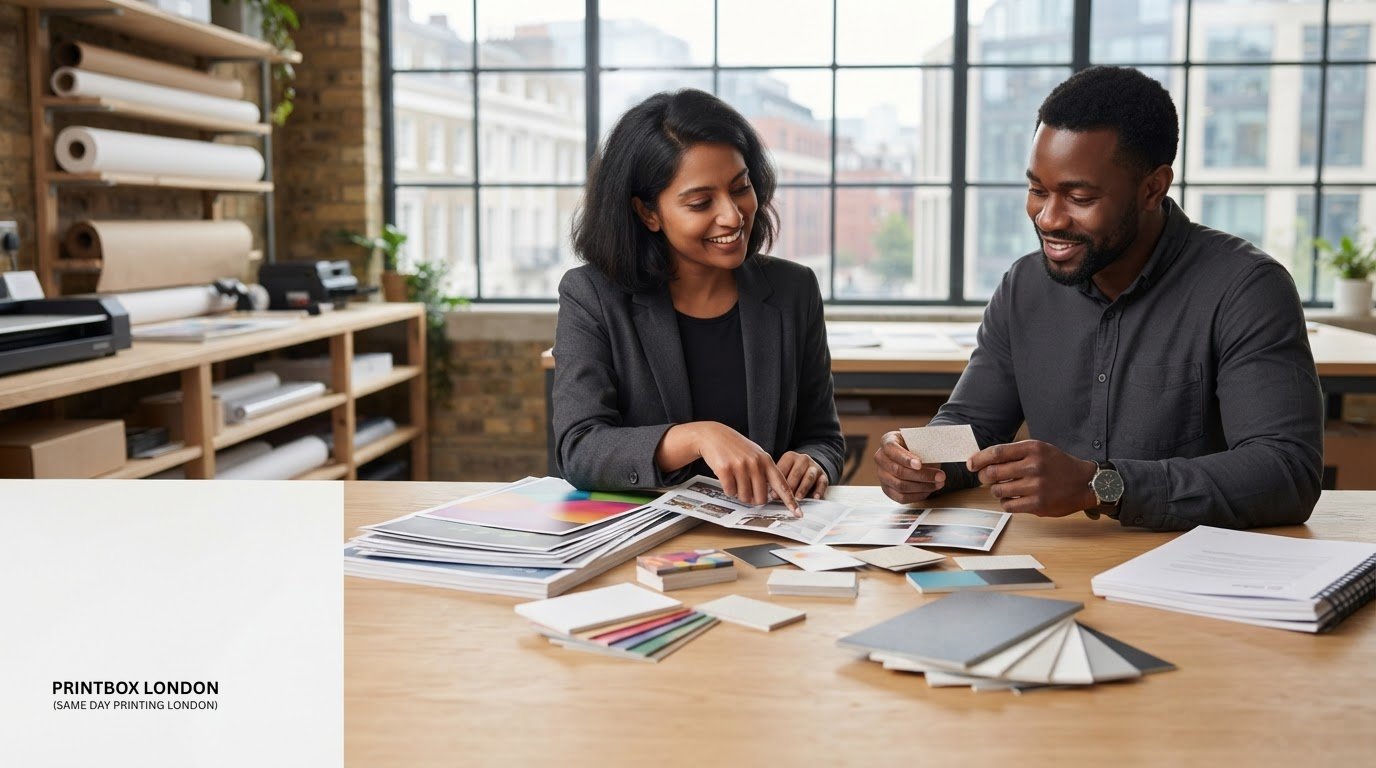
What if a short conversation could clear up the print decisions slowing your job down? Choosing a size, format or finish from a screen can be difficult when you’re unsure what will suit the final use. It can also be hard to explain a brief clearly when artwork is still being prepared or there are several versions to consider.
The advantage of face-to-face print consultation is the chance to explain your job in your own words and work through the details that are still open. Describe what the print needs to do, who it is for and what you already know. That gives the discussion a practical starting point and helps turn a broad idea into a brief with clear decisions, open questions and next steps.
This guide explains when an in-person conversation can help, how it compares with email or a phone call, and what to prepare. You’ll also find a practical checklist for discussing a print job with Printbox London (Same Day Printing London) in Tottenham.
Key Takeaways
- The advantage of face-to-face print consultation is that you can explain the job’s purpose and clarify requirements directly.
- Work through size, quantity, print sides, material and finishing as separate decisions before production.
- Choose the communication method that suits the task: discuss open choices in person, then use email to send exact details and artwork files.
- Prepare the product, finished size, quantity, deadline and collection or delivery preference to make the discussion more focused.
- Customers across Greater London can discuss posters, plans and documents at Printbox London (Same Day Printing London)’s Tottenham shop.
The advantage of face-to-face print consultation starts with a clearer brief
The advantage of face-to-face print consultation is that you can talk through a job before every production detail is settled. Explain what you need, and use the discussion to identify which details are clear and which still need a decision. The aim is a brief that reflects the actual job rather than assumptions.
Start with the print’s purpose. Is it meant to inform, promote, guide or record something? Who will use it, and where will they see it? Those answers give context to choices such as format and layout. They also help separate essential requirements from preferences. If wording or dimensions are fixed, say so. If you’re open to options, make that clear too.
What can an in-person print discussion clarify?
A conversation can turn broad descriptions into practical questions. “Make it easy to read” might mean adjusting the layout, choosing a suitable finished size or considering where the print will be viewed. You can also establish which specifications are already known, such as the quantity, and which are still undecided. That makes the brief more useful and easier to act on.
For example, if you need a document for a presentation, explain whether people will read it in their hands or refer to it on a shared display. That distinction gives the format discussion a clear purpose. If a business card design has details on both sides, mention that early so the intended layout is clear. Once the choices are made, record the agreed specification and check it against the final artwork.
Face-to-face communication can help when words alone don’t capture an idea. A sketch, gesture or reference can show what “more space around the title” means to you. For broader context, face-to-face interaction in human communication can include non-verbal cues alongside spoken words. A visual reference can support your explanation, but it should not replace the final print file.
When is a face-to-face conversation useful?
It’s particularly useful when you know what the print needs to do but aren’t sure how to describe the format, layout or intended use, or when several options seem suitable. It can also help when you’re working from a sample or visual reference and want to explain what you’d like to carry across. Bring what you have and point out what is still open. If the specification and final artwork are already settled, email may be all you need.
How speaking in person helps translate print ideas into specifications
A print idea becomes easier to plan when it is translated into details that can be recorded against the job. An in-person conversation helps you narrow the choices, distinguish preferences from requirements and identify what needs to be agreed before production. You’ll still need to review the artwork and confirm the final specification.
A useful brief answers a set of separate questions:
- Product and size: What are you printing, and what finished dimensions suit its intended use?
- Quantity: How many copies do you need?
- Print sides: Should the design appear on one side or both?
- Material: Do you have a material or thickness preference?
- Finishing: Is a process such as folding, binding, lamination or mounting needed?
Clarifying the product, size and intended use
Start with the viewing conditions. A poster people read close up has a different purpose from one they need to notice across a space. Describe the display area and viewing distance, then consider dimensions that suit the layout and use. Suitable poster sizes include A-series, B-series and custom dimensions, depending on the production requirements. Choose based on the job, not simply because a particular size is familiar.
The same approach applies to a banner. Explain where it will be displayed and which information needs to stand out. That context helps frame choices around format and layout without assuming one specification suits every job. Quantity is a separate detail, so include the number of copies even if other decisions are still open.
Making artwork and finishing easier to discuss
If you have a final print-ready PDF, use it as the reference for the job. Check that it reflects the agreed size and layout, and make clear which version is final, especially if you have made changes or have alternate files. A sample or visual reference can explain the direction you want, but it does not show that the supplied artwork is ready to print.
Finishing means a process applied after printing. Folding changes how a piece is presented, while lamination adds a protective layer. These choices affect how the finished item is used, so include them in the specification rather than treating them as decoration. For a card project, the intended layout and whether it prints on one or both sides are useful starting points.
To make the discussion actionable, label each point as agreed, undecided or dependent on the artwork. This helps prevent a preference from being mistaken for a confirmed instruction. If you’d like to share your requirements and deadline, you can also review Printbox London (Same Day Printing London)’s passport and ID photo service and passport, visa and ID photo options, or use the contact page.
Face-to-face print consultation versus email: which suits your job?
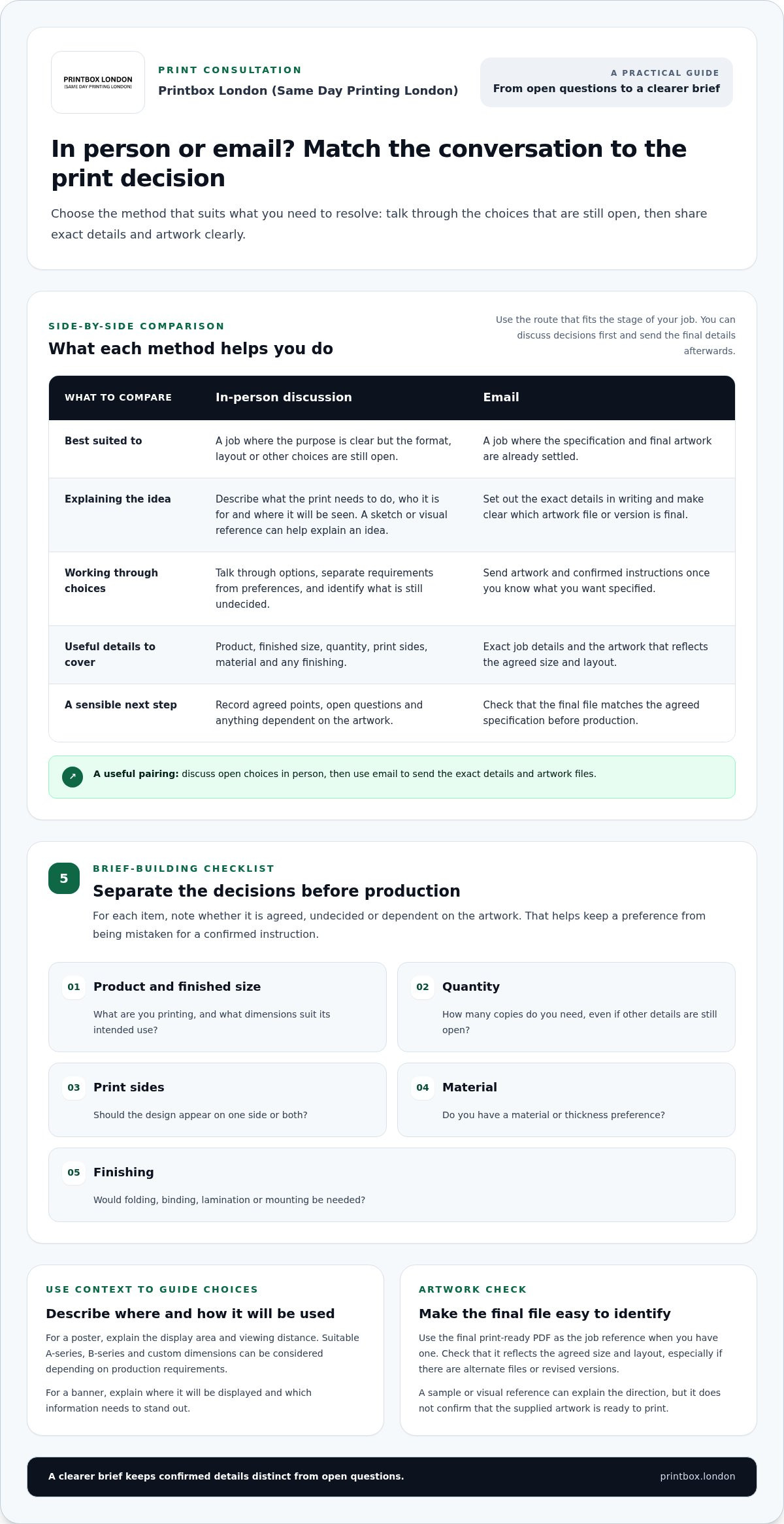
Choose the communication method that matches the question you need to resolve. An in-person discussion helps explain the context and talk through open choices. Email is useful for sending exact details and artwork. A phone conversation can help communicate a deadline or settle a straightforward question. These methods can work together: discuss what is unclear, then put the agreed details in writing.
| Method | Useful for | Keep in mind |
|---|---|---|
| In person | Explaining a project’s purpose, discussing undecided options and showing a visual reference. | Bring the details you already know, and identify which choices are still open. |
| Sending final artwork, exact quantities, written requirements and a deadline. | State the product and specification clearly so the message can be understood on its own. | |
| Phone | Raising a quick question or explaining a time-sensitive requirement. | Follow up important agreed details in writing so they’re easy to refer back to. |
When an in-person discussion may be the practical choice
Consider talking in person if several decisions depend on one another. For example, you may be weighing up a poster’s format and finishing but haven’t settled where it will be displayed. Explaining the setting gives the discussion a practical focus. A sample or visual reference can also help communicate a preference that’s difficult to describe in a message.
This is useful when you know what you want the print to do but don’t yet have the terminology for it. Explain the intended result, then work through the details that need to go into the brief. The advantage of face-to-face print consultation is the opportunity to clarify the context behind those details.
When email or a phone call can move things forward
If the specification is settled, email is a practical way to send the final artwork alongside the quantity, deadline and other order details. Keeping these facts together makes them easier to refer to than relying on memory after a conversation. Give the file a clear name and identify the final version if you’re sending more than one.
A phone call can help with a quick query or an urgent requirement. Follow it with an email containing the artwork and written specifications where useful. For a job with a tight deadline, share the required date early. Same-day printing is available for selected quantities and specifications, with turnaround depending on the order. To discuss your requirements with Printbox London (Same Day Printing London), use the contact options available.
Prepare for an in-person print consultation with this practical checklist
A little preparation helps you use the conversation well. You don’t need to know every print term or have every decision made. Bring the details you do know, mark anything undecided and explain the intended use. The advantage of face-to-face print consultation is easier to put into practice when you have a clear starting point and know what you need to resolve.
What details should you bring?
Note down the essentials before discussing the job. If a detail isn’t settled, say so rather than guessing. This keeps the conversation focused without locking you into choices you haven’t made.
- Product: Name the item, such as a poster, document, flyer or business card.
- Finished size: Give the dimensions you need, or bring a reference if you’re unsure.
- Quantity: State how many copies you require.
- Print sides: Say whether the design should appear on one side or both, if known.
- Material and finishing: Share any preference for material or thickness, and mention finishing such as folding or lamination if relevant.
- Deadline: Give the date you need the print by, especially if timing is tight.
- Collection or delivery: Say which you prefer so it can be included in the job details.
Bring your final print-ready artwork if it’s available. A PDF is generally suitable when correctly prepared, but the file still needs to be checked for the particular job. If the design isn’t final, bring a clear visual reference or explain which parts are still being decided. Avoid relying on a low-resolution screenshot as final artwork.
How to make the conversation focused
Start with the finished print’s purpose. Explain where it will be used, who needs to read or see it, and how people will encounter it. A document for close reading has a different use from a poster intended to be noticed at a distance. This context keeps the discussion tied to real requirements rather than a list of options without a clear reason.
Then separate what’s fixed from what’s open. You may know the deadline and quantity but still need to decide on size or finishing. Keep questions centred on those undecided points. Before you finish, recap the agreed product, specifications, artwork needed and next action. If the job is urgent, make the deadline clear at the outset. Same-day printing is available for selected quantities and specifications.
A useful print brief names the product, size, quantity, print sides, material, finishing and deadline, and flags any choices still to make. Use that checklist whether you’re visiting in person or sending your requirements remotely.
Discuss your London print requirements with Printbox London (Same Day Printing London)
A face-to-face conversation can help turn an uncertain print idea into clear requirements. Printbox London (Same Day Printing London) serves customers across Greater London from its physical shop at 52 West Green Road, South Tottenham, London N15 5NR. This is the in-person location; customers elsewhere in London are served from the Tottenham shop, not from additional branches.
A local print discussion from Tottenham, serving Greater London
You can discuss print jobs such as posters, plans and documents. Explain what the item is for and which details you’re still deciding. For a poster, that might mean talking through its intended display and size. For a plan or document, have the file and required dimensions ready so you can describe the job precisely.
Same-day printing is available for selected quantities and specifications. Turnaround depends on the order, so share your required deadline early rather than assuming a particular completion time. Collection is available once the order is confirmed ready.
The advantage of face-to-face print consultation is having a practical way to clarify requirements directly, especially if you’re weighing up options or finding it hard to describe the finished print. It helps identify what needs deciding next and gives you a clear brief to work from.
What to do next with your print brief
Gather the information that will help describe the job clearly. Include:
- Product: What you need printed, such as a poster, plan or document.
- Size and quantity: The finished dimensions and number of copies required, or the options you’re considering.
- Finishing: Any finishing preference, or note that you need to discuss the choice.
- Deadline: The date you need the print for, particularly if the job is urgent.
- Artwork: The final print-ready file if you have one, or a reference and a note about what is not yet final.
For urgent work, provide the complete specification and deadline together. If a poster is the job you’re planning, review the relevant poster printing options. Then contact Printbox London (Same Day Printing London) with your product, size, quantity, finishing requirements, deadline and artwork. That gives the discussion a clear starting point and helps establish the details to resolve.
Turn your print idea into a clear next step
A print job doesn’t need every detail settled before you start a conversation. Be clear about your goal and identify which decisions still need attention. The advantage of face-to-face print consultation is the chance to turn open questions into a workable brief, so you know what needs to be agreed before production.
Bring the information and artwork you have, explain what’s still uncertain, and make sure the next steps are clear. If timing is tight, include the required date in your first discussion. A print-ready file is useful, but the job’s specification and artwork still need to be considered together.
Start with the purpose of the print, then contact Printbox London (Same Day Printing London) with the product, quantity, deadline and artwork to discuss your next step.
Frequently Asked Questions
What is the advantage of face-to-face print consultation?
The advantage of face-to-face print consultation is being able to explain the purpose of a job and discuss unclear choices directly. It’s particularly useful if you have a visual idea but aren’t sure how to describe it as a print specification. Bring a reference and explain what you want the print to do. The discussion helps identify which decisions remain open.
Is face-to-face consultation better than emailing a print shop?
Neither method is always better. A conversation can help explore an undecided choice, while email is practical for sending a final artwork file or recording exact order details. If you discuss the job in person, follow up by email with the agreed specification. That gives you a written reference for checking the details before production begins.
What should I bring to a print consultation?
Bring the artwork or document you want printed, plus any reference that shows the intended look or use. If you have several versions, identify which one is current and point out any changes still needed. It’s also useful to note the deadline and quantity. If some choices are undecided, say so clearly rather than treating a preference as a final instruction.
Can an in-person discussion help me choose a print size?
Yes. A discussion can help relate the print dimensions to the space where it will be used. Measure the available area beforehand or take a photograph showing the surrounding space, and note how far away people will view the print. For a poster, this context helps frame the size decision. Consider the artwork’s proportions alongside the finished dimensions.
Can I discuss an urgent print job in person in London?
Yes. You can discuss an urgent job in person at Printbox London (Same Day Printing London)’s Tottenham shop. Bring the artwork, quantity, size and required deadline so the job can be described clearly. Same-day printing is available for selected quantities and specifications, with timing depending on the order.
What information does a print shop need to discuss my order?
Give the product type, finished size and quantity, then explain whether it needs single- or double-sided printing. Include material or thickness preferences, finishing, deadline and collection or delivery preference where relevant. Identify the final artwork file by name and say whether it’s ready to print. If a detail is undecided, flag it so the next step is clear.
Does Printbox London have print shops across London?
No. Printbox London (Same Day Printing London) has its physical shop in Tottenham and serves customers across Greater London, including Central London, North London, East London, South London and West London, as well as Haringey, Hackney, Islington, Camden, Enfield, Barnet, Westminster, Newham, Redbridge and Waltham Forest. These areas are service locations, not additional branches. Customers can collect from the Tottenham shop once an order is confirmed ready.
Article by
Printbox London Team
The Printbox London (Same Day Printing London) team provides practical printing guidance based on real customer requirements and day-to-day print production. We serve customers across Greater London from our Tottenham print shop, with same-day printing available for many products depending on quantity, specification, artwork and production capacity.