
Correx Board Sign Printing in London for Indoor and Outdoor Use
Nov 10, 2026
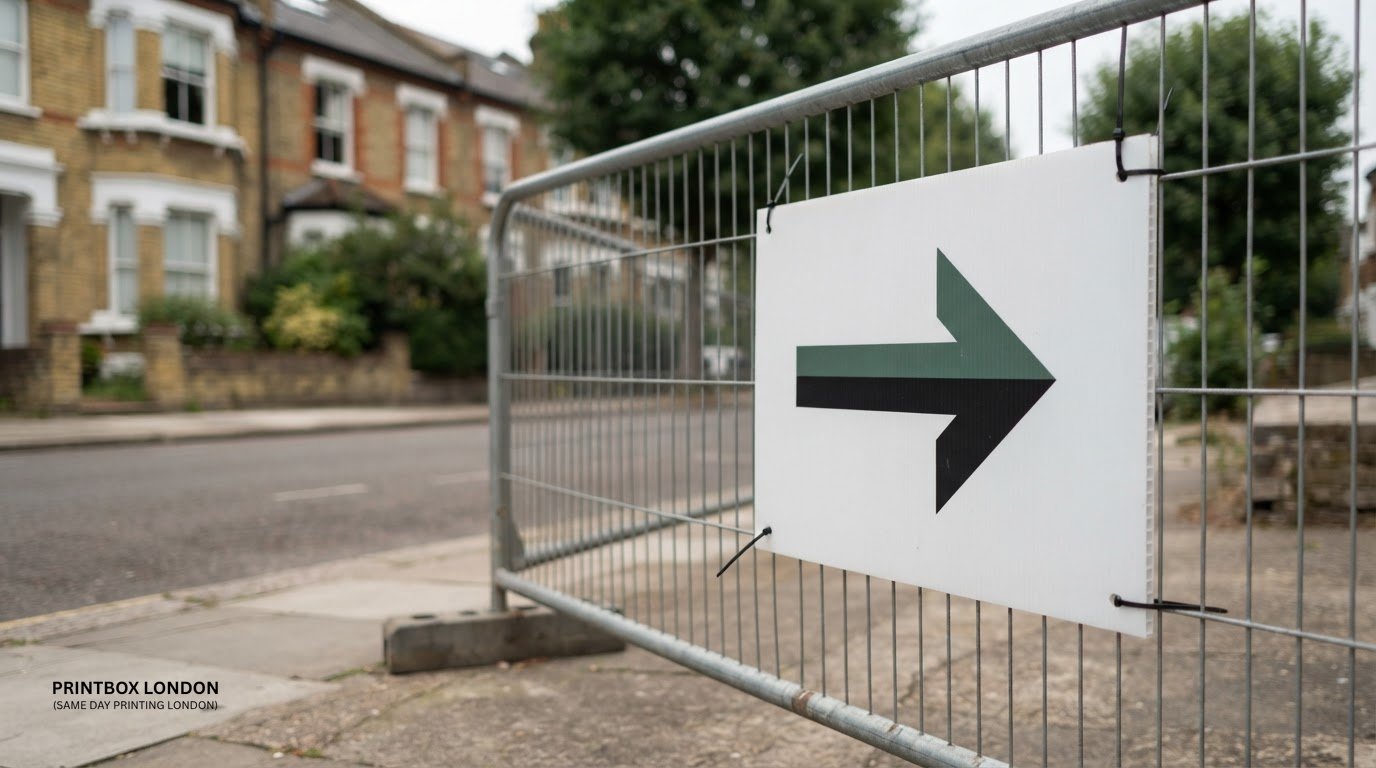
A Correx sign can work indoors and outdoors, but the right thickness depends on its use. Made from polypropylene, Correx is commonly used for temporary outdoor signs, including event and estate agent boards. For correx board sign printing in London, boards are available in 3.5 mm and 6 mm thicknesses, with the choice guided by where the sign will be displayed and how it needs to be supported.
That choice matters: a temporary indoor notice has different requirements from a board displayed outdoors. Correx signs can be printed on one or both sides, so plan the message around the direction people will view it from.
This guide covers common uses for Correx signs, their suitability for outdoor settings and how board thickness relates to different applications. It also explains display and fixing considerations, along with practical artwork guidance, such as setting the design to the finished board size and allowing for bleed. You’ll be better equipped to specify a sign for its intended use.
Key Takeaways
- Identify common Correx sign uses, from property and event displays to indoor notices.
- Understand how polypropylene construction affects the board’s suitability for outdoor settings.
- Compare standard and custom sizing to plan a sign for its display area.
- Choose board thickness with the sign’s intended use and support in mind.
- See what to consider when selecting a printed board for a site, event or business display.
What is a Correx board used for?
Correx boards carry short, clear messages on lightweight printed panels. Common uses include estate agent property boards, event notices and temporary site signage. Choose a finished format that suits the viewing distance, available space and mounting method, whether the sign is for indoor or outdoor display.
London printers offer Correx in standard A sizes and custom dimensions. Custom boards are available in 3.5 mm and 6 mm thicknesses. The right combination depends on the sign’s purpose and display, rather than its dimensions alone. A compact notice and a wide panel can need different support, even when both use the same material.
Standard sizes can simplify planning when an A-series format fits the display area. A custom size may make better use of a narrow window, site boundary or display frame. Specify the finished width and height, then set the design to those dimensions.
Custom sizing can help when a standard format leaves unused space or crowds the message. An estate agent may need a panel to fit an existing property display, while an event organiser may want a board sized for an entrance area. Keep the main wording prominent and legible at the final viewing size.
Custom shapes need separate consideration from custom dimensions. A rectangular board can be made to a specified width and height; a shaped outline requires a cut path and production planning. For contour-cut artwork, allow 5 mm of bleed around the vector cut path. Bleed is extra artwork beyond the edge, helping prevent an unprinted sliver after trimming.
Set artwork to the exact finished board size at 1:1 scale. The file then represents the real dimensions, rather than a smaller mock-up. For a straight-cut board, include 5 mm bleed on every side. These details help align the printed design with the board edge and intended shape.
Collect orders from the Tottenham shop once they’re confirmed ready. Same-day local courier delivery across London may be available, depending on postcode, job size, completion time and courier availability. Include the destination and board dimensions when planning delivery.
Before production, settle the display location, finished dimensions and whether the board needs a standard rectangle or shaped edge. Then prepare matching artwork. A narrow window display, for example, may need a custom width, while a freestanding event notice needs dimensions suited to its support.
Providing the finished size and display requirements gives the printer a clear specification, whether the sign is for a property, event or indoor notice. This helps align the board with its intended use.
Is Correx suitable for outdoor use?
Correx may be suitable for temporary outdoor signage, including property boards and event notices, depending on the product specification and display conditions. A sheltered entrance and an exposed boundary present different conditions, so check suitability for the intended site before ordering.
Assess the location before finalising the layout. Check which direction people approach from, whether the message will remain visible and whether nearby structures obstruct the view. At an event entrance, a clear directional message can guide visitors. On a property display, keep the main information readable from the pavement.
Wind exposure matters: a loose panel can move and become difficult to read. Check what fixing options are available for the specific board, and choose a mounting method suited to the surface. Ground stakes or spikes, tape, screws and cable ties may be options depending on the board and installation; confirm their suitability before use.
Plan any fixing points with the mounting method and board specification in mind. If the sign design and mounting allow, fixing near all four corners may help secure the panel. Keep important wording clear of the corners, and plan any holes or ties before finalising the artwork. A fixing that crosses a name, arrow or instruction can make the message harder to understand.
Suitability for outdoor use does not mean every installation will stay secure in all conditions. Consider site exposure, board size and support strength. A board behind a sheltered window or within a protected entrance needs a different setup from one mounted on an open fence.
Temporary signs are useful when the message or location changes. An event organiser can place directional boards at decision points and remove them afterwards. Estate agent boards can identify a property while it is being marketed. In each case, keep the displayed information current and secure the panel properly.
Tailor the artwork to the viewing distance and setting. Establish a clear hierarchy, making the main instruction or property message prominent before adding supporting details. Keep essential text away from edges and any planned fixing areas. For an outdoor event sign, a concise arrow and destination can be easier to read quickly than a paragraph of directions.
Choose the sign’s position, support and message together before production. This makes it easier to prepare artwork for the real display conditions and select a practical mounting approach, rather than treating the printed board as the whole installation.
Correx board uses for indoor and outdoor signs
Temporary Correx signs can organise information in indoor venues and outdoor sites. Choose the message and position for the people who need to act on it, such as visitors entering an exhibition or approaching a temporary site entrance.
At a London event, an indoor board can identify a registration desk, room schedule or queue entrance. Place each sign where visitors need that information, rather than putting every instruction at the main entrance. A short heading helps people scan the message while moving through a busy venue.
Outdoor signs can direct attendees to an event entrance or mark a temporary change to a site route. A construction project might need clear directions for visitors at its access point. Keep each message specific to its location, so people don’t have to guess which route or entrance it describes.
For property displays, an estate agent board can identify the agent and make the property message visible to passers-by. Set the amount of text according to viewing distance and reading time. A large headline and clear contact details are more practical than dense copy on a street-facing sign.
Planning or advertising requirements for temporary Correx signs in London depend on the site and display arrangement. On private land or at a venue, obtain permission from the person responsible for the location. For public space, ask the relevant council about requirements before displaying a sign.
Indoor and outdoor sign plans also differ in how messages are sequenced. At an exhibition, a welcome board can introduce the stand, while another notice identifies a demonstration area. Outdoors, a sequence of directional signs can guide visitors from an approach point to the entrance. Make each board useful on its own in case someone misses an earlier sign.
Give the main instruction visual priority. An event sign can place “Check-in” above a smaller location detail, while a site notice can lead with the action visitors must take. Use consistent colours and wording across a group of signs so people recognise that the boards belong to the same event or site.
Before arranging production, map the visitor route and note where each sign will be seen. This shows whether you need a welcome board, several directional messages or separate notices for different areas. It also helps prevent conflicting instructions at entrances, corridors or site access points.
Set the resolution for the final board dimensions and viewing distance, and keep important content clear of trimming and fixing areas. Contact Printbox London (Same Day Printing London) to confirm suitable artwork requirements for your board order.
What is Correx, and how thick are the signs?
Correx is a lightweight, corrugated plastic board made from polypropylene. Its fluted construction gives it a ridged interior, making it distinct from a solid sheet. Sign boards are available in 3.5 mm and 6 mm thicknesses, with the choice depending on the panel size, display and support.
Site signs can show directions, access information or temporary instructions at a construction project. A property board can carry an agent’s name and contact details, while event signs can guide visitors towards an entrance or registration area. Security notices can mark a restricted area or identify a site entrance.
Match the artwork to the job. A construction notice needs a message that’s easy to read from the intended approach. A property sign may need the agent’s branding and contact details to stand out. For event wayfinding, use a direct instruction such as “Registration” or “Main entrance”, with an arrow pointing along the route.
Correx can be attached to fences and railings with cable ties or screws. Position fixings in suitable areas of the board, not across essential wording or graphics. Using all four corner fixing points helps distribute the load. Consider the support and exposure: a loose panel can shift, particularly where wind reaches the display.
Reusing a sign can make sense when its information still applies at another location. A general site-direction board, for example, might move between projects, or an event organiser could reuse a sign with a recurring instruction. Before using it again, check that the message remains accurate and the board and fixing points are intact.
Thickness is one part of the decision, not a complete measure of suitability. A 3.5 mm board can suit a compact, temporary notice; a 6 mm option may be considered for a larger panel or a display needing more substance. The intended position, dimensions and fixing method should guide the specification together.
At an exhibition, a Correx panel can display a short message or identify a stand area. Indoors, adjust placement around visitor movement and sightlines. Outdoors, pay closer attention to exposure and mounting. In either setting, keep text and key graphics within the safe area, away from edges that may be trimmed or pierced.
Choose the format after deciding the sign’s purpose, location and audience. This keeps the material, thickness and artwork aligned, whether the board marks a site entrance, property, event route or restricted area.
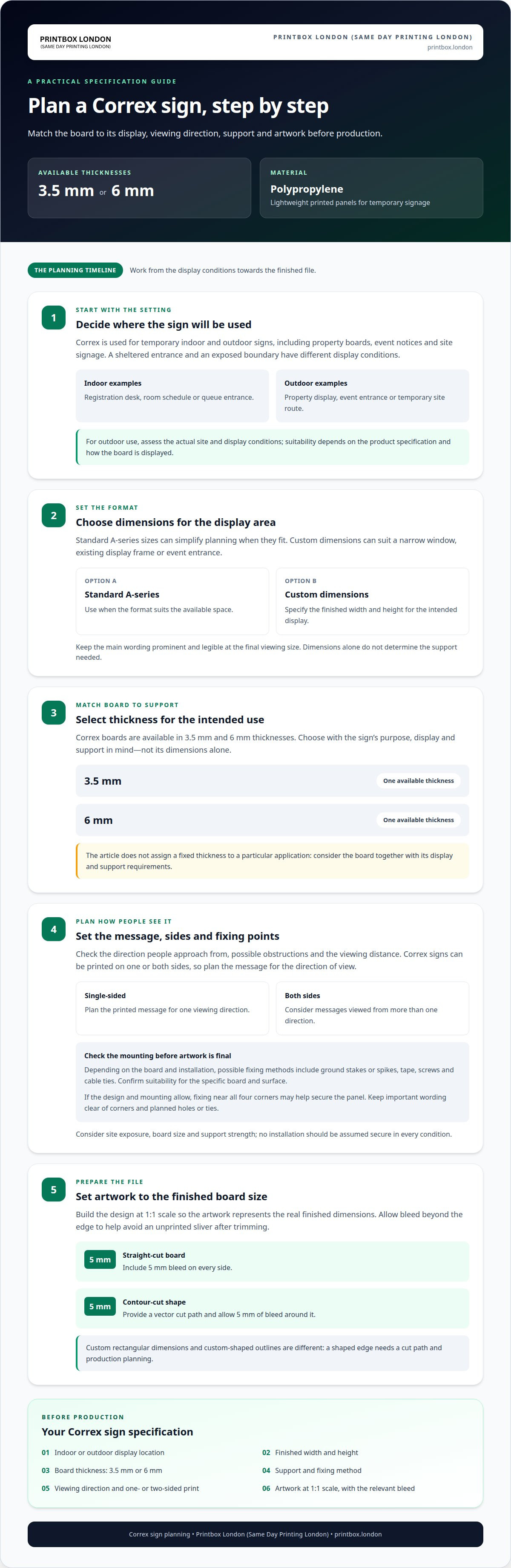
Board thickness and typical applications
Thickness affects how a Correx panel flexes and feels in use. Match the board to its dimensions, display position and support, rather than choosing by thickness alone.
Thickness, Rigidity and Applications
Correx is available in 3.5 mm and 6 mm thicknesses. The thicker board generally feels more rigid, while the thinner option can suit a compact panel that needs straightforward handling. For a broad display, consider how the full panel will be held or fixed. A board’s shape, flute direction and support also influence how it behaves after installation.
Consider the viewing setup, too. A small indoor display can rest on a counter or sit in a frame, while a larger panel needs suitable support across its area. Estate agent boards often need to remain visible on a fence or rail. Choose thickness to suit the dimensions and fixing method, not just the printed design.
Judge “durable” against the job. A temporary display moved between locations faces different handling from a board kept in one place. For agent boards reused across properties, consider how the edges, fixing points and printed surface will be handled during each move. Thickness alone does not guarantee a particular service life.
Choosing a Board Thickness
Start with the finished board size and how it will be displayed. A custom size may need a different balance of rigidity and support from a compact standard format. Next, consider whether it will be freestanding, fixed to a surface or attached to a fence. These details help decide between 3.5 mm and 6 mm.
For colour displays, prepare artwork at the finished dimensions and keep important text clear of the edges. A large block of colour or prominent logo can make a board easier to recognise, but the message still needs to suit its viewing distance. If the panel will be attached through its corners, keep essential words and graphics clear of those fixing areas.
Check the full specification before sending the file to print: board dimensions, thickness, single- or double-sided layout and intended display method. An estate agent board attached to railings, for example, needs a layout that accommodates its fixing points. A display placed against a wall can use the board face differently.
Choose the thickness and format together, then prepare the artwork to match. This gives the finished sign a practical balance of appearance, handling and support, whether it’s a one-off display or a set of agent boards.
Printbox London (Same Day Printing London): Sign Printing
Printbox London (Same Day Printing London) prints Correx boards for temporary signs, property displays and event messages. Provide the finished size, board thickness, single- or double-sided layout, artwork and intended display method. These details help set the print specification around how the sign will be used.
For time-sensitive projects, same-day printing is available for selected quantities and specifications. Turnaround also depends on factors such as artwork readiness and production workload, so include your deadline with the job details.
To discuss a Correx board sign, contact Printbox London (Same Day Printing London).
Get your Correx sign ready for its next display
Before ordering, bring together the practical details: the sign’s purpose, finished dimensions, artwork and display setting. This gives the print specification a clear starting point and helps ensure the board suits its intended use, whether it’s for a business display, event or temporary message.
For a coordinated campaign, correx board sign printing in London can sit alongside printed posters or flyers carrying the same message and visual identity. Printbox London (Same Day Printing London) offers same-day printing, including same-day poster and flyer printing, with turnaround depending on quantity and specification. Artwork readiness and the details of the order also affect timing.
Prepare the sign details and artwork, then get in touch to arrange your order.
A clear brief helps turn your planned display into a sign ready for its intended setting.
Frequently Asked Questions
What material is Correx?
Correx is a fluted polypropylene plastic board. Its internal channels distinguish it from a solid plastic sheet and create a flute direction, which matters when positioning or supporting a sign. It’s commonly used for temporary signage, such as event notices and property displays. Consider the sign’s location and mounting method when deciding whether this lightweight board suits the job.
Can I order for a tight deadline?
Yes, same-day printing is available for selected quantities and specifications. For Correx board sign printing in London on a tight deadline, provide the finished dimensions, quantity, artwork and required date together. Timing depends on the specification, artwork readiness and production workload. Contact Printbox London (Same Day Printing London) to confirm the turnaround for your sign.
Can I print on both sides of my Correx sign?
Printing options depend on the sign specification. If you need a Correx sign printed on both sides, contact Printbox London (Same Day Printing London) to confirm whether this is available for your job. A sign viewed from either direction may need a layout suited to each viewing direction. Plan the design carefully, especially if it includes arrows or instructions, so it guides people correctly.
Where can I get Correx board signs printed in London?
For Correx board sign printing in London, contact Printbox London (Same Day Printing London). Include the finished dimensions, quantity, artwork and intended display setting. If you need a particular printing option, such as printing on one or both sides, ask whether it’s available for your specification. Give your deadline too, so the team can confirm the turnaround and discuss collection or delivery arrangements.
Which London printers offer same-day or next-day Correx sign printing?
Printbox London (Same Day Printing London) offers Correx board printing, with same-day printing available for selected quantities and specifications. Turnaround depends on the order and production requirements, so contact the team to confirm whether same-day or next-day completion is possible for your job. For an urgent sign, provide its dimensions, quantity, artwork and required date. Artwork readiness, board specification and production workload all affect timing.
How much does Correx board sign printing cost in London?
For current pricing, contact Printbox London (Same Day Printing London) with your job details. Factors such as finished board size, quantity and specification can affect the price. Share these details together to ask about the cost of the sign you need. A price for a different specification may not reflect your job, particularly if dimensions or printing requirements differ.
What print options are available for Correx signs?
Printing options for Correx signs depend on the specification. Contact Printbox London (Same Day Printing London) to confirm whether the options you need are available for your job. The right approach depends on the artwork and display. A sign viewed from both sides, for example, may need a separate layout for each face, while a wall notice may need just one. Include the intended use when providing the artwork.
How long does Correx sign printing and delivery take in London?
Turnaround depends on the order, and same-day printing is available for selected quantities and specifications. Contact Printbox London (Same Day Printing London) to confirm the turnaround and whether delivery can be arranged for your order. Provide your deadline, postcode, quantity and finished size when asking about the available arrangements. Collection arrangements can also be confirmed with the team.
Article by
Printbox London Team
The Printbox London (Same Day Printing London) team provides practical printing guidance based on real customer requirements and day-to-day print production. We serve customers across Greater London from our Tottenham print shop, with same-day printing available for many products depending on quantity, specification, artwork and production capacity.