
Choosing the Best Paper for Printing a Dissertation
Sep 30, 2026
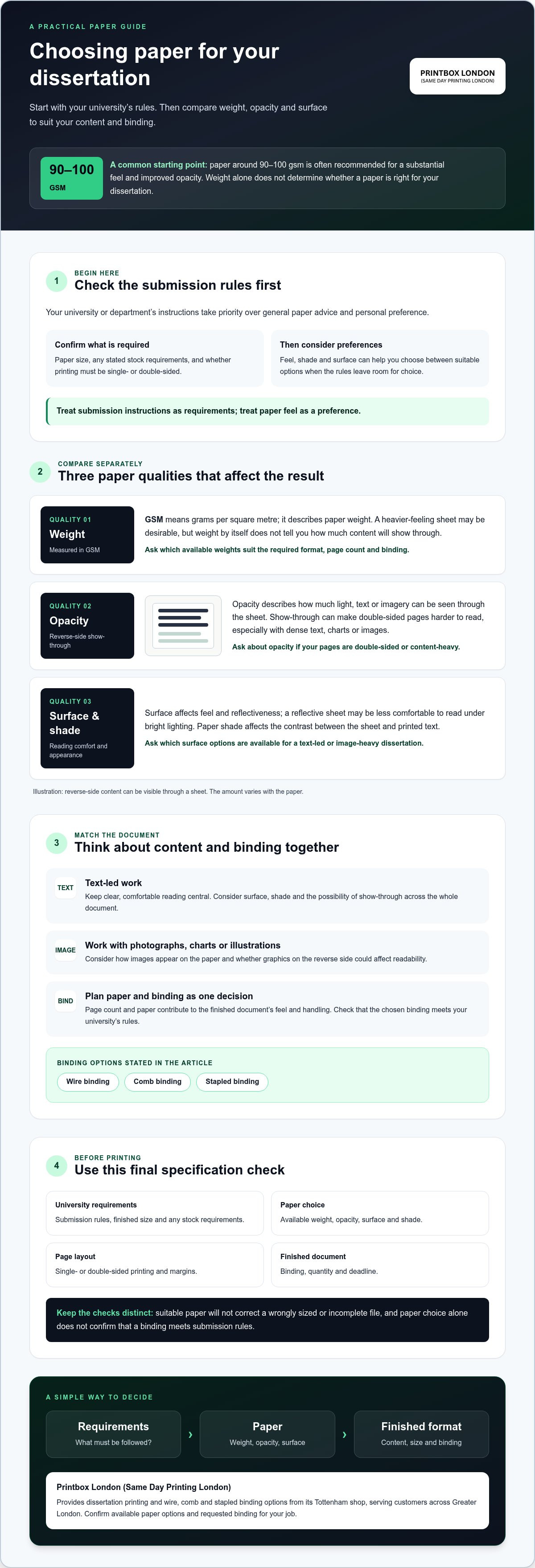
Heavier paper isn’t automatically the best choice for your dissertation. The best paper for printing a dissertation depends on how easily it can be read, whether printing on both sides could show through, and what your university requires. A paper weight around 90-100 gsm is often recommended for a substantial feel and improved opacity, but weight alone doesn’t tell the whole story.
It’s understandable to feel unsure. Paper size, finish, binding and page layout all affect the finished document, and a stock that works well for a text-heavy dissertation may not suit one with lots of colour images. Your university or department’s submission rules come first, so check them before settling on paper or binding.
This guide explains how weight and opacity affect readability, when an uncoated or smoother finish may suit your content, and what to consider when choosing a binding. You’ll also learn what to confirm with your university and printer, including single- or double-sided printing, margins, finished size and available paper options. With those details clear, you can make a practical choice with confidence.
Key Takeaways
- There’s no single best paper for printing a dissertation; choose based on your university’s requirements and how the finished document will be read and handled.
- Compare paper weight, opacity and finish separately to assess readability and the risk of text showing through.
- Match paper and binding choices to your dissertation’s mix of text, images and appendices, and check that the finished document will suit the required format.
- Before printing, confirm the paper specification, page size, quantity, single- or double-sided layout and deadline.
- Printbox London (Same Day Printing London) provides dissertation printing and wire, comb and stapled binding options from its Tottenham shop, serving customers across Greater London.
What makes paper suitable for printing a dissertation?
There’s no single paper choice that suits every dissertation. The best paper for printing a dissertation depends on your university’s submission instructions, how the pages need to read, the content you’re printing and how the finished document will be handled. Legibility and opacity matter, but so do the document’s size and binding.
Start with your university or department’s guidance. Check any stated paper size, stock requirements and rules for single- or double-sided printing before applying general advice. Personal preferences, such as a smoother feel or a particular shade of white, can help you choose between suitable options, but they don’t replace mandatory submission requirements.
How paper choice affects readability and handling
Paper surface and colour influence how a page looks and feels to read. A reflective surface may be less comfortable under bright lighting, whilst the paper’s shade can affect the contrast between the sheet and the printed text. Consider how your dissertation will be read, not just how it looks in a sample or on screen.
Opacity describes how much content from the reverse side is visible through the sheet. More show-through can make a double-sided page harder to read, particularly where text, charts or images are dense. Paper properties, including grammage and how the sheet is made, can help explain why two papers of similar weight may behave differently; see this Paper properties overview for background.
Handling is a practical preference: you may want pages that feel substantial and remain comfortable to turn. Submission instructions are different. Treat stated requirements as rules, and treat feel as a choice only where those rules leave room for it.
Why there is no single correct dissertation paper
A text-heavy dissertation has different reading demands from work featuring photographs, charts or illustrations. Images may make colour reproduction and show-through more noticeable, whilst clear, comfortable text remains central throughout. For mixed content, consider how the paper will perform across the whole document rather than choosing based on one page.
Page count and binding also affect the finished feel. A large document can become bulky, and the chosen stock contributes to how it handles once bound. Decide on the intended binding alongside the paper, then ask the printer to confirm which current stocks and specifications suit your job. Printbox London (Same Day Printing London) provides dissertation printing and document binding; confirm the available paper options and requested binding before proceeding.
Keep paper choice separate from file readiness and binding choice. A suitable stock won’t correct a wrongly sized or incomplete file, and choosing paper doesn’t confirm that a particular binding meets your university’s rules. Check each part of the specification on its own, then share those requirements with the printer so the paper and finished document can be assessed together.
Compare dissertation paper by weight, opacity and finish
Paper weight, opacity and surface describe different qualities. Compare them separately rather than relying on a single figure to decide what will work for your dissertation. This gives you a clearer way to discuss the specification with a printer, especially if your work includes double-sided pages or colour images.
| Property | What it means | When to ask about it |
|---|---|---|
| Weight (GSM) | GSM means grams per square metre. It’s a measure used to describe paper weight. | Ask which available weights meet your university’s requirements and suit the document’s page count and binding. |
| Opacity | How much light, text or imagery can be seen through the sheet from the other side. | Check this if pages will be printed on both sides or contain dense text and graphics. |
| Surface | The feel and reflectiveness of the paper’s face, which can affect reading comfort and how images appear. | Ask what surface options are currently available for a text-led or image-heavy document. |
| Colour | The shade of the sheet, which affects contrast between the paper and printed content. | Consider it if clear text contrast or the appearance of colour pages matters to your submission. |
What GSM tells you, and what it doesn’t
GSM stands for grams per square metre. It describes paper weight, but it doesn’t tell you everything about how a sheet will look or perform. GSM alone doesn’t establish opacity, texture or whether the paper suits your university’s requirements. Two papers with the same GSM can still differ in other ways.
Check your submission instructions first, then ask the printer which currently available options fit your specification. Printbox London (Same Day Printing London) can confirm current paper options for a dissertation job. Share your required size, printing sides and binding needs when asking about dissertation printing options.
Choosing opacity and surface for text or images
Show-through can distract from reading, particularly on double-sided pages with tightly set text, charts or other detailed content. Ask about opacity in relation to your actual layout, rather than assuming that a particular GSM will prevent show-through.
Surface is a separate choice. A less reflective sheet may be more comfortable for sustained reading, while image-led work may call for a discussion about how photographs, charts and colour pages will reproduce. Don’t assume a finish or stock is available without checking. If you’re deciding on the best paper for printing a dissertation, confirm the current options against your content, submission rules and binding specification before approving the job.
Which dissertation paper suits your content and binding?
Choose paper with the whole dissertation in mind, not just its opening pages. A text-led study, an image-heavy project and a document that mixes both can have different priorities. The best paper for printing a dissertation is the option that supports comfortable reading, suits the content and works with the required binding.
Paper considerations for text, charts and photographs
For long passages of text, prioritise clear contrast and a surface that’s comfortable to read under the conditions in which the dissertation will be used. If your work includes charts, photographs or illustrations, consider how the paper’s surface and colour may affect their appearance. Ask the printer what currently available options are suitable for your mix of text and images rather than assuming one stock will suit every page.
Front matter, appendices and colour sections can have different practical needs from the main chapters. Check whether your university allows different paper choices within one submission before planning separate stocks. If the paper’s appearance or image reproduction is important, ask whether you can review a sample or proof before approving the full print. Availability and proof options should be confirmed for your specific job.
Check how paper and binding work together
Confirm the required binding type and any university formatting instructions before finalising the paper or layout. Binding affects how a dissertation opens, how pages turn and how thick the finished document feels. A higher page count combined with a heavier stock can produce a bulkier volume, so discuss the complete specification rather than choosing paper in isolation.
If wire binding is required, prepare the document layout with the binding edge in mind. Keep important text, page numbers and images clear of the area that will be used for binding, and check your university’s margin instructions. For more detail on planning a wire-bound file, consult a wire binding setup guide; confirm the required clearance with the printer, as it depends on the job and binding specification.
For a document arranged as a booklet, page order and total page count also affect how the file is prepared. Printbox London (Same Day Printing London) offers booklet printing, but confirm the setup requirements for your specific format rather than assuming a general guide applies. See the booklet printing information when considering a booklet-style document.
Before approving the job, give the printer your university’s binding instructions, page count, finished size, print sides and preferred paper characteristics. Printbox London (Same Day Printing London) provides wire, comb and stapled binding options; confirm which option and paper specifications are currently suitable for your dissertation.
Use this checklist before choosing dissertation paper
Work through these checks before approving the paper or print job. The order matters: university instructions set the requirements, then your content and binding help narrow the practical choices.
- Check the requirements: Confirm finished size, paper specifications, colour-printing rules, margins, binding and whether pages must be single- or double-sided. Ask your university or department if instructions conflict or are unclear.
- Assess the content: Decide whether the dissertation is mostly text, includes detailed charts or photographs, or combines different types of content. Note any pages where colour or show-through could affect readability.
- Choose the binding: Verify the accepted binding style before setting the final layout. Allow for the binding edge in your margins so text and page details aren’t crowded or obscured.
- Confirm the stock: Ask the printer which paper weights, surfaces and colours are currently available, and whether they suit your requirements. Don’t assume a preferred option is in stock.
- Approve the file: Check the final page order and layout, then supply a properly prepared PDF for the agreed finished size and print specification.
Check university instructions before ordering
Get the requirements directly from your institution, course or department. Confirm the required size, paper, colour pages, margins and binding, as well as the rules for printing on one or both sides. Don’t rely on what another student submitted or assume common practice applies to your course. If instructions appear to disagree, resolve the details with the university before approving production.
Prepare the order details and print-ready file
Give the printer the document type, finished size, quantity, preferred paper characteristics, binding or other finishing, and deadline. State clearly whether printing is single- or double-sided. A PDF is generally suitable when correctly prepared, but the file still needs checking: review page order, fonts, image quality, margins and final layout. A file extension alone doesn’t make a document print-ready. Use a practical PDF preflight checklist to review it before sending.
These checks help identify the best paper for printing a dissertation without guessing about stock or overlooking a submission rule. Printbox London (Same Day Printing London) provides dissertation printing and document binding; available paper options and turnaround depend on the specific job. Same-day printing is available depending on quantity and specification.
Arrange dissertation printing with Printbox London (Same Day Printing London)
Printbox London (Same Day Printing London) provides dissertation and document printing, with wire, comb and stapled binding options. The physical shop is in Tottenham, and the service covers Greater London. Paper weights, finishes and current stock options aren’t confirmed here, so check what’s available for your exact dissertation before choosing.
What to include when requesting a dissertation quote
Send the details together so the printer can assess the complete job. Include:
- Finished page size and number of copies
- Whether pages should be printed single-sided or double-sided
- Your university’s paper requirements and any preferred paper characteristics
- The required binding or finishing, plus your deadline
- Whether you plan to collect or need to ask about delivery
Attach the final print-ready document, preferably a PDF that’s been checked for page order, layout, fonts and image quality. A PDF isn’t automatically ready to print just because it opens correctly. Confirm that the file matches the required finished size and that important content is positioned safely for the selected binding.
Sharing your requirements helps you assess the best paper for printing a dissertation without assuming a particular stock is available. Ask which current paper options suit your university’s specification, content and binding choice.
Confirm production and collection details
Before approving the order, ask the team to confirm the paper stock, print specification, binding and turnaround for the full quantity. Same-day printing is available depending on quantity and specification, so confirm the timing for your specific job before relying on a deadline.
Collection is from the Tottenham shop once your order is confirmed ready. If you need delivery, ask whether it can be arranged for your postcode and order; don’t assume local courier availability or timing without confirmation.
Make your dissertation print-ready with confidence
The best paper for printing a dissertation depends on your university’s rules, the content and the binding, not weight alone. Check opacity and surface as well as paper weight, particularly if pages will be printed double-sided or include detailed images. Confirm the finished size, margins, print sides and binding requirements with your university before approving the job.
Then ask the printer which paper options are currently available and suitable for your specification. Printbox London (Same Day Printing London) provides dissertation and document printing, with wire, comb and stapled binding options. Confirm the stock, binding and turnaround for your quantity and deadline, and send a final PDF that has been checked for page order and layout.
With the requirements confirmed and your file checked, you can move ahead knowing the paper and binding have been considered together. You’re ready to prepare a dissertation that’s clear to read and suited to its submission requirements.
Frequently Asked Questions
What is the best paper weight for printing a dissertation?
There isn’t one weight that suits every dissertation. As general guidance, 90-100 gsm is often recommended for a substantial feel and improved opacity, but check your university’s minimum requirements first. GSM measures paper weight, not opacity by itself. Ask the printer which options are currently available and suitable for your page count, whether you’re printing on one or both sides, and the binding you need.
Should a dissertation be printed on one side or both sides?
Follow your university or department’s submission instructions. Some allow double-sided printing, whilst others may specify single-sided pages or have rules for particular sections. If double-sided printing is permitted, check that the layout and margins work on both sides and ask about opacity to reduce distracting show-through. Don’t choose a print layout based only on what’s convenient; confirm the required format before preparing the final file.
Can dissertation paper show text through from the other side?
Yes. Text or images can be visible through a sheet, especially when printing on both sides or when pages contain dense content. This is called show-through. Paper weight can affect it, but GSM alone doesn’t determine opacity, as paper composition and manufacture also matter. If readability is a concern, ask the printer about the opacity of available options and consider how your actual pages will look.
Is thicker paper always better for a dissertation?
No. Heavier paper can feel more substantial, but it doesn’t automatically provide better opacity or suit every submission. A thick stock can also make a high-page-count dissertation bulkier, which may affect how the document handles once bound. Check university requirements, consider whether pages are single- or double-sided, and ask the printer to confirm suitable available options for your document and binding.
What paper should I use for a dissertation with colour charts or photographs?
Choose paper by considering both the text and the images, rather than assuming one finish is right for every project. For charts and photographs, ask how available paper surfaces may affect colour and image appearance. For long passages of text, consider reading comfort and glare. If the paper’s appearance matters, ask whether you can review a sample or proof before approving the full print.
Should I check paper requirements with my university before printing?
Yes. Your university or department’s instructions take priority over general paper advice. Confirm the required size, paper specification, colour-printing rules, margins, binding and whether printing should be single- or double-sided. Requirements can differ between courses, so don’t rely on another student’s submission as a guide. If instructions conflict or aren’t clear, ask the institution to confirm them before placing your order.
Can Printbox London (Same Day Printing London) print and bind a dissertation?
Yes. Dissertation and document printing are confirmed services, with wire, comb and stapled binding options. Printbox London (Same Day Printing London) serves customers across Greater London from its physical shop in Tottenham. Confirm current paper options, your chosen binding and turnaround for the complete job. This helps ensure the print specification suits your dissertation and any submission requirements set by your university.
Article by
Printbox London Team
The Printbox London (Same Day Printing London) team provides practical printing guidance based on real customer requirements and day-to-day print production. We serve customers across Greater London from our Tottenham print shop, with same-day printing available for many products depending on quantity, specification, artwork and production capacity.