
Choosing Paper Weight for Brochures: A GSM Guide
Oct 19, 2026
The heaviest brochure paper isn’t automatically the best choice. Choosing the right paper weight for brochures means balancing the feel you want with how the pages need to fold, how easy they are to read and how the finished brochure will be used.
GSM, or grams per square metre, gives you a paper-weight figure, but it can be hard to picture what that means in your hands. A brochure can feel too flimsy, become bulky when folded or be awkward to handle. It’s also not always obvious whether the cover and inside pages should use the same weight.
This guide explains what GSM can tell you, how format and fold affect the finished brochure, and what to consider when choosing paper for the cover and inside pages. Printbox London (Same Day Printing London) produces folded and saddle-stitched brochures, with paper or material, thickness and finish considered as part of the print specification.
Key Takeaways
- Choose brochure paper weight around its purpose, format, fold and how readers will handle it, rather than relying on GSM alone.
- GSM measures paper weight per square metre, but it doesn’t guarantee a precise thickness or stiffness.
- Compare lighter, midweight and heavier paper directions by the feel and folding behaviour you want. Consider whether the cover needs different characteristics from the inside pages.
- Use a simple decision process: define the brochure’s purpose, select its format, assess the fold, then decide on the desired feel.
- When choosing the right paper weight for brochures, prepare a clear print request with the finished size, quantity, print sides, paper preference, finish, deadline and artwork.
Brochure paper weight depends on the job it needs to do
The right paper weight depends on the brochure’s format, fold, content and how readers will handle it. A brochure that needs to be carried and referred to repeatedly may call for a different feel from a short-lived event handout. There’s no single weight that suits every job.
Choosing the right paper weight for brochures is about balancing substance with flexibility. A heavier-feeling sheet can make a brochure feel more substantial, but the finished piece also needs to fold comfortably and work with its construction. Paper weight influences handling; it doesn’t determine whether the design itself looks polished. Layout, typography, colour and image choices all contribute to visual style.
GSM is one way to compare paper weight. For background on how paper weight and density measurements are described, see paper density and weight measurements. Treat the figure as one part of the specification, not a complete prediction of how the finished brochure will feel in your hands.
Start with the brochure’s purpose and audience
Picture where the brochure will go after someone picks it up. A sales handout that readers may carry, revisit or pass to a colleague needs to feel suitable for repeated handling. A short event information piece may only need to present its details clearly and be easy to distribute. Neither purpose automatically dictates a particular GSM; it helps define the feel you want to achieve.
Ask whether readers are likely to carry, keep, display or pass the brochure on. A brochure intended for display might be handled differently from one handed directly to visitors. Use these expectations to guide the balance between sturdiness and flexibility, rather than selecting a number before considering the job.
Consider format, fold and distribution together
A single-sheet folded brochure and a multi-page saddle-stitched brochure are built differently. In both cases, the fold must work with the sheet’s flexibility and the finished construction. A choice that feels appealing as a flat sheet may feel too stiff or bulky once folded, especially when a brochure has several panels or pages. Think about the complete piece, not just one sheet held on its own.
Distribution matters too. Mailing, hand distribution and display each create different handling needs. A brochure that will be posted needs to be practical as a folded item; one handed out at an event needs to be comfortable to pick up and carry; a display copy should suit its intended use. These are useful prompts, not fixed rules. Printbox London (Same Day Printing London) produces folded and saddle-stitched brochures. Its brochure and booklet printing can be specified around the format and desired feel.
Quick decision summary: Match the paper characteristics to the job:
- Repeated handling: consider the sturdiness and substance you want.
- Multiple panels or pages: give flexibility and fold behaviour close attention.
- Mailing, handout or display: factor in how the brochure will be distributed and used.
What gsm tells you about brochure paper, and what it cannot
GSM means grams per square metre. It describes the weight of a given area of paper, making it a common way to compare paper weight in the UK. It’s useful when setting a print specification, but it doesn’t tell you exactly how thick, stiff or smooth a brochure will feel.
Think of GSM as a measurement, not a complete description of the finished sheet. Two papers with the same GSM can feel different because of their fibre, construction and surface treatment. Coating can change the surface feel, while the way the paper is made affects its body and flexibility. That’s why choosing the right paper weight for brochures involves considering the paper itself as well as its GSM.
A number on its own can’t predict whether a folded brochure will feel comfortable in the hand or sit neatly as a finished piece. Nor does a higher figure automatically mean a better result. The useful question is how the paper’s weight and construction work with the brochure’s format and purpose.
GSM versus thickness, stiffness and feel
Weight and thickness are related concepts, but they aren’t interchangeable. GSM measures mass per area; thickness describes the distance between the sheet’s surfaces. Stiffness is about how readily the sheet bends, while feel is the impression it gives in the hand. Paper construction and coating can affect those qualities, so don’t assume one GSM will feel or perform the same across different paper types.
Text pages and covers are different decisions
Inside pages need to work as part of the brochure: they should suit the content and allow the finished format to open and fold as intended. A cover may have a different role, protecting the pages and shaping the first impression. Separate cover and interior choices can be worth assessing, but the same GSM figure won’t necessarily deliver equivalent performance across different paper categories. Treat each choice as part of the complete specification.
For a useful comparison, focus on how the paper category, surface and weight work together in your intended format. Consider the cover and inside pages separately if they have different jobs, then describe the result you want rather than relying on a GSM figure alone.
Printbox London (Same Day Printing London) considers your preferred paper or material and thickness alongside the brochure’s format and finish. Share your brochure specification to discuss the job.
Compare brochure paper weight by fold, content and reader experience
Use lightweight, midweight and heavier as broad comparison points, not fixed GSM ranges or promises about a particular stock. The right direction depends on how the brochure is built and what it needs to communicate. A folded promotional handout, an image-led showcase and a multi-page information piece can all call for different balances of flexibility and substance.
| Brochure use | Desired feel | Fold behaviour to consider | Main trade-off |
|---|---|---|---|
| Promotional handout distributed in quantity | Lightweight and easy to carry | Should open and close comfortably in its folded format | Easy to distribute, but may feel less substantial in the hand |
| Image-led showcase | More body to support a considered presentation | Check that the sheet still suits the fold and finished size | More substance, but potentially less flexible to handle |
| Multi-page information piece | A balanced feel across the pages and cover | Consider how the pages work together when folded or saddle-stitched | Sturdiness must be balanced against bulk and ease of use |
These are starting points, not a universal paper recipe. Coating and finish influence the surface appearance and feel, but they don’t replace the weight decision. Choose the weight direction for the brochure’s structure and handling first, then consider how the finish supports the intended look.
When flexibility matters more than a substantial feel
For a folded handout that needs to open and close comfortably, a more flexible direction may suit the job. That can be useful when brochures will be distributed in quantity or carried away by readers. But weight alone can’t guarantee a clean fold: the sheet, fold layout and production finishing all affect the result. Consider the finished piece, not just the flat paper.
When a more substantial brochure feel matters
An image-led showcase or presentation piece may benefit from a firmer hand-feel that gives its content more presence. The trade-off is practical: a more substantial sheet still needs to fold, travel and be handled as intended. The suitable choice depends on the finished format and production specification, so don’t select a heavier direction without considering the fold and overall construction.
For folded and saddle-stitched brochures, compare how the cover and inside pages will work together as one finished item. Printbox London (Same Day Printing London) produces both formats and takes your preferred paper or material, desired thickness and finish into account when preparing the job. Describe the use, format and feel you’re aiming for, rather than relying on a GSM figure alone.
Choose brochure paper weight with this practical decision framework
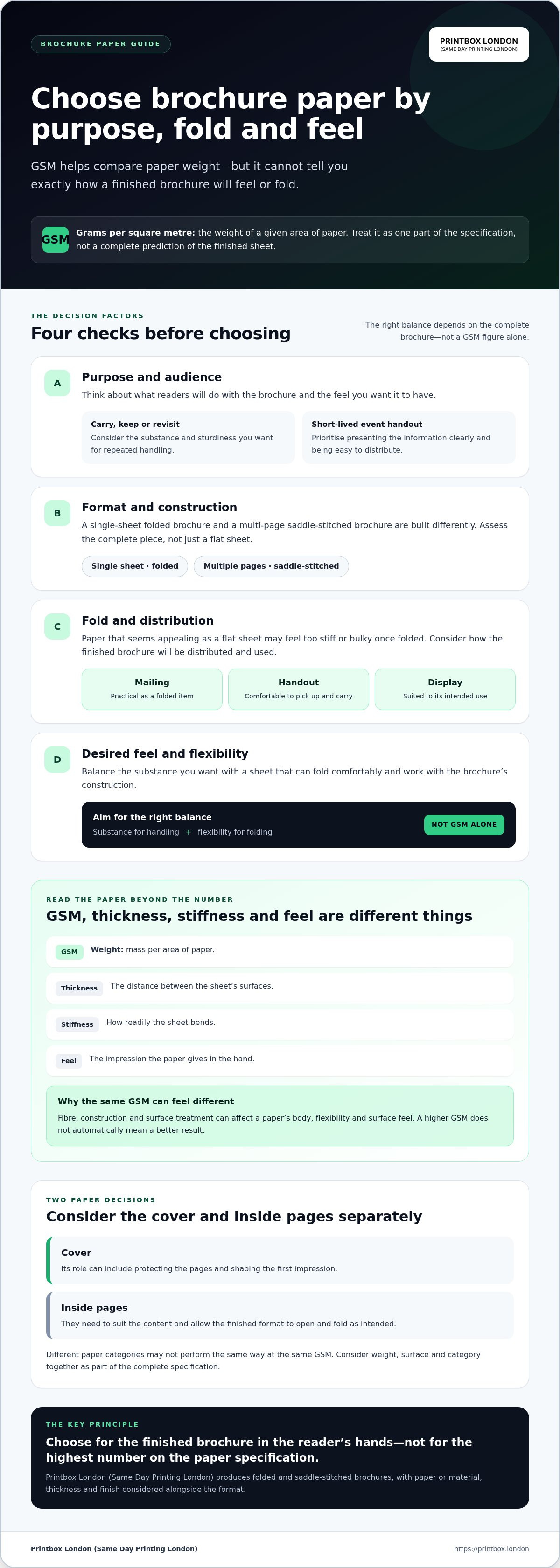
Make the paper decision from the finished brochure backwards. Start with its purpose, then work through format, fold and desired feel before noting a paper-weight preference. This keeps the choice tied to how the piece will read and handle, rather than turning a GSM figure into a decision on its own.
Match the paper decision to the finished brochure
First, record whether the brochure is folded or saddle-stitched, along with its finished size and page count. Then consider how much text and imagery it contains. Dense information needs to stay comfortable to read; image-heavy pages may put more emphasis on the presentation of the finished piece. Neither content type points to one automatic paper weight.
Next, think about how often readers will handle it and how it will be distributed. A brochure intended to be kept for reference has different handling demands from a handout passed around at an event. Decide whether flexibility, sturdiness or a more substantial presentation matters most. Then consider whether the cover and inside pages need different characteristics, or whether consistency throughout is the priority.
Check the complete print specification
Once the format and intended feel are clear, gather the details that give your paper preference context. A GSM request alone doesn’t establish that a particular paper is the right match for the job. The complete specification matters, including the construction, fold, page count and finishing. Printbox London (Same Day Printing London) considers paper or material, desired thickness and finish as part of brochure production.
- Define the use: note the brochure’s audience, content and how readers will use it.
- Choose the format: give the finished size and whether it will be folded or saddle-stitched.
- Assess the fold: consider how the sheet should open, close and sit as a complete piece.
- Set the desired feel: state whether flexibility, a firmer feel or a particular cover-to-page contrast matters.
- Specify the job: include quantity, single- or double-sided printing, preferred thickness, finish, artwork and deadline.
Also prepare the final artwork and say whether you have a collection or delivery preference. Readability, image coverage, quantity and distribution help explain why you favour a particular feel; they don’t dictate a stock recommendation by themselves. The final choice depends on the complete job specification and the production options suited to it.
Use this framework for choosing the right paper weight for brochures, then send the details together. Clear information helps Printbox London (Same Day Printing London) assess the folded or saddle-stitched format and the paper direction you have in mind. Same-day printing is available for selected quantities and specifications.
Prepare a brochure print request with Printbox London (Same Day Printing London)
Printbox London (Same Day Printing London) produces folded and saddle-stitched brochures. A clear print request helps match your paper preference to the finished format and gives the team the details needed to assess the job. If you’re still choosing the right paper weight for brochures, describe the feel you want as well as any GSM preference. A figure alone doesn’t specify the complete paper or production requirements.
Brochure production details are covered on the booklets and brochures printing page. Before sending a request, gather the information below.
What to include in a brochure print request
Start with the product type and finished size, then state the quantity and whether printing is required on one side or both sides. Include the page count and whether the brochure is folded or saddle-stitched. These details make the intended construction clear.
- Format: product type, finished size, page count and fold or binding style.
- Print run: required quantity and single- or double-sided printing.
- Paper direction: preferred paper or material, desired thickness and any GSM preference.
- Finish: describe the finish you want, if applicable.
- Timing: give the required deadline and whether you plan to collect or need delivery.
- Artwork: supply the final print-ready file, preferably as a correctly prepared PDF.
For the artwork, make sure the pages are in the intended order and set up for the finished size. Check that text and key details are positioned appropriately for the fold, and include any product-specific print requirements in your request. If you have a particular cover-to-inside-page contrast in mind, say so; the paper choice can then be considered as part of the full specification.
Plan around the deadline and collection
Same-day printing is available for selected quantities and specifications. Turnaround depends on the page count, quantity, stock and finishing, as well as the job’s current workload. Share your deadline with the complete specification and artwork so the timing can be assessed against the actual job. Don’t plan around an assumed turnaround before the order is confirmed.
For collection, arrange to pick up the brochures from the Tottenham shop once the order is confirmed ready. Include a delivery preference in the request if relevant, and agree the timing for the specific order rather than assuming a delivery time.
Send Printbox London (Same Day Printing London) your finished size, quantity, print sides, paper preference, finish, deadline and print-ready artwork to get your brochure request moving.
Turn your paper choice into a clear print brief
Move from comparing options to describing the brochure you want. Choosing the right paper weight for brochures becomes more straightforward when you connect your preferred feel to the finished format, fold and purpose. Include a GSM preference if you have one, but also explain how you expect readers to handle the brochure. That gives the specification useful context.
Printbox London (Same Day Printing London) produces folded and saddle-stitched brochures, with same-day printing available for selected quantities and specifications. Include your deadline with the job details so the requirements can be considered together.
From its Tottenham shop, Printbox London (Same Day Printing London) serves customers across Greater London, including Central, North, East, South and West London, and boroughs such as Haringey, Hackney, Islington, Camden, Enfield, Barnet, Westminster, Newham, Redbridge and Waltham Forest.
A clear brief is a practical first step towards a brochure that suits its purpose. Share what you have in mind and move ahead with confidence.
Frequently Asked Questions
Does GSM tell me exactly how thick brochure paper will be?
No. GSM measures paper weight by area, not the sheet’s precise thickness. If two paper descriptions show the same GSM, compare them within their paper category rather than assuming different categories will feel alike. A figure alone won’t tell you how a sheet will bend in a folded brochure. Use GSM to narrow your preference, then describe the finished format and feel you want.
Can the inside pages and cover of a brochure use different paper weights?
They can be specified separately for some jobs, depending on the format, page count, construction and production requirements. If you have a particular contrast in mind, describe the cover and inside pages as separate parts of the brief. For example, you might want the cover to feel distinct from the pages readers turn. Printbox London (Same Day Printing London) considers the requested result within the complete brochure specification.
Does a heavier paper weight always make a brochure feel more professional?
No. A heavier-feeling sheet can add substance, but it may not suit a brochure that needs to fold compactly or be easy to carry. Think about whether the piece is a quick handout, a reference readers will keep or a presentation for clients. The professional choice is the one that supports its purpose and feels appropriate in use, not simply the one with the greatest weight.
Will heavier paper make a folded brochure harder to fold?
It can, particularly if the sheet is also stiff or the finished piece has several panels. But GSM alone can’t predict the fold. If the artwork has a complex panel layout, include that layout and the required fold in your print brief. The paper, construction and finishing need to be considered together for the actual job, rather than relying on a general rule about heavier paper.
Does coated paper change the weight of a brochure?
Coating and GSM describe different aspects of paper: one relates to the surface, the other to weight per area. When deciding on a surface, think about how the brochure will be read as well as how it should look. For a text-led piece, consider whether the surface suits comfortable reading in its intended setting. State your finish preference alongside the paper direction in your print request.
What information should I send when requesting brochure printing?
Include the finished size, page count, quantity, print sides, fold or binding style, paper preference, desired thickness and finish. Add the deadline and whether you prefer collection or delivery. Send the final artwork with pages arranged in the intended order, and identify any version or layout details that affect production. This gives Printbox London (Same Day Printing London) a clear brief to assess for your brochure job.
Can brochure printing be completed on the same day in London?
Same-day printing is available for selected quantities and specifications, rather than as a standard promise for every brochure order. If you’re working to a deadline in London, send the finished size, page count, quantity, full specification and print-ready artwork together. The job’s requirements and production workload affect the turnaround. State your deadline clearly so timing can be considered for that particular order.
Article by
Printbox London Team
The Printbox London (Same Day Printing London) team provides practical printing guidance based on real customer requirements and day-to-day print production. We serve customers across Greater London from our Tottenham print shop, with same-day printing available for many products depending on quantity, specification, artwork and production capacity.