Cheap flyer printing for businesses
Oct 21, 2026
A flyer that tries to say everything can be easy to ignore. Cheap flyer printing works best when the design is simple: lead with one clear offer, make key details easy to spot and give readers an obvious next step. Keep the copy brief, especially on smaller formats.
It’s tempting to focus on print cost alone, but the right size, paper and finish matter too. Choose a practical specification that keeps your message readable and suits how you plan to hand out or display the flyers.
This guide explains how to shape a business flyer, choose its size and paper, and understand which specification choices affect the price. You’ll also find ideas for promoting an offer, event or service, and what to prepare for a print order. The aim is simple: help you choose flyers that fit your message and budget without adding details your audience doesn’t need.
Key Takeaways
- Build your flyer around one clear message, a strong offer and an easy-to-find next step.
- Choose paper and finish to suit how the flyer will be handled, shared or displayed.
- Prepare artwork at the correct finished size, with readable text and images that will print clearly.
- Compare sizes and quantities against your distribution plan, as these choices affect the overall order cost.
- Give each promotion a clear response route so you can see how people can act on the flyer.
Do you have any design tips for printing flyers for my business?
Yes. UK printers offer same-day and next-day flyer services, alongside standard production schedules. A standard flyer-printing turnaround is 5 working days before dispatch, so allow extra time for delivery and distribution.
Make the design easy to scan at its final printed size. Give the business name, offer and response details distinct places instead of giving every element equal prominence. For example, a gym promoting a trial session can make the offer the strongest visual element, with booking details beneath it.
Use contrast to distinguish sections. Dark text on a light background is generally easier to read than colour combinations with little difference in brightness. Keep body text clear of decorative graphics, and avoid placing essential details over a busy photograph. Leave clear space around a QR code and make it large enough to scan in the way recipients will hold the flyer.
For a double-sided design, use the front as a quick introduction and the reverse for useful supporting information. Check that phone numbers, web addresses, dates and offer conditions are accurate. A proof viewed at actual size can reveal tiny text, crowded margins or an image that looks sharp on screen but prints poorly.
Match the delivery option to your deadline
Separate production time from transit time when planning. “Dispatch” means the order leaves the printer, not that the flyers have arrived. Standard, express and fast-track options can refer to different production or dispatch schedules. Set your required in-hand date first, then allow time for delivery, sorting and distribution.
For an event, plan around the date the flyers need to be ready for handouts, not just the event date. A restaurant promotion, for instance, needs time for staff to place flyers at counters or include them with takeaway orders. Planning ahead can prevent paying for a quicker option when the distribution plan isn’t ready.
Same-day, next-day and delivery costs
Some UK same-day printing services require orders by 12pm. Have the final quantity and artwork ready before ordering, and distinguish next-day printing from next-day delivery. They describe different stages of the job, so the order’s dispatch schedule alone doesn’t establish when it will arrive.
Compare delivery options by the stated service, destination and order size. Free UK delivery offers may have a minimum spend, so read the terms and compare the total checkout cost. Don’t assume an express dispatch option also includes express transit.
- Use standard dispatch when your campaign schedule has room for production and delivery.
- Choose a faster dispatch option to fit a firm distribution date.
- For urgent work, prepare the final file and order details before the cut-off.
Work backwards from the first day flyers need to reach people. This gives you a practical delivery plan and time to distribute the finished batch effectively.
Paper stocks and finishes
Paper choice affects how a flyer feels, handles and reproduces colour. Compare size, thickness and finish with your distribution plan before choosing.
Flyer sizes, stocks and weights
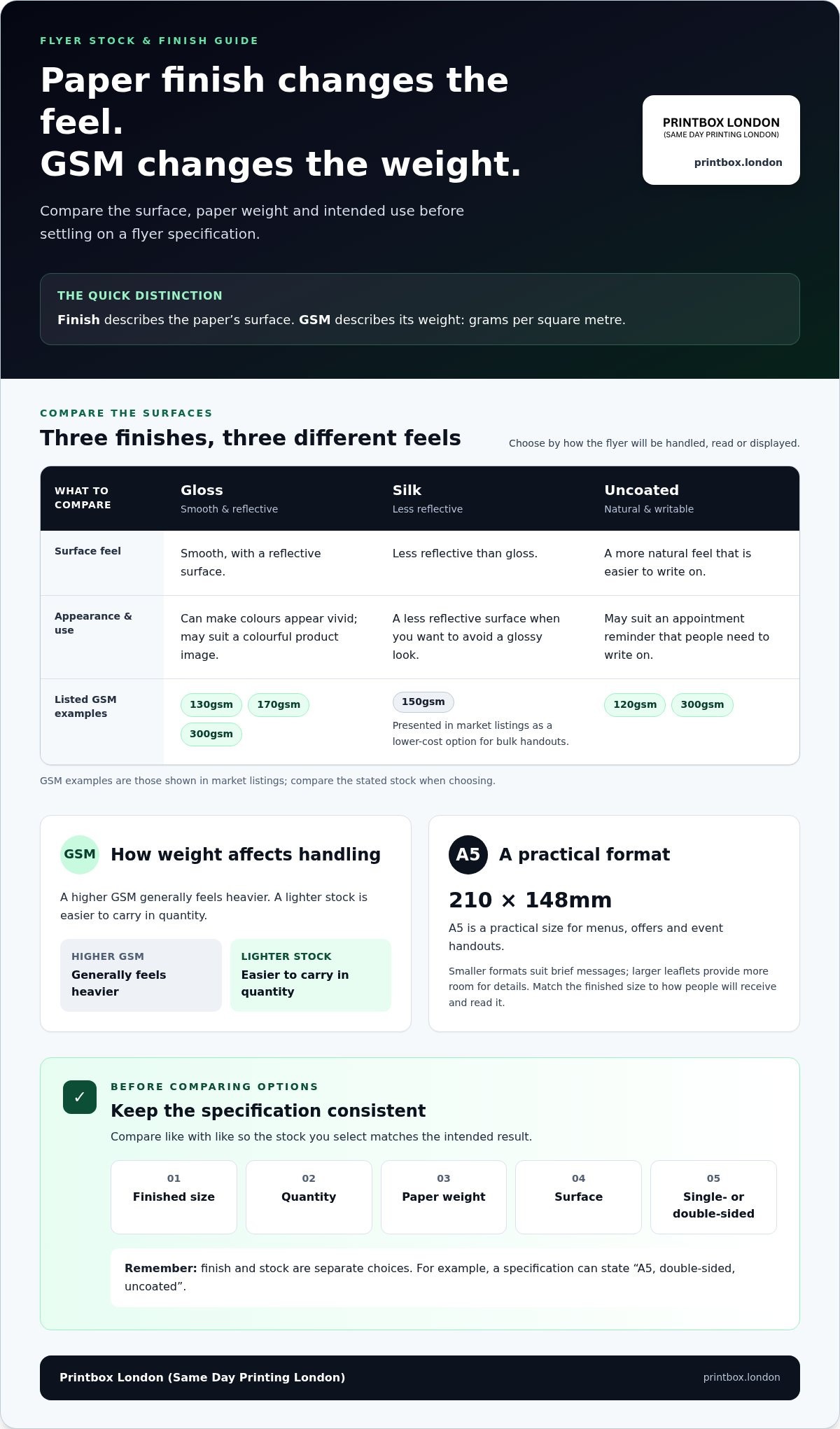
A5 is 210 × 148mm, a practical format for menus, offers and event handouts. Smaller formats suit brief messages, whilst larger leaflets provide more room for details. Match the finished size to how people will receive and read the flyer.
Paper weight is measured in GSM, meaning grams per square metre. A higher GSM generally feels heavier, while a lighter stock is easier to carry in quantity. Market listings include gloss at 130gsm, 170gsm and 300gsm, and uncoated options at 120gsm and 300gsm. These examples show why comparing the stated stock matters.
For bulk handouts, 150gsm silk is presented in market listings as a lower-cost option. A5 flyers for a café counter may need a different feel from leaflets distributed at an outdoor event. Decide whether ease of carrying, sturdiness or room for information matters most.
Finishes and recycled paper
Gloss has a smooth, reflective surface that can make colours appear vivid. Silk is less reflective, while uncoated paper has a more natural, writable feel. Choose for the intended use: a glossy promotion can suit a colourful product image, while an uncoated appointment reminder may be easier to write on.
Finish and stock are separate choices. A finish describes the paper’s surface; GSM describes its weight. Write both into your print specification, such as “A5, double-sided, uncoated”, so the selected option matches the intended result.
If recycled stock is a campaign requirement, specify it and check that the finished artwork suits its appearance. Recycled paper can differ in shade or surface from bright white stock, so consider how brand colours and small text will reproduce. After distribution, follow local council guidance for recycling used flyers.
Before placing an order, compare the same finished size, sides, GSM and surface across the options. A single-sided A5 event notice has different demands from a double-sided leaflet with detailed service information. Review the actual wording and colours at final size, not only on a screen.
For a straightforward comparison, note the format, quantity, paper weight, surface and whether the flyer is single- or double-sided. This concise specification makes it easier to compare paper choices consistently and select stock suited to how you’ll distribute the flyers.
Customisable templates and artwork uploads
A template can speed up flyer design, while uploading your own artwork gives you control over the layout. Either way, check the finished size and print details before placing your order.
Templates and artwork uploads
Choose a template suited to the flyer’s purpose, such as an opening offer, event announcement or service introduction. Replace sample text and images, then make sure the business name, offer and contact details stand out. Keep the layout simple enough to read quickly.
If you’ve already designed the flyer, upload the finished artwork rather than a screenshot. A correctly prepared print-ready PDF is generally suitable; finished artwork from Canva can also be provided. Check that the file opens at the intended size before ordering.
Artwork setup and file requirements
Set the document to the finished flyer size before placing text and images. Bleed is artwork extending beyond the trim edge to allow for small cutting variations; the safe area keeps important details away from that edge. Add crop marks only if the print instructions request them.
Use clear images at an appropriate resolution and avoid enlarging small web graphics. Check fonts, spelling and image placement at full size. Colour can look different on an RGB screen and in printed CMYK output, so prepare colour to the print specifications rather than relying on a screen preview alone.
For a double-sided design, confirm which page is the front and which is the reverse. Thicker stock can feel more substantial, but it won’t fix blurry images, crowded text or poor contrast. Review both sides before uploading.
Ordering and artwork approval
Before ordering, match the uploaded file to the selected format, paper and sides. Confirm the quantity and delivery details too. A mismatch, such as A4 artwork selected for an A5 flyer, can affect the layout or scaling, so compare the file dimensions with the product choices.
After uploading, review the artwork preview or proof if one is provided. Check the whole design, not just the headline: verify contact details, alignment, margins and the reverse side. Approval means accepting the layout shown, so correct visible errors before proceeding.
- Save a final version with a clear file name, such as “Spring offer, A5, double-sided”.
- Keep editable design files separately from the PDF submitted for printing.
- Reopen the exported file to check that fonts and images display correctly.
A clean upload helps avoid artwork changes that could delay production. Follow the print specifications for your chosen flyer format, then submit the final file only after checking every side and detail.
Flyer and leaflet sizes and starting prices
Compare quality by looking for reviews that describe print clarity, colour, trimming and whether the delivered format matched the order. Printbox London (Same Day Printing London) has no minimum order quantity; ask for a quote with your required specification to establish the cost.
Prices and order requirements
There isn’t one starting price for every flyer job. The total depends on finished dimensions, quantity, paper, single- or double-sided printing, finishing and delivery. Compare quotes using the same details, then consider the complete order cost rather than a headline figure.
Include the exact quantity, finished size and print sides in your price request. Add any folding or other finishing requirements, along with your deadline and collection or delivery preference. These details help define the job, whether you’re preparing handouts for a small event or a wider business promotion.
There’s no minimum order quantity, so you can plan a smaller run for a specific promotion instead of ordering surplus copies. The right quantity depends on where you’ll distribute the flyers and how soon the offer or information may change. For a time-limited campaign, a smaller run can also reduce the risk of leftover materials.
When comparing print quality and customer reviews, look for specific comments about legible text, image clarity, clean trimming and accurate specifications. Reviews about a similar product or use are more informative than general praise. Check that feedback discusses printed results and service; a high rating alone doesn’t prove that a particular finish suits your project.
Flyer and leaflet formats
A flyer usually presents a direct message on a single sheet. “Leaflet” can mean a flat sheet too, but it’s also commonly used for a folded piece with multiple panels. When ordering, state the format, finished dimensions and whether the size refers to the flat sheet or the folded leaflet.
For a familiar reference, A5 measures 210 × 148mm, A6 measures 148 × 105mm, and A4 measures 297 × 210mm. The right choice depends on how the item will be distributed and how much content readers need. A compact handout can be convenient at a counter, while a larger sheet gives more room for a price list or service information.
A folded leaflet suits information that benefits from clear sections, such as an introduction, service details and contact information. A half-fold has four printed pages; a cross-fold has eight. Treat each panel as part of the reading order, keeping the cover’s key message distinct from the inside details.
Before comparing quotes, decide whether your content needs a flat format or folded panels. A flyer suits one concise offer; a folded leaflet can organise more information without presenting every detail at once. Match the format to the reading task, then compare quotes using the same quantity and print specification.
Business promotion with flyers
A flyer works best as part of a defined promotion, with a clear next step. Decide who should see it, what you want them to do and how you’ll assess responses. For example, a hair salon could promote a new service to nearby residents and direct readers to book online.
Start with the audience and location. A takeaway might distribute menus to homes within its delivery area, while a venue could place event handouts where likely attendees go. Match the message to that audience: a family event needs different details from a lunchtime offer for office workers. Avoid distributing the same general flyer everywhere if different groups need different information.
Give the promotion a clear reason to act. A launch, seasonal offer, new menu or upcoming event gives readers a specific context. Include relevant conditions, such as valid dates or participating locations, so the deal is easy to understand. Keep the central benefit prominent and use the remaining space for practical details.
Plan distribution before choosing the quantity. Decide where handouts will go, who will distribute them and when they need to arrive. For example, a café planning a weekend promotion can arrange for staff to hand out flyers beforehand, rather than leaving the batch unused. Choose a format for the setting: a compact handout is easy to carry, while a larger leaflet can include more service details.
Make the response route easy to follow. A flyer can direct readers to a booking page, telephone number, shop address or QR code. Use one main action, such as “book a table”, and make sure the destination page shows the same offer and terms. A broken QR code or mismatched promotion can waste the attention your printed advertising earns.
Track responses with a campaign-specific detail. A unique discount code, dedicated web address or separate booking reference can help identify which flyer prompted an enquiry. Keep the method simple enough for staff to record consistently. For example, ask customers to quote a short offer code when booking, then compare its use with the distribution plan.
Review the results before repeating the campaign. Note which locations received handouts, which offer appeared and what response route you used. If readers noticed the flyer but didn’t act, check whether the offer, terms or booking step caused friction. If one distribution spot brought a strong response, use that insight to plan the next print run.
A lasting impression comes from a joined-up campaign: the right audience, a clear offer, planned distribution and a trackable response. Treat each flyer run as a specific marketing test, then use the results to refine the next promotion.
Printbox London (Same Day Printing London): Same Day Printing
Printbox London (Same Day Printing London) provides same-day flyer printing for businesses with tight campaign deadlines. Same-day printing is available for selected quantities and specifications; turnaround depends on factors including flyer size, paper, finishing and artwork readiness.
Send the required quantity, finished size and print-ready artwork when arranging an urgent order. Clear details help establish the production requirements and turnaround for your promotion. For larger or more complex jobs, contact Printbox London (Same Day Printing London) to confirm availability.
Same Day Printing also covers posters and business cards, useful when a launch or event needs matching printed materials. Contact Printbox London (Same Day Printing London) to discuss your flyer requirements or visit printbox.london.
Turn your flyer plan into action
Start with a simple campaign brief. Set out the audience, the message you want them to remember and the action you want them to take. Then choose the design and print specification to suit that purpose. This keeps decisions focused and helps you judge whether the finished flyers support your promotion.
Choosing cheap flyer printing shouldn’t mean choosing a format that works against your campaign. Consider how people will receive the flyer, where they’ll read it and what you want them to remember. A clear brief also keeps artwork, quantity and production choices aligned from the outset.
For a business promotion that needs printed materials, Printbox London (Same Day Printing London) can help with the next step. Share your requirements and artwork to discuss the job. A clear plan gives your campaign a practical starting point, so you can move from an idea to a flyer ready for its audience.
Put your message in front of the right people with a flyer plan built around a clear purpose.
Flyer printing FAQs
Which paper stocks and thicknesses do you provide for custom flyer printing?
Available paper options include matt, gloss, silk, recycled and waterproof stocks. The appropriate thickness depends on the selected product and stock. If feel matters, describe how the flyer will be used, for example, kept in a wallet or placed on a counter. Include that preference with your size and quantity so the specification suits how recipients will handle it.
Are there any design services available if I don't have my own design?
You can design a flyer with an online template or a tool such as Canva, then supply the finished artwork for printing. Start with your logo, business details and one clear offer. If adapting an existing design, replace all sample information and check that the images and wording belong to your business. Save the final version separately so you don’t submit an older draft by mistake.
Do the size options refer to folded or unfolded?
Size descriptions can refer to the flat sheet or the finished size after folding, so identify which measurement you need before choosing. For a folded design, include both the open and closed dimensions in your order details. This helps avoid selecting a product based on its flat sheet size when you care about how it fits in a holder or envelope.
What is the cheapest flyer printing in the UK?
There isn’t one cheapest option for every campaign. A lower total may suit a one-off local promotion, while a different quantity may work better for repeated distribution. Decide how many flyers you can use before the offer changes, then compare the complete quoted order with your plan. The useful measure is whether the run fits your campaign, not just its headline cost.
How much does it cost to print 100, 500, or 1,000 flyers in the UK?
Each quantity needs pricing against the chosen product specification, so a quote for 100 flyers won’t automatically establish the cost for 500 or 1,000. Printbox London (Same Day Printing London) has no minimum order quantity. Request the quantities you’re considering together, using the same finished size and options, so you can assess which run suits your intended distribution without ordering excess copies.
Which UK online printers offer the cheapest flyer printing?
No online printer will be the cheapest for every flyer specification. For a useful comparison, match the finished dimensions, quantity and print requirements, then consider the complete order total and stated delivery terms. Check that the order description matches the product you need rather than relying on a low headline price. This keeps the comparison focused on equivalent products and practical delivery expectations.
How do flyer prices compare by size, paper weight, and finish?
These choices affect the quoted total, but the difference depends on the full job specification. For a useful comparison, keep quantity and print sides constant, then request alternatives for the sizes or paper options you’re considering. Compare the final totals for those exact choices to decide whether a larger format or different stock is worthwhile for your campaign.
What file format, bleed, and resolution do printers require for flyers?
PDF is the preferred artwork format; JPG or JPEG, PNG, TIFF and ZIP files are also accepted. Raster images should target 300dpi at final size, with CMYK colour and suitable bleed where relevant. A common bleed allowance is 3mm, though requirements vary by product. For a multi-page upload or a double-sided design, label the file clearly and identify the intended print sides.
Article by
Printbox London Team
The Printbox London (Same Day Printing London) team provides practical printing guidance based on real customer requirements and day-to-day print production. We serve customers across Greater London from our Tottenham print shop, with same-day printing available for many products depending on quantity, specification, artwork and production capacity.