
A5 vs A6 Flyers: Choose the Right Size for Your Message
Oct 02, 2026
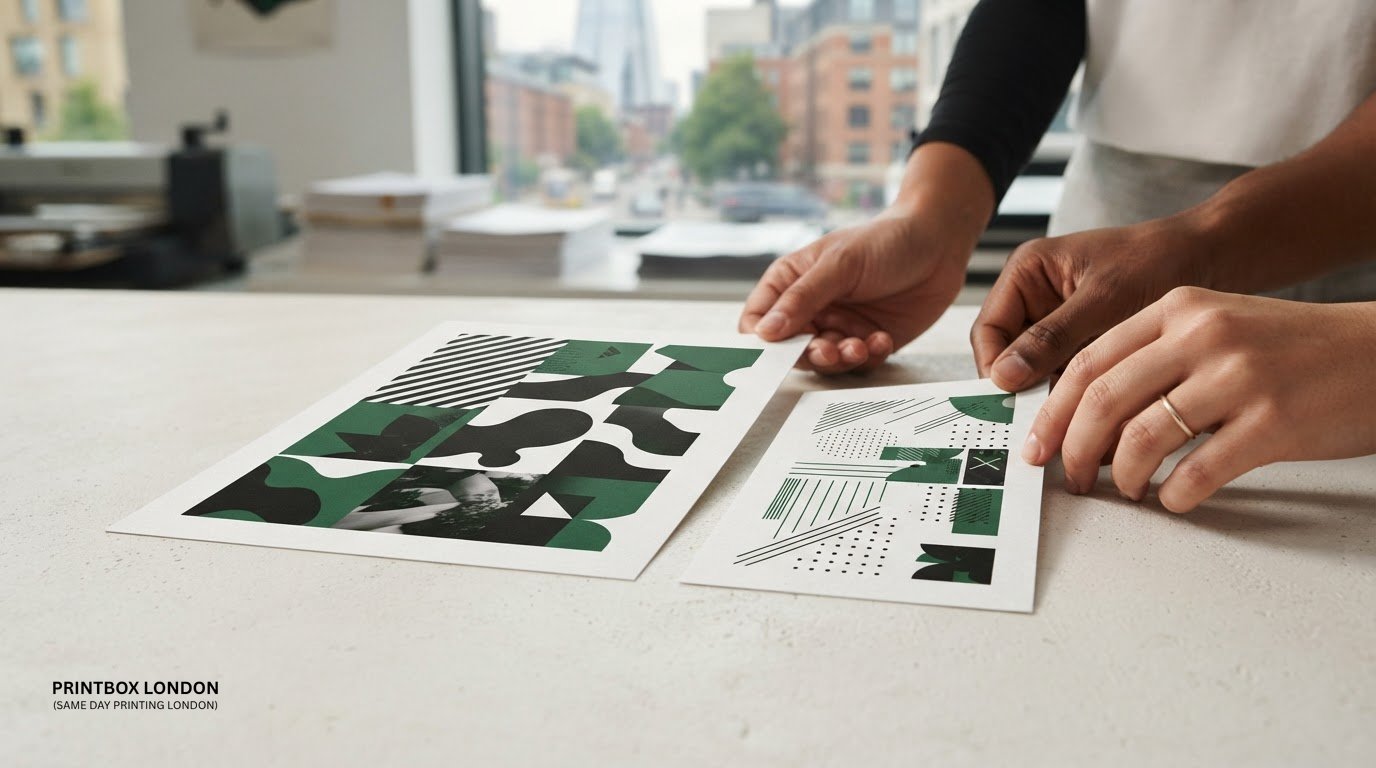
The smaller flyer isn’t always the simpler choice. A6 is compact and easy to hand out, but A5 gives your message twice the space. Choosing between A5 vs A6 flyers comes down to what people need to read and how you plan to distribute them.
If you’re unsure whether A6 leaves enough room or A5 will be awkward to carry, start with the information your flyer needs to communicate. This guide compares the dimensions, readability and practical uses of both formats, so you can match the size to your campaign rather than guess. You’ll also find out when A6 suits a short promotion or invitation, when A5 works better for more detail, and what to check before requesting a print quote, including quantity, material, finishing and artwork readiness.
Key Takeaways
- A5 vs A6 flyers differ in both space and portability: A5 measures 148 × 210 mm, while A6 measures 105 × 148 mm.
- Consider A5 for content such as service information, event details or a small menu that needs more room for text and images.
- Choose A6 when a concise message needs to be easy to carry and hand out. Keep the copy and imagery focused.
- Make your choice by checking the message first, then the available space and how people will receive the flyer.
- Before requesting a quote, confirm the finished size, quantity, single- or double-sided printing and material with Printbox London (Same Day Printing London).
A5 vs A6 flyers: the size difference at a glance
A5 gives you more room for copy and images; A6 is smaller, more compact and easier to carry. The right choice depends on how much your campaign needs to say and how people will handle the flyer.
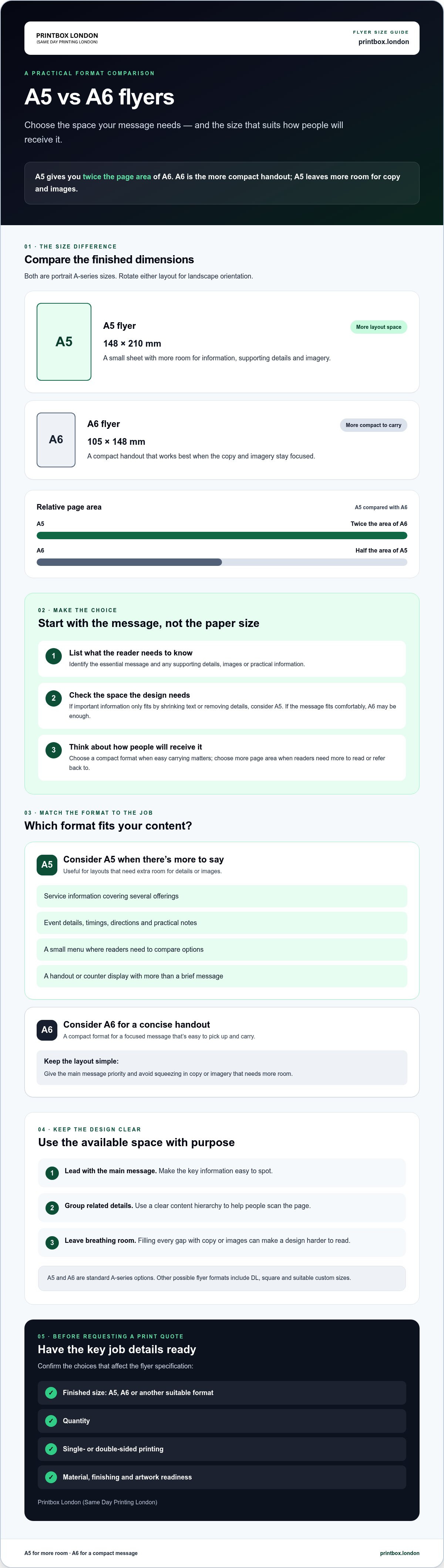
A5 flyers measure 148 × 210 mm and A6 flyers measure 105 × 148 mm, so an A5 page has twice the area of an A6 page. These are portrait finished sizes; either can be turned to landscape by rotating the layout. Both belong to the ISO A-series, where each size has a distinct page area and each step down halves the previous size. See the international paper size standard for background on the system.
| Format | Finished dimensions | Relative space | Likely use | Main trade-off |
|---|---|---|---|---|
| A5 | 148 × 210 mm | Twice the area of A6 | Information or imagery that needs more room | Less compact to carry |
| A6 | 105 × 148 mm | Half the area of A5 | A short message or compact handout | Less room for copy and images |
What are the exact A5 and A6 flyer dimensions?
For a portrait layout, A5 is 148 mm wide by 210 mm high. A6 is 105 mm wide by 148 mm high. These are the finished page dimensions, defining the space available for your layout before allowing for margins or any bleed required in the artwork. More page area can make it easier to arrange several pieces of information, but it doesn’t mean every campaign needs the larger format.
These are standard A-series choices, not the only possible flyer shapes. A campaign may suit another format, such as DL, square or a suitable custom size. Printbox London (Same Day Printing London) offers A6 flyer printing as one of its flyer options.
How does flyer size affect the first impression?
In the hand, A5 feels more like a small sheet to read, while A6 is closer to a compact card. A5 can give a headline, supporting details and an image more breathing room. A6 is convenient to pick up and carry, but asks you to keep the message focused. Neither format guarantees more attention. Choose based on the information people need and how they’ll receive the flyer.
When A5 flyers suit a message with more to say
Choose A5 when your campaign needs room for several useful details, supporting images or both. It can suit a service overview, event information with timings and directions, or a small menu where readers need to compare options. The extra space gives you more layout flexibility, but it won’t make a crowded design clear by itself.
Does your campaign need A5 flyer space?
Before settling on A5, list what the reader needs to know or do. Does the flyer need to explain several services, show event details, include directions or make a call to action easy to spot? If the essential message fits comfortably in a smaller format, A6 may be enough. If reducing the design means shrinking text or dropping important information, A5 is worth considering.
Use the extra area with purpose. Put the main message first, group related details together and leave space around key elements. A clear heading and content hierarchy help readers scan the page. Filling every gap with extra copy or images can have the opposite effect. The University of Florida’s Anatomy of a flyer also explains how visual hierarchy and white space contribute to an organised design.
Where can an A5 flyer work well?
A5 can be practical when someone has a moment to read, keep or refer back to the information. For example, a business might use it as a handout introducing several services, an event organiser might include a schedule and venue details, or a café might present a small menu. These are possible uses, not a guarantee of campaign results.
- Handouts: Consider A5 if the reader needs more than a headline and a brief offer.
- Counter displays: A larger page can make details easier to arrange when flyers are available for people to pick up.
- Event information: A5 may suit a programme of timings, directions and practical notes in one place.
Think about where the flyer will sit and how people will take it away. If compact carrying matters more than including extra detail, a smaller format may be more convenient. A5 is one option among A-series, DL, square and suitable custom flyer formats. The right size depends on your content and print requirements. You can review A5 flyer printing options once you’ve decided the format fits your layout.
When A6 flyers make a compact campaign easier to handle
A6 suits a focused message that needs to be easy to pick up, carry and hand out. It can work for a short offer, an event reminder or a contact-led message, where a clear headline and one main next step matter more than extensive detail. These are examples, not fixed rules. The right format depends on the content and how people will receive it.
The trade-off is space. A smaller page gives you less room for copy and imagery, so a long explanation or several competing messages can quickly feel cramped. When deciding between A5 vs A6 flyers, check what must stay on the page before choosing the compact option.
Is A6 large enough for your flyer message?
Check whether the finished design can comfortably include three essentials:
- A headline that makes the subject clear.
- Key details such as the offer or event information people need.
- A next step, for example, a contact detail or clear call to action.
If these elements don’t fit without crowding, edit the message before reducing the type size. Remove secondary copy, use a shorter explanation and keep imagery focused. Important text shouldn’t have to compete for space. Final readability depends on the design itself, including type size, contrast, spacing and the conditions in which someone reads it. A proof viewed on screen may not feel the same as a printed flyer held in the hand.
When is a compact A6 format practical?
A6 can be convenient for hand-to-hand distribution, event reminders and inserts where a smaller handout is easier to manage. For example, a brief invitation with a date, venue and response route may suit a compact layout. If recipients need to compare several services or follow detailed directions, the limited space may make another format more appropriate.
Plan distribution alongside the message. A flyer handed out quickly has different handling needs from one intended to present several pieces of information. The A-series system keeps a consistent shape across sizes; the international standard for paper sizes explains how those proportions are maintained. That doesn’t make A6 the right choice for every campaign, and the format alone says nothing about postage eligibility or cost.
Printbox London (Same Day Printing London) offers A6 alongside A-series, DL, square and suitable custom-size flyers. Once you’ve checked the message and distribution plan, review the A6 flyer printing options to compare the format with your artwork needs.
Choose between A5 and A6 using your content and distribution plan
Make the choice in four steps: define the message, check how much space it needs, consider how people will receive it, then set up the artwork at the intended finished size. This keeps the decision grounded in your campaign rather than a general preference for a larger or smaller flyer.
How much information does the flyer need to carry?
List the elements that must appear:
- A headline that identifies the message.
- The offer, purpose or reason to take notice.
- Essential details, such as dates, times or contact information.
- A clear next action for the reader.
If these need more breathing room, A5 may give the layout greater flexibility. If the copy is concise, A6 may be enough. Size alone doesn’t determine readability. A busy layout, unclear imagery or text set too small can make either format difficult to scan. Keep the heading prominent, group related details and remove secondary copy before squeezing essential text into the design.
How will people receive and read the flyer?
Think about how recipients will use it. A flyer handed out quickly needs its main point to register at a glance. One people are expected to keep and consult may need more room for supporting details. Consider where recipients will read it and how long they’re likely to handle it.
For example, a concise event handout with a date, venue and booking detail could suit A6 if everything fits clearly. If it also needs a schedule, directions and several supporting details, A5 may be a more practical starting point. That’s one scenario, not a rule for every campaign.
Once you’ve chosen the format, prepare the artwork to match its finished dimensions. Don’t design at one size and assume it can be reduced or enlarged without affecting text, image placement or spacing. For a detailed file setup checklist, refer to Preparing Flyer Artwork: A Practical Print-Ready File Guide. Printbox London (Same Day Printing London) offers A-series, DL, square and suitable custom-size flyers, so you can consider the format alongside your design and distribution plan.
Prepare the right-size artwork and arrange flyer printing in London
A5 gives a design more room for information and imagery; A6 keeps the handout compact. Once you’ve settled on a size, make sure the artwork matches the finished format. A file prepared at the wrong dimensions can affect how text, images and spacing appear on the printed page.
What details should you confirm before ordering flyers?
- Product and finished size: for example, A5, A6, DL, square or a suitable custom format.
- Quantity: how many copies you need.
- Print sides: whether the design is single-sided or double-sided.
- Material and finish: state your preference for material or thickness and any finishing requirements.
- Timing and collection or delivery preference: share your deadline and ask which arrangements are available for your order.
Supply the final artwork at the intended finished size. PDF is the preferred format. Check that the page dimensions match your chosen flyer size, raster images are suitable for the final size at 300 dpi, and colour is set to CMYK. Include a 3 mm bleed where relevant, as bleed requirements are not universal for every product. Keep text within safe margins and check that images are clear. Requirements can vary by job, so don’t assume every file is immediately print-ready. For more help with file setup, refer to Preparing Flyer Artwork: A Practical Print-Ready File Guide.
How can London customers check availability?
Same-day flyer printing is available for selected quantities and specifications. Turnaround depends on the complete job, including quantity, size, material, artwork readiness, finishing, stock and current production workload. Confirm these details and your deadline before arranging the print run.
Collection is from the verified shop at 52 West Green Road, South Tottenham, London N15 5NR, once the order is confirmed ready. Printbox London (Same Day Printing London) serves customers across Greater London, including Central London, North London, East London, South London and West London, as well as Haringey, Hackney, Islington, Camden, Enfield, Barnet, Westminster, Newham, Redbridge and Waltham Forest. Tottenham is the physical shop location; the other areas are service areas, not branches. If you prefer delivery, include that in your enquiry so the available arrangements can be confirmed for your order.
Choose your flyer size and get your artwork ready
The decision between A5 vs A6 flyers comes down to your message and how people will receive it. Choose A5 when you need more space for details or imagery; choose A6 when a concise message and easy handling matter most. Either way, keep the key information clear and prepare the artwork at the intended finished size.
Printbox London (Same Day Printing London) offers A5, A6 and other A-series flyer formats, as well as DL, square and suitable custom sizes. Before requesting a quote, confirm your size, quantity, material, print sides and artwork. Same-day printing is available for selected quantities and specifications, with turnaround depending on the order.
With the format matched to your campaign and the print details confirmed, you’ll be ready to move ahead with confidence.
Frequently Asked Questions
What is the difference between A5 and A6 flyers?
A5 measures 148 × 210 mm, while A6 measures 105 × 148 mm. A5 provides more page area for information and imagery; A6 is the more compact format. The right choice depends on how much your flyer needs to communicate and how recipients will receive or read it. Neither size suits every campaign automatically, so consider your message and layout before choosing.
Are A5 or A6 flyers better for a business promotion?
Neither is automatically better. A5 can suit a promotion with several details, images or sections, whilst A6 can work for a short offer, reminder or contact-led message. First decide what readers need to understand and do. Then choose the format that presents those essentials clearly. Avoid overcrowding a smaller design or adding unnecessary copy simply to fill a larger page.
Can you fit a detailed design on an A6 flyer?
Yes, but A6 has less space than A5, so keep the layout focused. Make the headline, essential information and next step easy to find. Remove secondary copy before shrinking important text to an uncomfortable size. Check the design at its finished dimensions, not only on screen. If the information still feels crowded, A5 may give you more room to organise it.
How do I choose between A5 and A6 flyers?
Write down the main message, supporting details and call to action first. Then consider whether the design needs images and how recipients will receive, read or keep it. Choose A5 if the content needs more room; consider A6 for concise copy and a compact handout. Before preparing the artwork, confirm the finished dimensions so the layout is built for the intended print size.
Can A5 and A6 flyers be printed double-sided?
Printbox London (Same Day Printing London) asks customers to specify single- or double-sided printing where relevant. Confirm your preference alongside the finished size, quantity and material when discussing the job. If you use both sides, plan the layout so each has enough room for readable content and a clear hierarchy. Availability and turnaround can depend on the complete print specification.
Is same-day printing available for A5 and A6 flyers in London?
Same-day printing is available for selected flyer quantities and specifications in London. Turnaround depends on the order, including its quantity, material, finishing, artwork readiness, stock and production workload. Contact Printbox London (Same Day Printing London) with your finished size, quantity, print requirements, artwork and deadline to check availability for your particular job. Don’t assume every specification has the same turnaround.
What artwork file should I provide for A5 or A6 flyer printing?
PDF is the preferred artwork format, but the file still needs to suit the intended finished size. Check the page dimensions, image quality, layout and any relevant bleed or safe margins before submitting it. Requirements can vary with the product and specification, so a PDF isn’t automatically print-ready. Send the final artwork and ask Printbox London (Same Day Printing London) if you’re unsure whether it’s suitable.
Article by
Printbox London Team
The Printbox London (Same Day Printing London) team provides practical printing guidance based on real customer requirements and day-to-day print production. We serve customers across Greater London from our Tottenham print shop, with same-day printing available for many products depending on quantity, specification, artwork and production capacity.