
5 ways to transport A0 posters, from tubes to flat packing
Oct 29, 2026
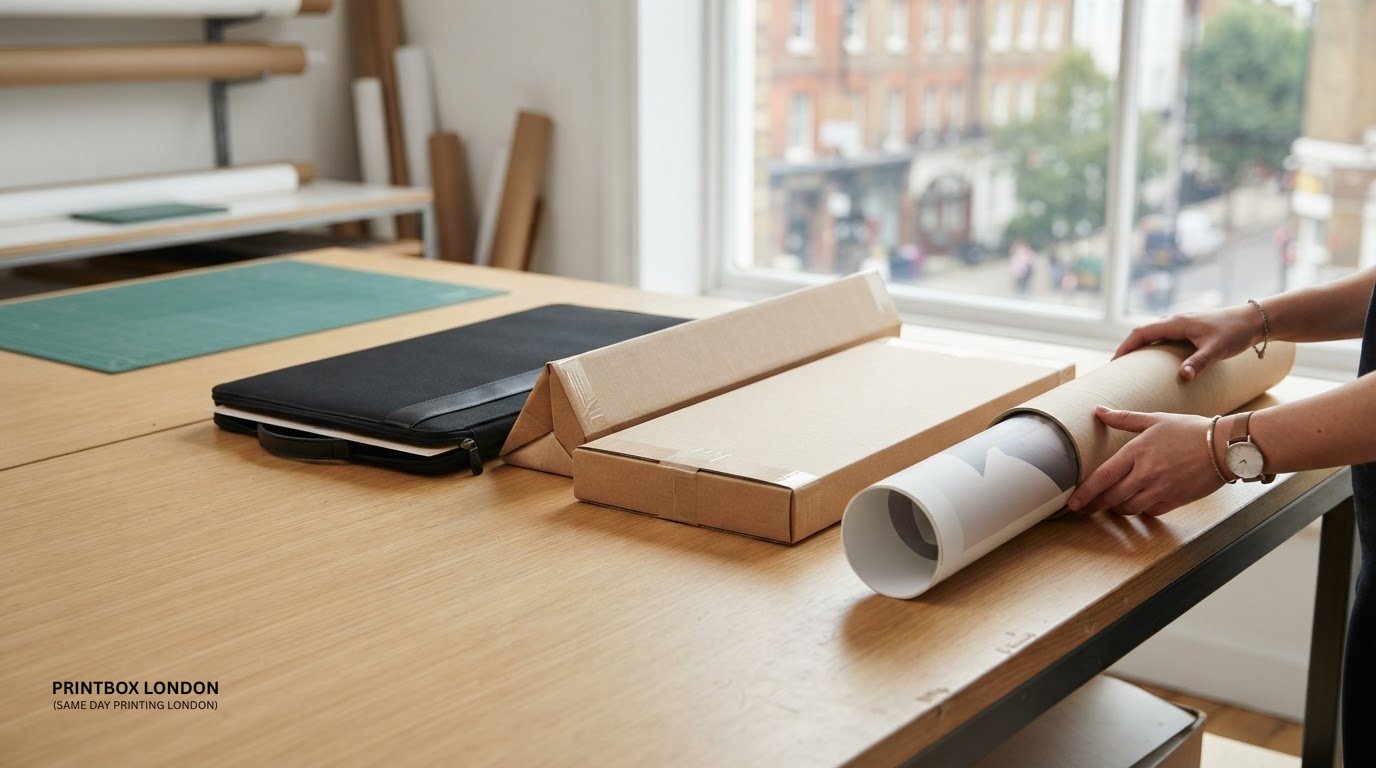
A tube isn’t always the best way to transport A0 posters. Roll a flexible poster inside a protective tube when carrying it flat would be awkward; choose a rigid flat pack when the print needs to stay unrolled, or use a triangular box for a sturdy alternative that won’t roll around. The right choice depends on the poster and how it needs to arrive.
Rolling a large print makes it easier to carry, but tight rolling or rough handling can leave it curled or creased. That’s why the packaging, the way you hold the poster and how you store it after the journey all matter.
This guide compares five practical transport options, including tubes and flat packing. You’ll learn how to handle and store A0 prints, reduce curling and choose an approach that suits your poster and journey.
Key Takeaways
- Choose between a tube, a rigid flat pack and a triangular box based on how your A0 poster needs to travel.
- Handle the print carefully and support it properly to help avoid creases and surface damage.
- Use suitable packing and storage to reduce curling before and after the journey.
- Match the tube’s length and width to the poster so it fits without being forced into shape.
- Rolling can protect a flexible drawing in transit, but flat packing is preferable when it needs to stay unrolled.
1. Alternatives to tubes for shipping
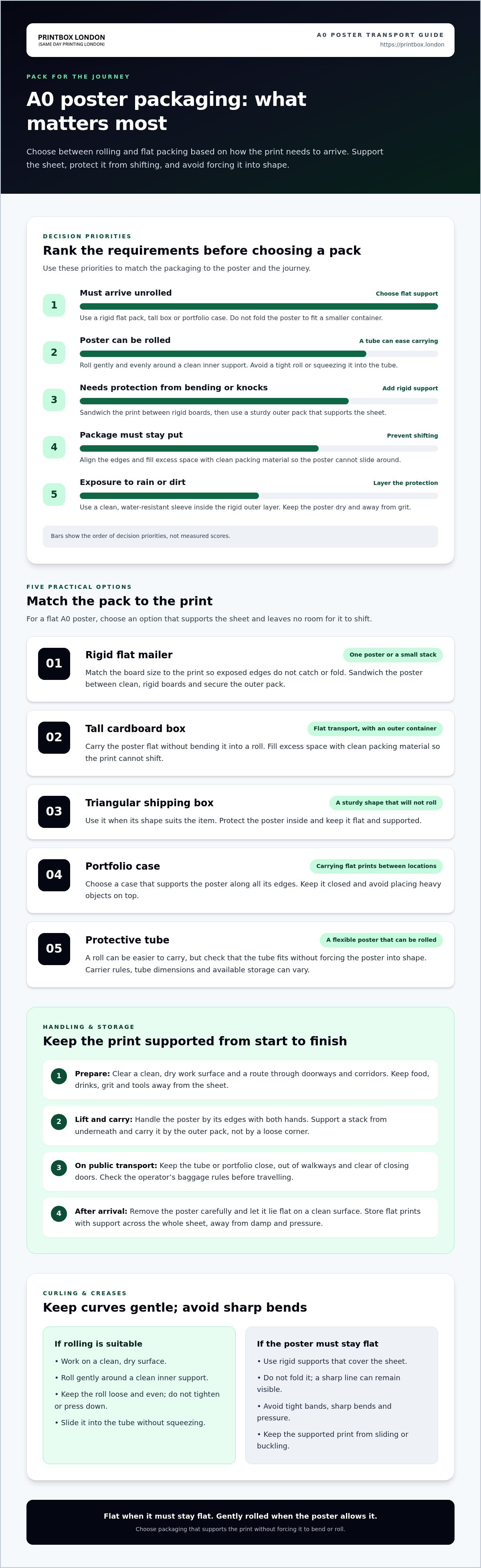
For an A0 poster that should stay flat, choose a rigid cardboard pack, a tall box or a portfolio case. UK prices for tubes and portfolio cases vary with dimensions, material, closure and construction. Those details affect the cost, so compare the features you need before choosing a pack.
A tall cardboard box can carry a flat poster without bending it into a roll. A triangular shipping box is another option for large paper prints, and its shape helps keep the package from rolling. Whichever you choose, make sure it supports the poster, leaves room for protective layers and keeps the print from shifting.
Flat packing is best when a print must arrive unrolled. Place the poster between clean, rigid boards and secure them so they cannot slide apart. Keep tape on the outer packaging, never on the poster or printed surface. A portfolio case can carry flat sheets, provided it supports the poster along all its edges.
Rain, dirt and crushing call for different layers of protection. Place the poster in a clean, water-resistant sleeve, with enough room to avoid pressure marks. Sandwich it between rigid card or boards, align the edges, then put the bundle in a sturdy box or portfolio case. The sleeve helps shield the print from moisture and dirt, while the rigid outer layer helps resist bending and knocks.
- Rigid flat mailer: Use for one flat poster or a small stack. Match its board size to the print, so exposed edges don’t catch or fold.
- Tall cardboard box: Choose this when a flat pack needs an outer container. Fill excess space with clean packing material, so the poster cannot shift.
- Triangle shipping box: Use its shape to keep large paper artwork contained. Protect the poster inside before placing it in the box.
- Portfolio case: Carry flat prints between locations. Keep the case closed and avoid placing heavy objects on top.
Before travelling, lift the closed package carefully and check that the contents do not move. If the poster must arrive flat, use a supported flat pack rather than bending it to fit a smaller container. Choose packaging for the print and journey, and carry it by the outer pack rather than gripping the poster.
When choosing between the two outer shapes, consider how the package will be handled and stored. A tall cardboard shipping box is described as stable and easy to store without a postal fee because it does not roll. Its non-rolling form can be useful when keeping the package upright or putting it away. Keep the poster supported inside, and use clean packing material to prevent it from shifting.
A triangular shipping box can protect large paper documents or artwork and will not roll. Use it when its shape suits the item, and keep the contents flat and supported inside. With either option, align the rigid support with the poster’s edges and leave no room for it to slide. Choose packaging that protects the paper without forcing it to bend or roll.
2. Guidelines for handling, storing and moving posters
An A0 tube isn’t automatically accepted on every UK train, bus or flight. It depends on the operator’s baggage rules, the tube’s dimensions and available storage, so check the relevant carrier’s policy before travelling. A tube that fits one train’s luggage space may not suit a coach or aircraft.
To roll an A0 poster, work on a clean, dry surface and handle it by the edges. Roll it gently around a clean inner support, with the printed side facing outwards where the material allows. Avoid pressing down, tightening the roll or forcing the edges into alignment. Slide the roll into its tube without squeezing it.
Folding an A0 poster is not a safe choice if you need an uncreased print. A fold creates a sharp line that can remain visible, so keep the sheet flat or roll it gently instead.
To carry several posters, stack them with clean protective sheets between prints, then place the bundle in a rigid portfolio or flat pack. Align the edges and support the stack from underneath. Carrying loose sheets by a corner can bend or crease them.
Clean hands and a clear work surface help prevent damage. The London Transport Museum’s collection care guidelines cover handling, storage and moving posters within museum collections. Apply the same care to a newly printed sheet: clear away food, drinks and tools, then lift the poster with both hands. Do not drag it across a table or grip the printed face.
If no cardboard envelope is available for small drawings, place them between two sheets of thick cardboard. For an A0 print, use rigid supports that cover the full sheet instead of leaving corners exposed. Keep the package dry and away from grit, which can scratch or mark the surface when it shifts.
Store a flat poster with support across its whole area, away from damp and pressure. Do not lean an unprotected sheet where it might slide, buckle or catch on furniture. If storing a roll, keep it inside its tube and do not put heavy objects on top.
- Before moving: Clear a route through doorways and corridors, then hold the package securely.
- On public transport: Keep the tube or portfolio close, out of walkways and clear of closing doors.
- After arrival: Remove the poster carefully and let it lie flat on a clean surface.
For an A0 print that must arrive flat, use a supported flat pack rather than folding it. If a flexible poster can be rolled, a clean, gentle roll helps avoid tight creases and edge damage.
3. Preventing curling
Curling often follows the direction a poster has been rolled or stored. An A0 sheet is large, so unsupported edges can hang and encourage a curve. Choose flat storage when the print must stay flat; if rolling is necessary, keep the roll loose and even. Avoid sharp bends, tight bands and pressure that could turn a curve into a crease.
Before unrolling, clear grit, staples, drinks and tools from the table, then place the poster printed-side up. Hold opposite edges and lower the sheet gradually rather than letting it spring open. If the ends lift, do not press directly on the print. Cover it with clean, smooth card and apply gentle, even support across the curl.
Take a rolled print out of its tube only when you are ready to use or store it. Place the tube on a clean surface, remove the end cap, then ease the poster out without pulling one corner. Let it open naturally. Forcing it flat by hand can crease the paper, especially along an edge that has started to curl.
To help a poster settle flat, place it between clean, rigid sheets and keep the support level. A light, evenly distributed weight on the protective top sheet can hold down the edges. Avoid placing books, clips or heavy objects directly on the artwork, as concentrated pressure can leave dents or marks. Check the sheet before adding weight.
- Match the pack to the print: Use a flat, supported pack if curling would affect display or handling.
- Keep a roll consistent: Roll smoothly, without tight spots or crushed ends, and use a tube that lets the print slide in easily.
- Limit movement: Secure the outer pack so the poster cannot shift, rub against rough surfaces or press against a hard edge.
- Store it supported: Keep a flat poster on a clean, level surface, rather than leaning it where its own weight can bend an edge.
Separate prints with clean sheets before stacking to reduce rubbing between printed faces and prevent a curled edge pressing into another poster. Keep the stack aligned and supported underneath, then check the corners after moving it. If a sheet starts to lift, adjust the support rather than bending the corner back.
For display, support the poster’s top edge evenly to help prevent it curling. Choose the best way to transport A0 posters by considering how the print will be stored and displayed afterwards. A print that must remain flat benefits from flat support throughout the journey and at its destination.
4. Tube dimensions and features
Measure the poster before choosing a tube. Note its shorter and longer edges, then compare them with the tube’s usable length and opening. Leave room for a gentle roll and protective wrapping. A tube that is too short can crush the print’s edges, while a narrow opening can force the roll and leave pressure marks.
An A0 poster’s millimetre measurements should match the finished sheet, so measure its actual width and height before packing. The printed area and finished paper edge may differ. Use the physical sheet as your guide, rather than relying only on the artwork file or a label. That check helps you select a tube long enough for the whole rolled poster.
Royal Mail size limits depend on the service and the parcel’s packed dimensions. Both the tube’s length and girth affect its classification, so measure the complete package, including end caps and padding, against the service’s current limits. A poster may fit inside a tube but exceed the parcel size limit once packed.
A cardboard transport tube measuring 64 cm long with an 8 cm diameter is one example, not a universal fit for every A0 print. Compare those measurements with your rolled poster before using a similar tube. The finished package may be longer or wider than the bare tube once its caps and protective layers are in place.
- Check usable length: Measure inside the tube between its closed ends, not just along its exterior.
- Check the opening: Compare its diameter with the roll’s widest point, including any protective sleeve.
- Check the closure: Fit the cap securely without pressing it against the rolled paper.
- Check the packed parcel: Measure the closed tube after wrapping, then compare its dimensions with the chosen postal service.
Tube material and construction matter. Rigid cardboard resists everyday knocks better than a soft sleeve, while a secure end cap helps stop the poster sliding out. Check for splits, crushed ends and loose closures before packing. If the cardboard bends with light handling, it may not support the print adequately during the journey.
Don’t force the poster into a tube simply because its label says A0. Roll the sheet gently, test that it slides in without catching, then remove it if the edges snag. Choose the best way to transport A0 posters by matching the actual print, its protective layer and the complete package to the journey.
London Transport Museum’s Reimagining Historic Posters exhibition featured 21 original prints from its collection. For any print being transported, use the actual sheet and its protective layer to settle the tube dimensions, rather than treating a familiar format as a guarantee. Keep the rolled sheet loose enough to enter and leave without scraping, and ensure the closure holds without bearing on the paper. After packing, reassess the complete parcel: the dimensions of the protected, closed tube are the ones that matter for the journey. These checks help balance a secure fit with room for the print.
5. Why rolled drawings can be better protected
A rolled drawing can be easier to carry than a loose, flat sheet. Inside a rigid tube, the paper stays contained and its edges are less exposed to hands, doorways and other items. This protection can help on a busy journey, especially when carrying a large drawing through a crowded space.
Rolling also avoids a sharp fold across the image. A crease can interrupt fine lines, labels or measurements on an architectural drawing. A smooth roll keeps the sheet curved rather than bending it along one hard line. For plans that need to be read clearly, that distinction matters.
Protect the drawing as you roll it. Start on a clean, dry surface and remove grit that could rub against the printed face. Hold the drawing by its edges and roll it evenly around a clean support, keeping the curve broad and relaxed. Do not squeeze the roll, force the ends together or use tight bands that could dent the paper.
Choose a tube that lets the finished roll slide in without catching. If the opening is too narrow, pushing the drawing inside can crush an edge or create a tight curl. A secure end cap keeps the roll contained, and a sound outer wall helps shield it from knocks. Check for damaged ends before packing.
Rolled transport works for flexible paper drawings that can be unrolled at their destination. It is less suitable if the sheet must remain flat or rolling could damage its surface. In those cases, support the drawing between rigid boards instead. Choose based on the paper, printed finish and how the drawing will be used after the journey.
- Roll gently: Keep the curve even from edge to edge, without pinching corners or tightening the centre.
- Protect the print: Use a clean protective layer between the drawing and the tube where needed.
- Carry the tube securely: Keep it from being crushed under bags or caught against hard edges.
- Unroll with care: Set the tube on a clear surface, remove the cap and ease the drawing out steadily.
A technical plan carried to a meeting, for example, may be easier to transport rolled than held open across both arms. At the destination, place it on a clean table and unroll it without pulling one corner. If it resists opening, let it relax gradually instead of pressing hard along the edges. This helps preserve the surface and printed detail.
Choose a roll when portability and edge protection matter more than keeping the sheet flat during transit. For delicate, finished or display-ready artwork, weigh that convenience against the risk of curling before packing.
Printbox London (Same Day Printing London): Same Day Printing
Printbox London (Same Day Printing London) provides A0 poster printing when you need a new print for a presentation, display or event. Same Day Poster Printing is available depending on the quantity and specification, so share your finished size, print quantity and artwork when arranging an urgent job. A print-ready PDF helps clarify the intended layout and dimensions. If the poster needs to travel rolled, plan its protective packaging separately so the print stays supported on the journey. For larger or more complex requirements, turnaround depends on the job details. Contact Printbox London (Same Day Printing London) to discuss your poster printing requirements or visit printbox.london.
Plan the print around its destination
Plan the journey as well as the print. Before ordering, consider where the poster will be displayed, how you will carry it through the venue and whether it needs to travel with other campaign materials. These details help you choose a format and prepare suitable artwork.
The best way to transport A0 posters depends on how the finished print will be handled at its destination. Give Printbox London (Same Day Printing London) the finished size, quantity, artwork and intended use when discussing a poster order. Same-day printing is available for selected quantities and specifications, so include your deadline when you get in touch. Same Day Flyer Printing is also available for selected quantities and specifications.
A clear plan for the print and its journey makes the next step simpler. Share the essential job details and move ahead with confidence.
Frequently Asked Questions
What size poster tube fits an A0 poster?
Choose a tube with usable internal length longer than the edge running along the roll. An A0 sheet measures 841 × 1189 mm, so the required length depends on how you orient it. Before buying, roll the actual poster gently with any protective sleeve, then measure the finished roll’s length and widest point. Check the tube’s internal dimensions, not just its external measurements or advertised size.
Are rigid poster tubes or flat portfolio cases better for transporting A0 posters?
A rigid tube suits a flexible poster that can travel rolled, particularly if you will carry it through crowded spaces. Choose a flat portfolio case when the print must stay unrolled, such as artwork that needs to arrive ready for immediate display. For example, use a case for a presentation poster that must lie flat on arrival, and a tube when portability matters more.

Article by
Printbox London Team
The Printbox London (Same Day Printing London) team provides practical printing guidance based on real customer requirements and day-to-day print production. We serve customers across Greater London from our Tottenham print shop, with same-day printing available for many products depending on quantity, specification, artwork and production capacity.