
5 Ways to Make Printed Marketing Materials Last Longer Through Design
Oct 31, 2026
Making printed marketing materials last longer starts with planning how people will use them, not just how the artwork looks on screen. A piece has a longer useful life when it stays relevant, easy to understand and worth keeping. Think beyond the moment it is handed out: what should readers remember, and what might they need to refer to later? Those answers give the design a practical purpose.
Durability is not simply a matter of choosing heavier paper or adding a protective layer. The design, print quality and setting all affect whether a piece remains useful and visible. This guide covers five connected decisions: matching the material to its purpose, choosing suitable paper, preparing the print, selecting finishes and considering ink. It also looks at how business cards, brochures, flyers and leaflets can remain useful beyond an initial campaign. Use these principles to create print that supports your message over time and gives readers a reason to keep it.
Key Takeaways
- Start with the job each item needs to do, then make its message, contact details and next step easy to find.
- Choose paper and print quality to suit how often the material will be handled and how long it should stay in use.
- Use a clear layout and readable text so people can understand the message at a glance and return to it later.
- Match the finish and ink to the material’s purpose rather than adding treatments that don’t improve its usefulness.
- Plan business cards, brochures, flyers and leaflets around how people will carry, keep or refer to them.
1. Designing print materials for a clear purpose and longer use
Give each printed piece one clear purpose before you design it. A business card introduces someone and keeps their contact details to hand. A service brochure can explain an offer, answer common questions or serve as a reference. That purpose helps you decide what to include and what to leave out. To make printed marketing materials last longer, keep the core message useful after a specific campaign ends.
Plan for the reader’s next step. Include the contact method they are most likely to use, such as a phone number, website or email address, and make the call to action specific. “Book a consultation” is more direct than “Find out more”. If a QR code links to a web page, label its destination so readers know what they will find before scanning.
Make the design easy to scan. Establish a clear order with a prominent headline, supporting details and a visible action. Choose type that remains legible at the finished size, and use images that explain or reinforce the message. For example, a product leaflet can pair a concise benefit with a relevant image instead of squeezing in unrelated pictures and competing headlines.
Consistent branding helps separate print items feel like part of the same business. Use the same logo, colour palette and type style across a flyer, brochure and business card. Teams like Framework Creative specialise in developing cohesive visual media and brand assets that carry impact across different formats. The pieces do not need to look identical: keep recognisable brand elements, then adapt each layout to its format and role in different campaigns.
Build flexibility into artwork you plan to reuse. Separate evergreen information, such as a service overview, from details that change, such as an event date or seasonal offer. A reusable guide might contain a checklist or reference information, with a separate panel for campaign-specific content. This makes updates more focused and lowers the risk of outdated wording carrying over to a new print run.
Before approving a design, review it at the finished size and from a reader’s perspective. Can someone find the main point quickly? Are the contact details easy to spot? Does the call to action make sense without explanation? Thoughtful spacing, aligned elements and purposeful images can make a design feel polished without relying on decoration.
- Set one purpose and one main message for the item.
- Make contact details and the next action easy to locate.
- Keep reusable content separate from dated campaign details.
- Check readability at the intended finished size.
When the design works across formats, it is easier to keep campaign materials consistent without making every piece a copy. Explore marketing materials as you decide which printed format best supports the task.
2. Choosing high-quality paper and printing
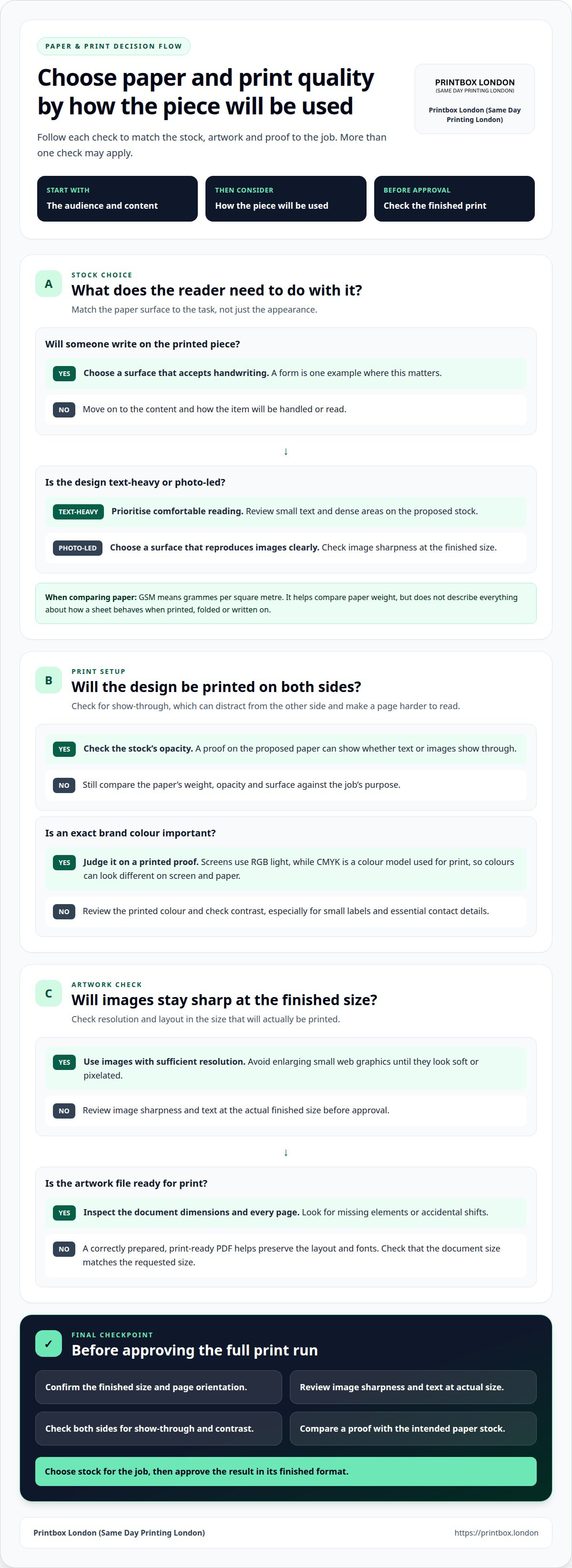
Choose paper to suit the audience, content and intended use. A text-heavy information sheet needs to be comfortable to read, while a promotional card may benefit from strong colour and a firm feel. Compare suitable stocks using the same artwork. Handling samples makes differences in weight, opacity and surface easier to judge than technical descriptions alone.
GSM means grammes per square metre and describes paper weight. It helps when comparing stocks, but does not tell you everything about how a sheet performs. Ask how the paper behaves when printed, folded or written on. A form, for example, needs a surface that accepts handwriting, while a photo-led design needs a surface that reproduces images clearly.
Check opacity when the design is printed on both sides. If text or images show through, they can distract from the other side and make the page harder to read. A proof on the proposed stock can reveal this before a full print run. Review dense areas, fine lines and small type under normal viewing conditions, not just on a bright monitor.
Print quality also relies on the artwork file. Use images with sufficient resolution for the finished size, and do not enlarge small web graphics until they look soft or pixelated. A correctly prepared, print-ready PDF helps preserve the layout and fonts. Check that the document dimensions match the requested size and inspect every page for missing elements or accidental shifts.
Review colour with the final print in mind. Screens use RGB light, while CMYK is a colour model used for print, so the same colour can look different on screen and on paper. If a brand colour is important, judge it on a printed proof. Check text and background contrast, especially for small labels and essential contact details.
Before choosing a stock, describe the job in plain terms: where the item will be used, what it needs to communicate and whether readers will write on it. Ask for clear explanations of terms such as weight, opacity and finish. A useful explanation links each option to your needs, so you can decide based on function rather than jargon.
Use a final pre-approval check to catch production problems:
- Confirm the finished size and page orientation.
- Review image sharpness and text at actual size.
- Check both sides for show-through and contrast.
- Compare a proof with the intended paper stock.
Good paper and accurate printing work together. Choose stock that suits the content, then approve the result in its finished format before printing the full quantity.
3. How printed marketing materials can remain visible for longer
Printed materials stay visible when people can keep, display or revisit them. A useful piece may remain with a customer for days, weeks or longer. Extend its useful life by matching the format to where it will be seen and protecting it from handling, light and moisture.
To make print last longer, choose a useful format, place it where the intended audience will notice it and protect it from damage. Display a poster in a sheltered indoor position, for example, or leave a brochure where customers can pick it up again.
Store spare copies flat in a clean, dry place away from direct sunlight, damp and heat. Keep brochures and flyers in a folder or closed drawer, and avoid placing heavy items on top. Store posters in a protective tube or flat portfolio, and separate sheets to prevent rubbing, creases or ink transfer.
Placement affects how long a piece stays visible. Put a notice where people naturally pause, such as beside a reception desk or on an indoor noticeboard. Keep it at a readable height and away from competing signs. A holder near a till or enquiry desk keeps business cards easy for customers to take.
For outdoor use, limit exposure: keep brochures and flyers under cover, and bring them inside when they are not needed. Wind, rain and direct sun can crease a poster, make it damp or fade its colours. If an outdoor display is necessary, use a suitable protective enclosure and secure it against movement. A finish alone does not protect against every weather condition.
To clean printed signs and displays, identify the surface and follow its care instructions. Remove loose dust with a clean, soft cloth; if needed, use a lightly damp cloth and dry the surface afterwards. Avoid abrasive pads, strong solvents and soaking, which can mark the print or damage its edges. Test a cleaning method on a discreet area first.
Visibility depends on more than physical condition. A faded, hidden or outdated message stops working even if the paper is intact. Check displayed materials regularly: replace copies with unreadable text, update changed details and remove items when an offer or event ends. This keeps current information in view.
Print can complement digital marketing. A poster or brochure can direct readers to a relevant web page or social media account, while the printed piece remains available for later reference. Use a clear prompt and an easy-to-scan QR code, and keep the linked page useful.
4. Matching paper, finish and ink to the intended lifespan
A short-lived handout and a frequently handled brochure need different protection. Choose paper, finish and ink for the message, setting and likely handling. To make printed marketing materials last longer, do not add a finish automatically. Select one that addresses a real concern, such as scuffing or moisture.
Lamination adds a protective layer over a printed sheet and can help guard against handling and surface marks. UV coating applies a cured coating to selected areas or a surface, while varnish adds a clear coating for protection and appearance. Performance depends on the material and application, so these finishes are not interchangeable guarantees against every kind of wear.
The cost of durable print finishes in the UK depends on the job and is provided after a quote request. Factors include size, quantity, paper and chosen finish.
Whether laminated or coated print can be recycled depends on its materials and local facilities. Added layers can complicate recycling if paper fibres need to be separated from coatings or film. If easy recycling is a priority, consider an unlaminated design and check local disposal guidance for the finished item.
Paper choice sets the foundation. A short-term flyer or mailer can use lightweight paper, including recycled or FSC-certified options, while a piece intended for repeated handling may suit heavier, more durable stock. Choose for the format and use rather than assuming the heaviest paper is always best.
Ink and artwork affect how a print holds up. For longer-lasting print, consider how ink choice fits the paper, finish and intended use. Large areas of solid colour can require more ink coverage, so use white space deliberately and keep important text readable. Before approving a proof, check that small details and brand colours remain clear at the finished size.
Sunlight, moisture, friction and repeated handling can all contribute to fading, peeling or wear. Direct sun can fade colours, damp can weaken paper, and frequent rubbing can mark exposed surfaces. Store print away from bright windows and moisture, and choose a protective finish when the setting calls for it.
Match protection to likely wear. A display poster that is rarely handled may need a different finish from a menu or brochure passed between customers. For poster lamination, consider the display setting and handling, then weigh surface protection against recycling preferences. Brief the job clearly: explain where the item will be used, how long it needs to remain in service and what damage you want to prevent.
Also consider added weight and recycling implications. Good-quality paper and printing help keep marketing materials effective, especially when the message needs to stay legible through repeated viewing. A printed piece may stay on a noticeboard or in a pile of papers until someone picks it up, so choose stock and ink with that uncertain lifespan in mind.
A 2020 GreenBiz Group survey found that 75% of e-commerce companies still used paper-based packaging. The global paper and packaging market was valued at approximately USD 500 billion in 2020, underscoring the scale of paper use and the value of matching material choices to how a printed piece will be handled.
5. Business cards, brochures, flyers and leaflets
Different formats stay useful in different ways. A business card fits in a wallet or card holder, while a brochure can provide details people return to. Flyers and leaflets often promote a specific service, event or offer, so make their key information quick to find and easy to remember.
On a business card, prioritise the details someone needs after a brief introduction: name, role, phone number, email address and website. Keep type legible at the finished size, and avoid cramming both sides with small text. A clean layout helps recipients find a contact later, even after carrying the card around or putting it aside.
A brochure has more space to serve as a reference. Organise it into clear sections, such as services, opening information or a simple guide. A contents panel, labelled sections or a short checklist can help readers return to relevant details. Avoid relying on temporary campaign copy if the brochure needs to remain useful after one promotion.
Flyers and leaflets can earn a second look by including practical information. A restaurant leaflet, for example, might pair a clear offer with a menu summary, contact details and a prompt to visit the website. A community event flyer could include the date, location and essential attendance information. Make the main message prominent, then arrange supporting details in a logical order.
Physical size affects how people handle and keep a printed piece. A compact flyer can fit into a bag, while a larger format gives maps, menus or product details more room. Flyer formats include A-series, DL, square and custom sizes. Choose the format to suit the content and distribution method, not just habit.
Choose paper to suit how each format will be used. A card or brochure handled repeatedly can benefit from stock selected for durability; a short-term leaflet can use lighter paper. Consider folds too: keep brochure text clear of the fold, and make sure a leaflet remains readable when opened and refolded.
Before printing, check each item at its actual finished size. Confirm spelling, contact details, dates, image quality and margins. For a folded brochure, review every panel in reading order. For a flyer, make sure essential information remains visible when it is displayed or left on a counter.
Printed pieces can stay visible for weeks or months if people keep or display them. Business cards may remain in a holder, and useful leaflets can be picked up later from a noticeboard or a pile of papers. The key is to give each format a reason to be kept, not just a message to see once.
Printbox London (Same Day Printing London): Same Day Printing
Printbox London (Same Day Printing London) can print finished artwork for campaigns and customer use. Choose Same Day Poster Printing for a display, Same Day Flyer Printing for handouts, or Same Day Business Card Printing for networking and enquiries.
Same-day printing is available for selected quantities and specifications. Turnaround depends on factors including size, material, finishing, artwork readiness and production workload. To help the order run smoothly, prepare print-ready artwork and specify the finished size, quantity and any finishing requirements. This helps match production to the intended use, whether the material needs to be easy to distribute or kept for reference.
For an urgent print job, contact Printbox London (Same Day Printing London) with your requirements, or visit printbox.london.
Put your next print campaign to work
Before your next campaign goes to print, decide how long each piece needs to work and what action it should prompt. Use that brief to test every design and production choice: will it help the material stay useful to its audience? Making printed marketing materials last longer starts with this decision, not with adding treatments by default. Note what readers ask about or return to, then use those observations to refine your next print run.
Printbox London (Same Day Printing London) handles urgent print requirements through Same Day Printing, including Same Day Poster Printing and Same Day Flyer Printing. Same-day production depends on quantity and specification, so share the format, quantity and artwork when discussing a time-sensitive job. This helps align the finished materials with their purpose.
Start with a clear brief to give your next campaign a considered foundation.
Frequently Asked Questions
Which paper stocks and finishes are most durable for marketing materials?
No single paper-and-finish combination suits every marketing job. For business cards or reports intended to be kept, choose heavier, durable stock; lamination can help protect surfaces that are handled often. Assess the finished piece as a whole: a coating will not make lightweight paper rigid, and heavier paper alone will not prevent surface scuffs. Base your choice on how the item will be carried, handled or displayed.
What printing methods and inks resist fading, water and abrasion best?
Soy- or water-based inks are recommended for long-lasting printed pieces, but ink choice alone does not establish resistance to water or abrasion. No single print method is best for every material and exposure. Consider the likely risks separately: sunlight can fade colour, moisture can damage paper, and repeated rubbing can mark a surface. Match the protective finish and storage to the conditions the piece will face.
Article by
Printbox London Team
The Printbox London (Same Day Printing London) team provides practical printing guidance based on real customer requirements and day-to-day print production. We serve customers across Greater London from our Tottenham print shop, with same-day printing available for many products depending on quantity, specification, artwork and production capacity.