
5 steps for last minute portfolio review printing
Nov 25, 2026
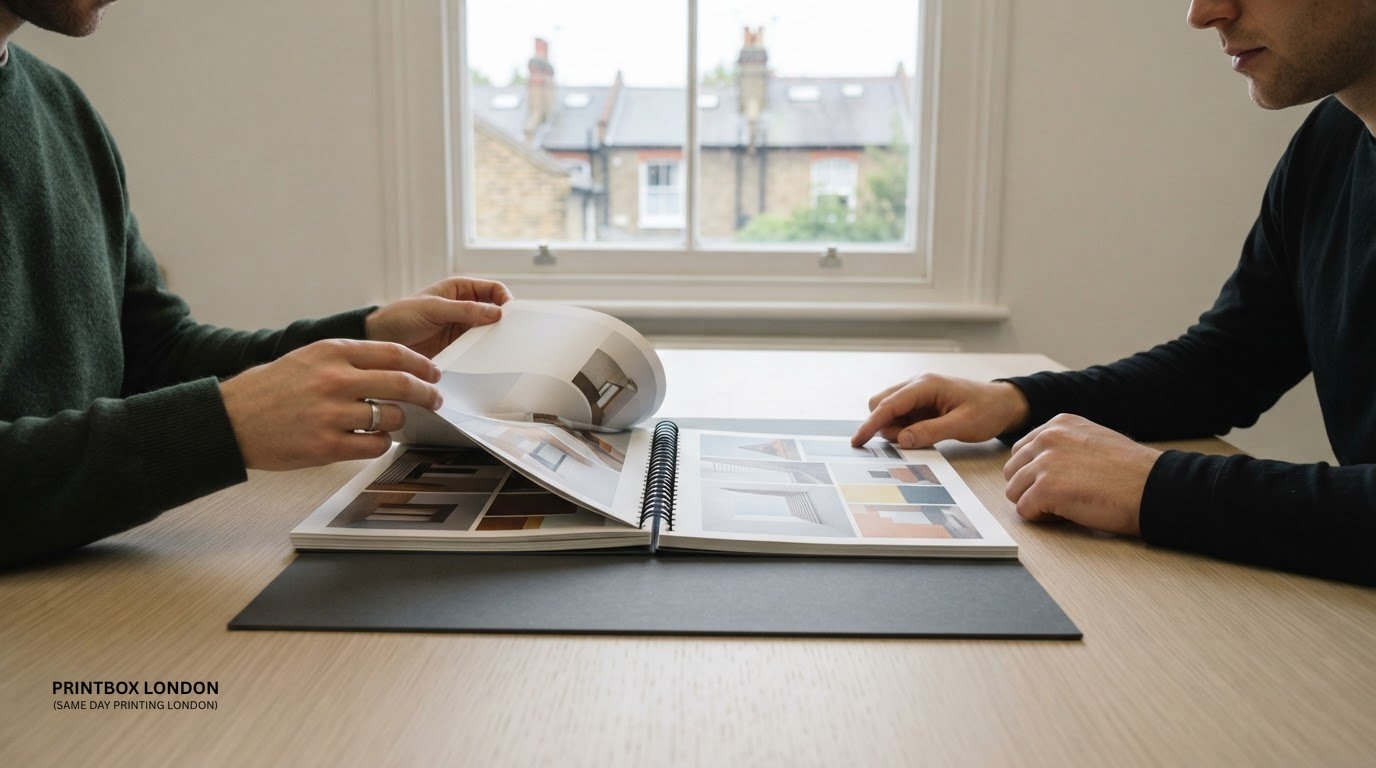
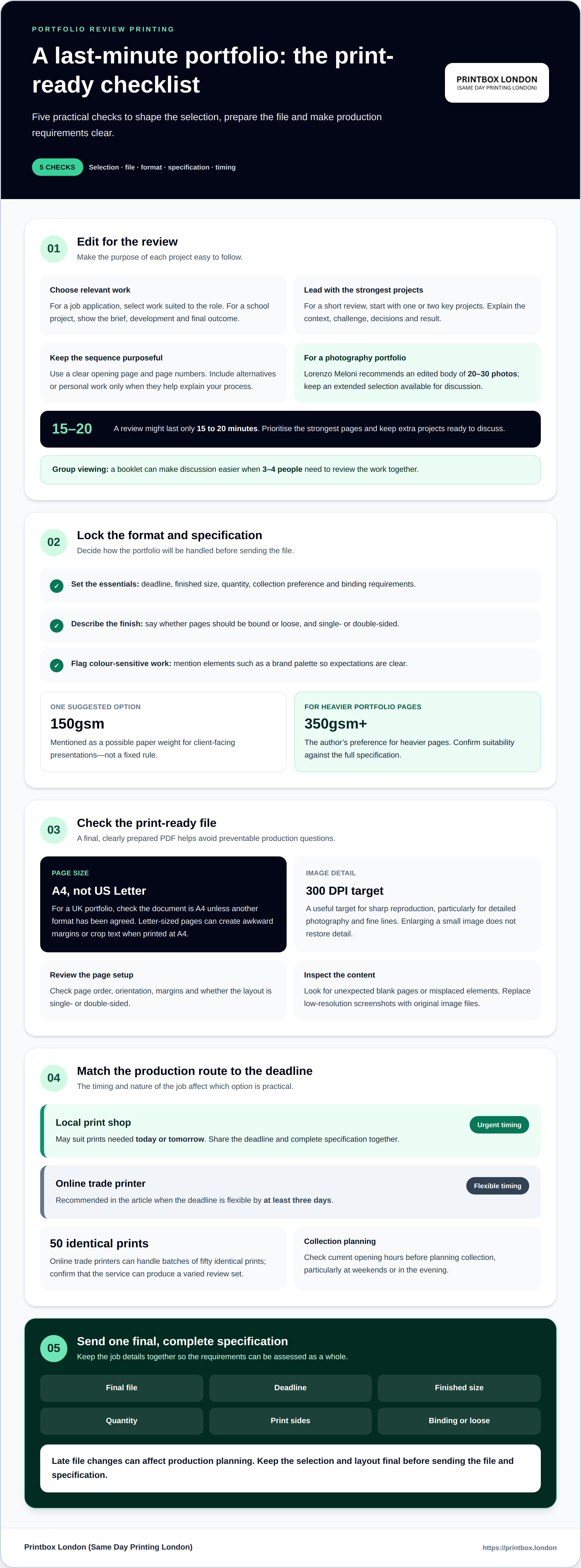
For last-minute portfolio review printing, focus on five decisions: choose the work, finalise the file, select a format, specify print and binding requirements, and allow time for production. The right choices depend on what you’re presenting and how the portfolio will be handled.
A tight deadline makes a final, clearly prepared file especially important. A concise selection is easier to produce than a portfolio that is still changing, and the layout, page count and binding all affect the finished result.
This guide covers five practical steps for preparing a portfolio for review. You’ll learn what details to provide, which file checks matter and how to choose a suitable format, helping the print team move the job forward with fewer avoidable questions.
Key Takeaways
- Choose a focused selection of work that makes your skills and design decisions easy to understand.
- Decide on the portfolio format, page count and binding before sending files for print.
- Prepare a print-ready PDF and check the page size, image quality, margins and layout.
- Share the quantity, specification and deadline clearly so the print team can plan the job efficiently.
- Same-day printing can help with urgent portfolio deadlines, with timing depending on the job’s requirements.
1. Portfolio printing for job applications and school projects
A printed portfolio gives an interviewer or tutor something tangible to review alongside your on-screen presentation. For a job application, choose work relevant to the role; for a school project, show the brief, development and final outcome. Keep the sequence purposeful so the reviewer can understand what you made and why without sifting through unrelated pages.
For a short review, lead with one or two key projects rather than trying to show everything. Explain each project’s context, the problem, your proposed solution and the result. Include a rejected alternative if it helps clarify a design decision. This communicates scope and process without turning the presentation into a step-by-step diary.
Choose work that demonstrates the contribution you want recognised. A student applying for a graphic design course might pair a finished identity with selected sketches and explain how feedback shaped the outcome. A candidate for a senior design role should foreground examples that show advanced skills, influence and craft. Give each image a clear point: what was challenging, what changed and what the final work achieved.
Personal projects can start useful conversations, especially when they show curiosity beyond a formal brief. A self-directed poster series, for example, can demonstrate how you set constraints, test visual ideas and refine a consistent approach. Label it clearly as personal work, then explain the key decision rather than presenting it as client work or overstating its impact.
Photographers should make the printed sequence feel like a complete project, not a random selection of strong frames. Lorenzo Meloni recommends an edited body of 20-30 photos, while an extended selection can remain available for discussion. Use captions or a brief introduction to establish the subject, setting and progression. A coherent edit lets reviewers follow the photographic story without needing to handle every image.
Keep the physical presentation suited to the room. An iPad screen can feel limiting when several people need to view the work together; a booklet can make discussion easier for a group of 3-4. A review might last only 15 to 20 minutes, so prioritise the strongest pages and keep extra projects ready to discuss. Use a clear opening page and page numbers, so reviewers can return to a project during discussion.
2. Choosing a printer for portfolio reviews
Start by setting out your deadline, finished size and quantity. These details help assess the production requirements and turnaround. A portfolio needed today calls for a different plan from one with a flexible deadline. Share the review date, collection preference and binding requirements together so the complete job can be considered from the outset.
Next, explain how the portfolio will be used. A copy handled by a recruiter may need a different feel from loose images for a studio discussion. Paper weight affects how pages feel and handle; 150gsm is one suggested option for client-facing presentations. Treat it as a reference, not a fixed rule. Page count, format, image coverage and binding all shape the suitable specification.
Choose images with your intended audience in mind. If you’re approaching five prospective clients, identify what each values, then select work that demonstrates those strengths. Professional studios like The Photography Co demonstrate this clarity by curating portfolios around distinct subject areas and client briefs. A branding portfolio might foreground identity systems for a business seeking clear visual communication. Keep the collection relevant and varied; several near-identical examples can take space without adding useful evidence.
A suitable reviewer should understand your field and offer specific, constructive feedback. A graphic designer could ask a creative director to assess hierarchy and consistency, while a photography student might seek feedback from someone familiar with sequencing. Give the reviewer context, such as a job description, course brief or target audience. Their comments can help you decide which images deserve prominence.
Production details matter too. State whether pages should be bound or loose, single- or double-sided, and how many copies you need. Mention colour-sensitive work, such as a brand palette, so expectations are clear. For last-minute portfolio review printing, send the final file and full specification together. Late changes can affect production planning.
Opening hours vary between UK print shops, particularly at weekends and in the evening. Check current hours before planning your portfolio collection.
For a time-sensitive London job, share the print specification and deadline to discuss the practical next step.
Choosing between a local shop and an online trade printer is another part of matching production to the job. Local print shops may be suitable when prints are needed today or tomorrow, while online trade printing is recommended when the deadline is flexible by at least three days. The extra time can make the online route practical for work that does not need immediate collection.
For heavier portfolio pages, the author prefers portfolio pages weighing 350gsm or more. Online trade printers can handle batches of fifty identical prints, which may suit a larger run of the same image. For review sets with varied selections, confirm that the service can produce the mix you need. Similarly, creative studios and businesses producing regular presentations in-house often rely on managed print providers like bendiximaging.com to support their everyday print equipment and workflows.
3. File checks and print proofs
Start with the finished page size and export a print-ready PDF. For a UK portfolio, check that the document uses A4 rather than US Letter, unless you’ve agreed another format. Letter-sized pages can create awkward margins or crop text when printed at A4. Confirm the page order, orientation and single- or double-sided layout. A file that looks tidy on screen can still contain misplaced elements or an unexpected blank page.
Check image resolution at the size each image will print. A 300 DPI image is a useful target for sharp portfolio reproduction, particularly for detailed photography and fine lines. Enlarging a small image does not restore detail, so replace low-resolution screenshots with the original files. Review logos and text at normal viewing size, too. Thin lettering and subtle detail can appear less clear in print than on a bright screen.
For artwork that reaches the page edge, include 3 mm bleed around the finished page. Bleed is extra image beyond the trim line, allowing small cutting variations without leaving a white edge. Keep names, captions and important details inside a safe margin. Crop marks show where the page should be trimmed, but they don’t replace bleed. Follow the printer’s file setup where it differs from a general guideline.
Colour needs attention before export. Screens display colour using RGB light, while print uses CMYK inks; some bright screen colours can therefore look different on paper. Check brand colours, skin tones and dark backgrounds across the document. Flattening PDF transparency can help prevent unexpected white boxes around graphics. Incorrect overprint settings can also cause a logo or important text to disappear against a dark background.
A proof lets you inspect output before producing the full set. Review a printed sample for image brightness, colour, cropping, page order and small text. A test print is useful when the portfolio includes a critical photograph or custom colour treatment. If there’s no time for a physical sample, discuss a digital proof and remember that it cannot show paper texture or reproduce printed colour exactly.
Make proofing decisive. Compare the sample with the approved PDF, note specific corrections and send one consolidated change list. For example, identify a caption by page and describe the spelling or position correction. Avoid replacing the entire file for a single adjustment unless the layout requires it. Once approved, label the PDF clearly as the production version and remove earlier drafts from the handover.
For last-minute printing, send the final file with its finished size, page count, colour requirements and finishing choices. Clear instructions give the production team one reference for checking and preparing the job.
4. Urgent and same-day portfolio printing
For an urgent portfolio, give the print team the deadline, quantity, finished size and binding choice together. Same-day printing is available for many jobs, with turnaround depending on specification, artwork readiness, stock, workload and confirmation time. A print-ready PDF and a straightforward finish make production easier to plan than a file still changing.
UK print options include local print shops that may offer same-day collection, and online trade printers that can ship orders within 24-48 hours. These are different services, not interchangeable deadlines. A posted order’s arrival time isn’t the same as production time, so delivery arrangements must fit the review schedule.
To manage a tight deadline, send one final file with concise instructions. State whether you need a bound booklet or loose pages, the page count, colour requirements and number of copies. If the portfolio includes a large-format poster or complex finishing, mention it at the start. Each production requirement can affect the time needed to prepare the job.
Keep the job moving by avoiding late edits after approving the artwork. If a correction is essential, identify the page and exact change, then supply a clearly labelled replacement PDF. A corrected caption on one page, for example, is easier to action than a new file with no explanation. Confirm which version is final before production begins.
Urgency leaves less time to catch colour or finishing issues. RGB screen colours may not reproduce identically in print, so a vivid image can look different on paper. Binding also adds production steps, particularly if page order, orientation or finish changes late. A proof can reveal cropping and colour concerns, but a digital preview cannot show the physical feel of the finished piece.
For last-minute portfolio review printing, simplify decisions without losing sight of the work’s purpose. Use an agreed page size, consistent layout and binding suited to the portfolio. If the deadline is close, consider whether a shorter selection or unbound set would meet the review need. A smaller, ready-to-produce job can be more practical than a lengthy specification that still needs changes.
Same-day or next-day services are offered by different UK providers, but opening hours, production capacity and collection arrangements vary. Share your deadline and complete specification early; the job’s quantity, artwork and finish shape the available turnaround. Include a collection preference when submitting the job, so it can be considered alongside the production requirements.
5. Last-minute printing and binding
Binding belongs in the production plan, not as a finishing detail to decide at collection. It affects how the portfolio opens, stays together and handles during viewing. A booklet gives reviewers a consistent sequence, while loose sheets make individual images easy to rearrange. Choose the format that suits the discussion, then keep page size and orientation consistent throughout.
For last-minute work, decide how you want the pages presented, but check which binding options are available before preparing the final file. Binding affects how the portfolio opens and how the pages are held together. State your preferred format alongside the page count and finished size.
Can UK print shops print and bind portfolios from a USB drive or online upload? A print-ready PDF can be supplied through a shop’s accepted file-submission method, such as USB or online upload. Check whether binding is available, and make the final version easy to identify with clear instructions for size, colour and page order.
Page count influences the binding choice and the finished feel. A 20-page portfolio, for example, is easier to handle than a much longer document, but the format still needs to suit the amount of work. For a longer portfolio, ask the print professional to advise on a suitable format for its thickness and intended use. Don’t remove important pages simply to meet an arbitrary page target.
Consistency matters across the whole portfolio. Check that every page uses the same format, orientation and margin logic, and that spreads are in the correct order. If a reviewer turns from a full-bleed photograph to a page with narrow borders, make the change look deliberate. A clear opening page, section dividers and consistent captions also make the portfolio easier to navigate.
Allow time for any requested finishing in the production schedule. Even a print-ready file may need checking for page sequence, blank pages or a cover that does not match the interior. Late changes can mean exporting and checking the PDF again. Send one approved file, state your requirements and confirm what is available before ordering.
For an urgent job, prioritise the pages the review needs and leave out unnecessary extras. If a complete portfolio will not fit the deadline, a smaller, coherent selection may work better than an unfinished document. The right decision depends on page count, the chosen format, artwork readiness and production workload.
Portfolio Printing
For portfolio printing, contact Printbox London (Same Day Printing London) to check whether the service is currently available. If it is, provide the finished file, page size, quantity and binding requirements so the print job can be prepared to match your format.
Turnaround depends on the service’s availability, artwork readiness, finishing, stock, workload and order confirmation. A print-ready PDF and clear instructions help move the job forward. If your review also needs supporting presentation materials, same-day poster and flyer printing is available depending on quantity and specification.
Share your deadline and complete requirements when you contact Printbox London (Same Day Printing London).
Make your portfolio ready for the conversation
A printed portfolio is more than a set of pages. It gives you a starting point for discussing your work, your decisions and the ideas you want reviewers to remember. Before sending it to print, decide which project you’ll open with and what you want the audience to notice first. That small choice can help keep the review focused on your strengths.
If you need last-minute portfolio review printing, make the next step simple: gather the final artwork and note the format, quantity, binding and deadline. Clear instructions help move the job towards production without unnecessary changes. Keep the final file ready, then leave yourself time to prepare for the review.
Your work deserves to be presented with purpose. Take the next step and get ready to make the most of your portfolio review.
Frequently Asked Questions
Where can I get a portfolio printed at short notice in the UK?
For a London portfolio deadline, Printbox London (Same Day Printing London) provides portfolio printing, with same-day printing available for selected quantities and specifications. Send the finished file, page size, quantity, binding preference and deadline together so the print team can assess the job. Based in Tottenham, the shop serves customers across Greater London.
How much does last-minute portfolio printing cost in the UK?
The cost depends on the portfolio’s size, page count, quantity, material and finishing. A bound copy and a set of loose prints involve different production choices, so provide the complete specification when requesting a quote. Include whether the pages are colour or black and white, along with your binding preference, to get a quote based on the actual job.
What file formats, resolution and colour settings should I provide for professional portfolio printing?
A print-ready PDF is generally suitable for preserving page layout and order, provided it meets the requirements for the job. Requirements for other file formats, resolution and colour settings vary, so check them with the printer. For raster images, 300 dpi at the final printed size and CMYK colour may be suitable, depending on the job and the printer’s requirements. For example, don’t enlarge a small web image to fill a full page, as it may lose detail. Bleed requirements depend on the product and artwork.
What are typical same-day printing deadlines and collection times?
There isn’t one collection time that suits every same-day job. Turnaround depends on the quantity, specification, artwork readiness, finishing, stock, workload and when the order is confirmed. Provide your review deadline and collection preference with the files, then collect once the order is confirmed ready. Printbox London (Same Day Printing London) is closed on Sundays, so plan for another collection day if your review falls then.
Which is faster for portfolio printing: local print shop, online printer or office-supply store?
If you need to collect a portfolio today, a local print shop is a practical option when the job fits its production schedule. Online printing also involves dispatch and delivery, while office-supply services can vary in portfolio formats and finishing choices. Compare the full turnaround, including binding and collection or delivery, rather than print time alone. Share your file and specification early to help establish a workable plan.
Article by
Printbox London Team
The Printbox London (Same Day Printing London) team provides practical printing guidance based on real customer requirements and day-to-day print production. We serve customers across Greater London from our Tottenham print shop, with same-day printing available for many products depending on quantity, specification, artwork and production capacity.